Minoot or Minute? The Correct Spelling and Meaning
Quick Answer
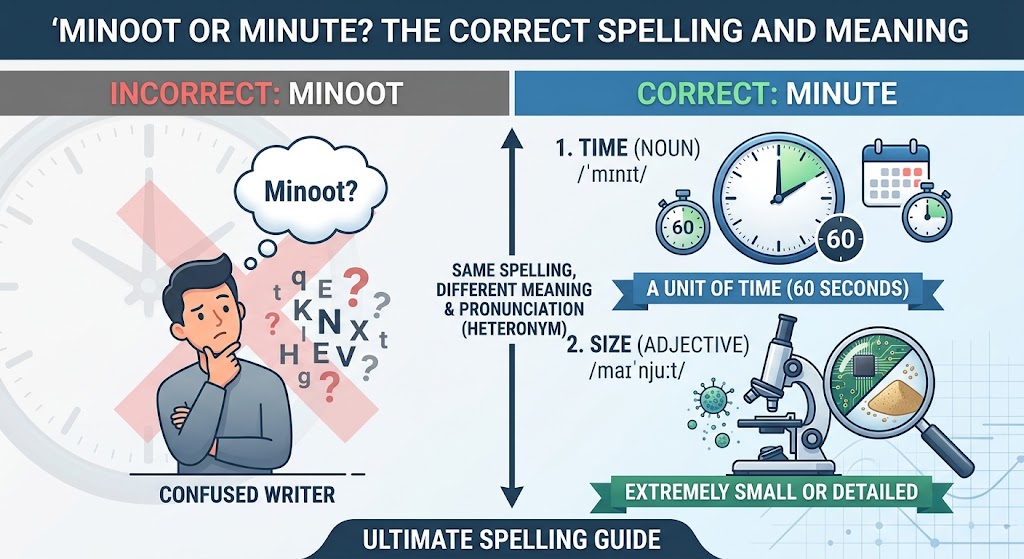
Minute is the correct English spelling. Minoot, minut, mynute, minot, minewt, minoote, and similar forms are generally misspellings or phonetic attempts to write minute.
The tricky part is that minute has two different pronunciations and meanings:
- minute = 60 seconds → pronounced MIN-it
- minute = very small, tiny, or extremely detailed → pronounced my-NYOOT
So, if you mean something small, the correct spelling is still minute—not minoot.
| Meaning | Correct spelling | Pronunciation | Example |
|---|---|---|---|
| 60 seconds | minute | MIN-it | I’ll be there in a minute. |
| Very small or tiny | minute | my-NYOOT | The scientist examined minute particles. |
| Extremely detailed | minute | my-NYOOT | She noticed every minute detail. |

At-a-Glance: Minoot vs Minute
| Form | Correct? | Meaning |
|---|---|---|
| minute | Yes | A unit of time; also very small or detailed |
| minoot | No | Common phonetic misspelling of minute |
| minut | No in standard English | Usually an incomplete or incorrect spelling |
| mynute / mynute | No | Phonetic misspelling |
| minot | No for this meaning | A different name or term in other contexts, not standard minute |
| minewt | No | Phonetic misspelling |
| minnute | No | Incorrect spelling |
| minuet | Yes, but different word | A type of historical dance and music |
The most important rule is simple: Both meanings are spelled minute.
The spelling changes neither for time nor for something tiny. Only the pronunciation and grammatical role can change.
The Detailed Difference: Why “Minute” Has Two Meanings
English contains many words with more than one meaning. Sometimes those meanings are pronounced differently. Minute is one of these words.
Minute meaning 60 seconds
When minute refers to time, it is usually a noun.
The meeting starts in five minutes.
Here, a minute is a unit of time equal to 60 seconds.
It is pronounced:
MIN-it
The stress falls near the beginning of the word.
Other examples include:
- Give me a minute.
- The train leaves in ten minutes.
- We talked for nearly an hour and a half.
- The presentation lasted forty minutes.
- Wait a minute before making a decision.
Minute meaning very small
When minute means extremely small, tiny, or very detailed, it is usually an adjective.
The machine contains minute components.
Here, minute means very small.
It is pronounced:
my-NYOOT
The stress falls on the second syllable.
Examples include:
- The researcher studied minute organisms.
- There were minute differences between the two samples.
- She examined the minute details of the contract.
- The repair required minute adjustments.
- The artist included minute patterns in the design.
This meaning is more formal than simply saying small or tiny.
When to Use “Minute”
Use minute for time
Use minute when talking about a period of 60 seconds.
Examples:
- One minute has sixty seconds.
- Please wait for a minute.
- The video is three minutes long.
- I finished the task in under a minute.
- We have only five minutes left.
The plural is minutes when there is more than one.
- one minute
- two minutes
- thirty minutes
How do you spell minute as in time?
The correct spelling is:
minute
Pronunciation:
MIN-it
Use minute for something extremely small
Use minute when describing something that is extremely small or difficult to notice.
Examples:
- There was a minute crack in the glass.
- The investigators examined minute pieces of evidence.
- The two designs had minute differences.
- The watch contains minute mechanical parts.
In this sense, minute can often be replaced with:
- tiny
- extremely small
- microscopic
- very slight
However, the best replacement depends on context.
For example:
There were minute differences between the reports.
Here, tiny differences works naturally.
But:
She checked the minute details.
Here, minute can suggest not only small details but also very fine or precise details.
Minute Meaning Small: What Does It Really Mean?
The meaning of minute as an adjective is not simply “small” in every situation.
It usually means:
extremely small in size, amount, degree, or importance
For example:
The scientist measured minute particles.
The particles are physically very small.
But consider:
There was a minute difference in temperature.
The difference may not be physically small. Instead, the amount of difference is extremely slight.
This means minute can describe:
- physical objects
- differences
- quantities
- details
- changes
- adjustments
- measurements
Examples:
- minute particles
- minute details
- minute differences
- minute changes
- minute adjustments
Examples by Context
Minute in everyday time expressions
The time meaning is extremely common in everyday English.
- I’ll call you in a minute.
- We only have a minute to decide.
- The game begins in twenty minutes.
- He arrived a minute late.
- Take a minute to think about it.
“In a minute” does not always mean exactly 60 seconds
This is an important usage edge case.
In casual conversation:
I’ll be there in a minute.
The speaker often does not mean exactly sixty seconds. It usually means:
- very soon
- shortly
- after a brief period
Context determines whether the expression is literal or approximate.
Minute in scientific and technical writing
The adjective minute meaning extremely small appears more often in formal, scientific, academic, and technical writing.
Examples:
- The microscope revealed minute structures.
- Engineers detected minute changes in pressure.
- The analysis identified minute variations in the material.
- The experiment required minute adjustments.
In casual conversation, many people would simply say:
very small changes
instead of:
minute changes
Both can be correct, but minute sounds more formal and precise.
Minute details
The phrase minute details is common and means very small or fine details.
Examples:
- The designer focused on minute details.
- The report examined the minute details of the incident.
- He remembered minute details from the conversation.
Minute detail meaning
A minute detail is a very small detail that might be easy to overlook.
For example:
The two photographs looked identical except for one minute detail.
That means there was one very small difference.
Common Mistakes: Minoot, Minut, and Similar Spellings
Mistake: Writing “minoot”
❌ The difference was minoot.
✅ The difference was minute.
Minoot is not the standard spelling of the English adjective minute.
People often write minoot because minute meaning “very small” is pronounced roughly like my-NYOOT.
English spelling, however, does not always match pronunciation directly.
Mistake: Writing “minut”
❌ The machine required minut adjustments.
✅ The machine required minute adjustments.
The standard English spelling is minute.
Mistake: Pronouncing both meanings the same way
❌ The scientist studied MIN-it particles.
For the meaning “extremely small,” standard pronunciation is generally:
✅ my-NYOOT particles
But:
✅ MIN-it particles would not normally communicate the intended meaning.
Mistake: Using “minute” when “small” is clearer
Although minute is correct, it may sound overly formal in some situations.
Formal:
The device detected minute variations.
Everyday English:
The device detected very small changes.
Choose the word that fits your audience and tone.
Minute vs Minuet
Another source of confusion is minuet.
These are completely different words.
Minute
Minute can mean:
- 60 seconds
- extremely small
Minuet
A minuet is a type of formal dance that became especially associated with European courtly culture, as well as music written for that dance.
Example:
The orchestra performed a minuet.
So:
❌ minute dance
✅ minuet dance
But:
❌ minuet detail
✅ minute detail
The words may look somewhat similar, but their meanings are unrelated in modern usage.
Is “Minute” a Noun?
Yes. Minute can be a noun.
Minute as a noun: a unit of time
The movie lasted ninety minutes.
Here, minute is a countable noun.
Minutes as a record of a meeting
There is also another meaning:
She wrote the minutes of the meeting.
In this context, minutes means the official written record of what happened during a meeting.
This is pronounced like the time word:
MIN-its
Example:
Please review the meeting minutes before Friday.
This is different from minute meaning very small.
Minute as an adjective
The team examined minute differences.
Here, minute describes the noun differences, so it is an adjective.
This is pronounced:
my-NYOOT
Fast Decision Rule: Which “Minute” Do You Need?
Use this quick test.
Are you talking about 60 seconds?
Use:
minute
Pronounce it:
MIN-it
Example:
I need one more minute.
Are you talking about something extremely small?
Use:
minute
Pronounce it:
my-NYOOT
Example:
There was a minute difference.
Are you talking about a historical dance?
Use:
minuet
Example:
They performed a minuet.
Are you trying to write “minoot”?
The standard English spelling you probably need is:
minute

A Practical Proofreading Test
Before using the word, ask yourself:
Test 1: Can I replace it with “60 seconds”?
If yes, use minute.
The race lasted one minute.
Test 2: Can I replace it with “tiny” or “extremely small”?
If yes, use minute.
The difference was minute.
The difference was tiny.
Test 3: Am I writing the word based only on how it sounds?
If you are tempted to write:
- minoot
- minut
- mynute
- minewt
- minoote
stop and check the spelling.
The correct standard English word is usually:
minute
Test 4: Does the sentence need a simpler word?
In highly technical or formal writing, minute can be useful.
In everyday writing, tiny, small, or very slight may sometimes be easier for readers.
Memory Trick for “Minute”
A simple memory trick is:
One spelling, two pronunciations, two main meanings.
Remember:
MIN-it = time
Think of:
A minute on the clock
my-NYOOT = tiny
Think of:
A minute detail is difficult to notice
Another useful reminder:
The spelling stays the same even though the pronunciation changes.
That is why writing minoot is incorrect even though the adjective pronunciation may sound similar to that spelling.
Formal, Casual, British, and American Usage
Both major meanings of minute are used in both British English and American English.
The spelling is the same:
minute
The two main pronunciations are also broadly recognized in both varieties:
- MIN-it for time
- my-NYOOT for extremely small
The biggest difference is often frequency and register, not British versus American spelling.
Casual English
In everyday speech, people often prefer:
- tiny
- very small
- little
- slight
Example:
Formal:
There was a minute difference.
Casual:
There was a tiny difference.
Formal English
Minute meaning extremely small is especially useful in:
- academic writing
- scientific writing
- technical documents
- detailed reports
- formal descriptions
Example:
The inspection revealed minute variations in the surface.
Pronunciation can depend on context
Written English usually makes the intended meaning clear from the surrounding words.
Compare:
We waited for a minute.
This clearly refers to time.
We noticed a minute change.
This clearly means a very small change.
The context tells the reader which pronunciation and meaning apply.
Edge Cases and Related Confusions
“Minute detail” vs “detailed minute”
A minute detail means a very small or fine detail.
The report examined every minute detail.
But the word minute does not usually mean “detailed” in every context.
For example:
She gave a minute explanation.
This may be grammatically possible in a particular formal context, but it is not the most natural everyday way to say a detailed explanation.
Usually, choose the word that directly expresses your intended meaning.
“Minute” does not always mean physically tiny
A minute difference is not an object. It means the difference is extremely slight.
Examples:
- a minute improvement
- a minute variation
- a minute change
- a minute error
“Minute” can also refer to exactness
The adjective often suggests something very fine, precise, or requiring close attention.
For example:
The technician made minute adjustments.
The adjustments are very small and precise.
FAQs
Is “minoot” a real English word?
Minoot is not the standard English spelling for minute. It is usually a phonetic misspelling based on pronunciation.
How do you spell minute meaning small?
The correct spelling is:
minute
When it means very small, it is commonly pronounced my-NYOOT.
How do you spell minute as in time?
The correct spelling is:
minute
When referring to 60 seconds, it is pronounced MIN-it.
Does minute mean small?
Yes. Minute can mean extremely small, tiny, or very slight.
Example:
The researchers found minute differences.
What is the difference between minute and minute?
The spelling is the same, but the pronunciation and meaning can change.
MIN-it = 60 seconds.
my-NYOOT = extremely small.
Is minute a noun?
Yes. Minute is a noun when it refers to a unit of time.
It can also appear in the plural minutes to refer to the official written record of a meeting.
What does “minute detail” mean?
A minute detail is a very small, fine, or easily overlooked detail.
Is “minuet detail” correct?
No. Minuet refers to a historical dance or a piece of music associated with that dance.
For a very small detail, use:
minute detail
What is the abbreviation for minute?
The common abbreviation for minute as a unit of time is min.
For example:
10 min
In formal or technical contexts, style guides may have specific preferences for spacing and punctuation.
Final Takeaway
If you are wondering whether to write minoot or minute, the correct standard English spelling is minute.
Use minute for:
- 60 seconds, pronounced MIN-it
- something extremely small, pronounced my-NYOOT
The spelling stays the same even though the meaning and pronunciation change.
So you should write:
a minute of time
and:
a minute detail
—not minoot, minut, mynute, or similar phonetic spellings.
When proofreading, ask yourself whether you mean time, something extremely small, or the completely different word minuet. That quick check will usually give you the correct answer.