Cancellation vs Cancelation: Which Spelling Is Correct?
Quick Answer
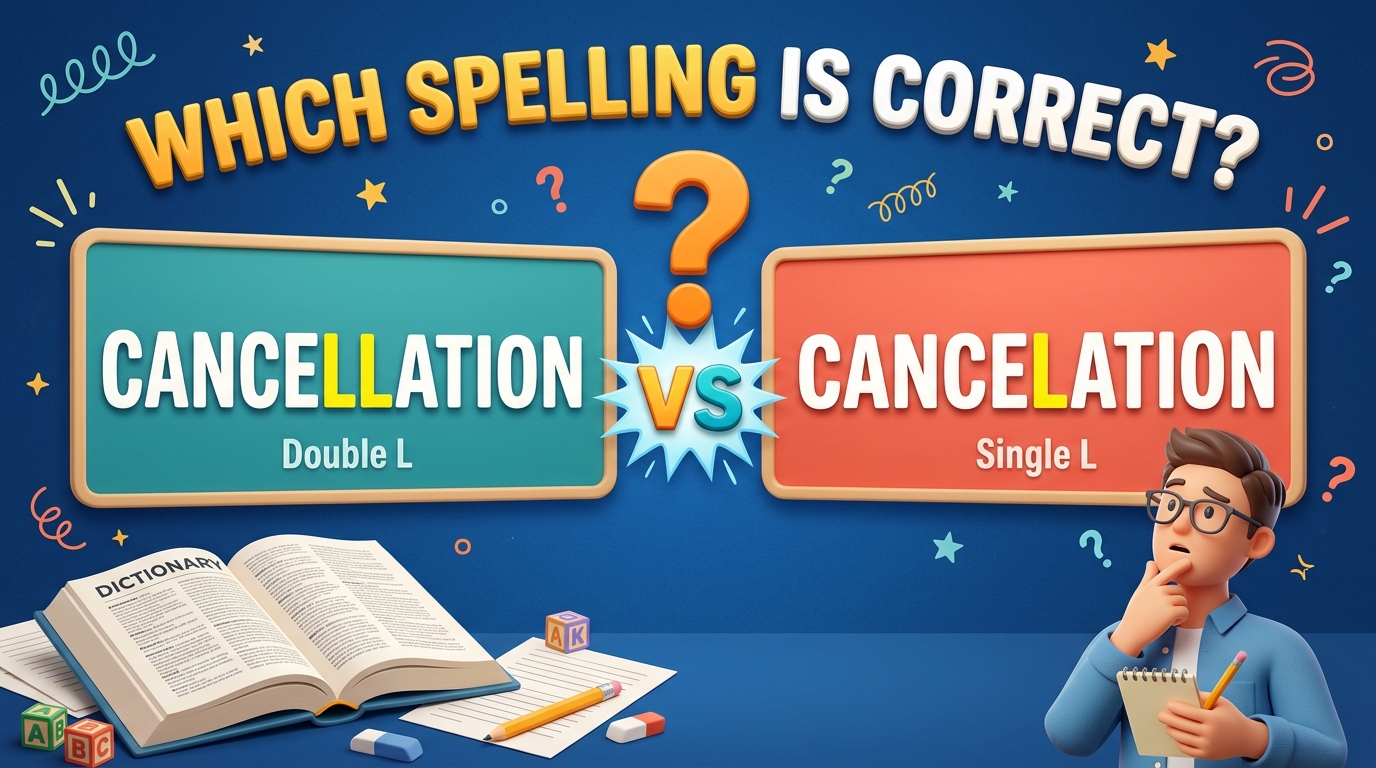
Both “cancellation” and “cancelation” are correct spellings. The difference is regional preference: cancellation is the standard and overwhelmingly preferred spelling in British English and is also the usual spelling in American English. Cancelation is an accepted American English variant, but it is much less common.
If you are unsure which form to use, choose cancellation. It is the safest option for academic writing, professional communication, websites, business documents, and international audiences.
- Cancellation: The preferred spelling in British and American English.
- Cancelation: A valid but uncommon variant, especially associated with American English.
- Meaning: Both words mean the act of canceling something or the state of being canceled.
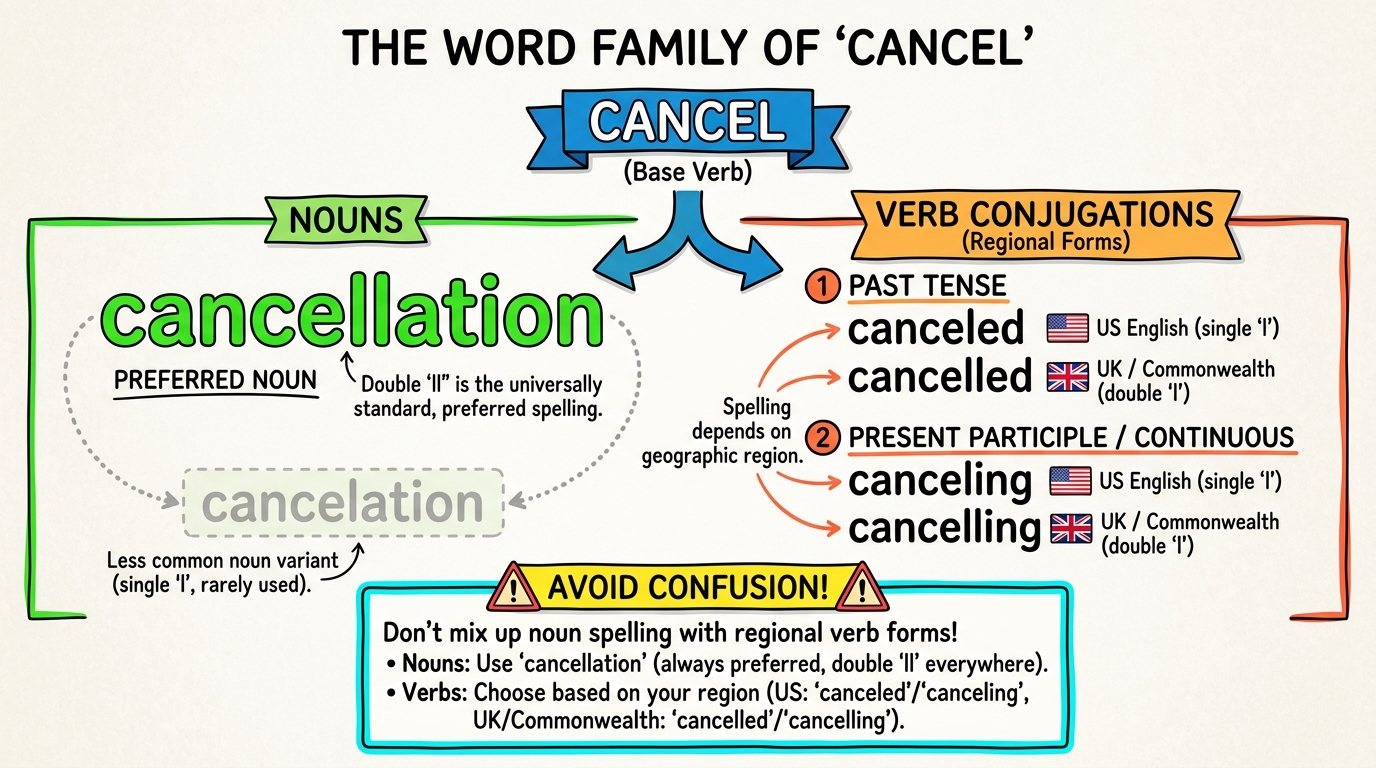
- Related spelling: British English generally uses cancelling and cancelled, while American English generally uses canceling and canceled.
The key point is that this is primarily a spelling and regional-usage question, not a difference in meaning.
At-a-Glance Table
| Feature | Cancellation | Cancelation |
|---|---|---|
| Correct spelling? | Yes | Yes |
| Meaning | The act or result of canceling | The same |
| Part of speech | Noun | Noun |
| British English | Standard spelling | Uncommon |
| American English | Standard and preferred spelling | Accepted but much less common |
| Frequency | Very common | Relatively rare |
| Formal writing | Recommended | Usually avoid unless following an established style |
| Business and legal writing | Preferred default | Use only when required by a specific convention |
| Pronunciation | Generally the same | Generally the same |
| Related verb | Cancel | Cancel |
| Related British forms | Cancelling, cancelled | Not the usual regional forms |
| Related American forms | Canceling, canceled | Not the usual regional forms |
Quick rule: When choosing between cancellation or cancelation, write cancellation unless a publication, organization, or established house style specifically requires the alternative.
What Is the Difference Between Cancellation and Cancelation?
The difference between cancellation and cancelation is the spelling, not the definition. Both nouns describe the act of canceling an arrangement, event, order, subscription, appointment, booking, or other commitment.
For example:
- “The cancellation of the flight caused delays.”
- “The cancelation of the flight caused delays.”
Both sentences are grammatically correct. However, the first is the more conventional choice and will look more familiar to most English readers.
1. Meaning
Both words refer to the same general concept: something planned, scheduled, ordered, or agreed upon is called off, withdrawn, or brought to an end.
Examples include:
- The cancellation of a concert.
- The cancellation of a hotel reservation.
- The cancellation of a subscription.
- The cancellation of an insurance policy.
- The cancellation of a scheduled meeting.
- The cancellation of an order before shipment.
The spelling does not change the underlying meaning. A cancelation fee and a cancellation fee, for instance, refer to the same type of fee, although the latter is more conventional.
2. Part of speech and grammatical function
Both cancellation and cancelation are nouns. They name an action, process, decision, or result rather than expressing the action themselves.
Compare these sentences:
| Sentence | Word function |
|---|---|
| The cancellation was unexpected. | Noun |
| We received a cancellation notice. | Noun modifying another noun |
| The airline announced the cancellation of the route. | Noun followed by an of-phrase |
| The airline canceled the route. | Verb |
| The route was canceled yesterday. | Past participle in a passive construction |
The noun is cancellation or cancelation. The verb is cancel, and its spelling changes according to the grammatical form and regional convention.
3. Why does one spelling have two Ls?
The usual spelling, cancellation, contains a double l. The alternative, cancelation, contains a single l before the ending -ation.
Both forms are established variants, so it is not accurate to claim that every English noun formed from a verb must preserve or remove a particular consonant. English spelling contains historical conventions and accepted variants, and this pair is one example.
The practical lesson is simple: learn cancellation as the default spelling rather than trying to derive the noun mechanically from cancel.
When to Use Cancellation or Cancelation
Although both spellings are correct, they are not equally suitable in every situation. The best choice depends on your audience, regional English convention, and any style rules you need to follow.
Use cancellation in most situations
Choose cancellation when writing for a general audience or when consistency and familiarity matter.
Use it in:
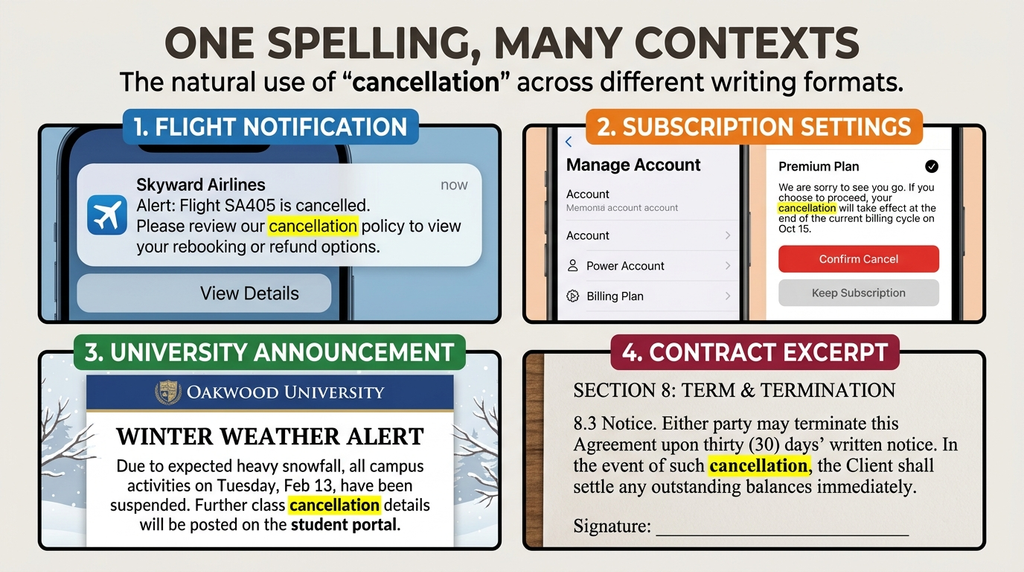
- Academic writing: “The cancellation of the experiment affected the research schedule.”
- Business communication: “We apologize for the cancellation of your appointment.”
- Customer service: “You will receive an email confirming your cancellation.”
- Travel and hospitality: “The cancellation of the flight was announced this morning.”
- News articles: “The unexpected cancellation disappointed concertgoers.”
- Legal and administrative documents: “The agreement specifies the conditions for cancellation.”
- Website content: “Read our cancellation policy before making a booking.”
In each example, cancellation is the conventional choice and will be understood across English-speaking regions.
When is cancelation appropriate?
Cancelation is not inherently wrong. It is an accepted spelling, particularly in American English, but it is far less common than cancellation.
You might encounter it in:
- American publications that permit the single-L variant.
- Existing company documents that consistently use cancelation.
- A particular organization’s forms, templates, or style guide.
- Text where you are reproducing a source’s original spelling.
For example:
“The website displays a cancelation fee for customers who change their bookings.”
This sentence is understandable and grammatically correct. However, if you are writing the sentence yourself, cancellation fee is the more conventional choice.
Editorial recommendation: Do not alternate between the two spellings in the same article or document. Select one form and apply it consistently, preferably using cancellation.
Cancellation vs Cancelation: Examples by Context
The following examples show how the preferred spelling works in everyday, professional, and formal situations.
1. Travel and bookings
Recommended
The airline announced the cancellation of the morning flight.
The standard spelling for travel announcements and passenger communications.
Also correct, but less common
The airline announced the cancelation of the morning flight.
More natural examples:
- Please check the cancellation policy before booking your hotel.
- The cancellation of our train service caused considerable inconvenience.
- I received confirmation of my reservation cancellation.
- Customers can request a cancellation through the booking portal.
2. Business and customer service
Preferred examples
- We have processed your cancellation request.
- Your subscription cancellation will take effect at the end of the billing period.
- A cancellation confirmation will be sent to your registered email address.
- The company introduced a clearer cancellation policy.
In customer-facing writing, consistency is especially important. Customers may see the same terminology in confirmation emails, invoices, account settings, and help articles.
Using cancellation throughout makes the interface and documentation more consistent with common English usage.
3. Education and academic writing
Examples:
- The cancellation of classes was announced before the examination period.
- Researchers discussed the reasons for the cancellation of the study.
- The cancellation of the lecture gave students additional preparation time.
- The university published a notice about the cancellation of the event.
In essays and academic papers, use cancellation unless your institution or publication specifies another spelling convention.
4. Everyday conversation and messages
Examples:
- Sorry for the cancellation; I hope we can meet another day.
- I received a message about the cancellation of our appointment.
- The cancellation came at the last minute.
- Is there a fee for cancellation?
Although the noun is more common in formal writing, it is entirely natural in everyday conversation. There is no need to substitute cancelation to make a sentence sound more casual.
5. Legal, financial, and policy documents
Examples:
- The contract outlines the conditions for cancellation.
- Cancellation of the policy may require written notice.
- The agreement includes a cancellation clause.
- A cancellation charge may apply if the customer withdraws after the deadline.
Legal and financial documents should follow their governing terminology and applicable style requirements. If no specific convention applies, cancellation is the safer default.
Common Mistakes and How to Correct Them
Confusion over cancellation often extends to related words such as canceling, cancelling, canceled, and cancelled. These forms are connected, but they do not follow precisely the same regional spelling pattern.
Mistake 1: Assuming cancelation is always wrong
Incorrect assumption: “Cancelation is not a real English word.”
Correction: Cancelation is an accepted variant, but cancellation is much more common and is the better default.
Why it matters: Recognizing a valid variant helps you distinguish genuine spelling errors from differences in accepted usage.
Mistake 2: Using cancellation and cancelation interchangeably in one document
Inconsistent:
- Please read our cancellation policy.
- A cancelation fee may apply.
- Contact support to request a cancellation.
Better:
- Please read our cancellation policy.
- A cancellation fee may apply.
- Contact support to request a cancellation.
Why it matters: Consistent spelling makes a document appear carefully edited and reduces unnecessary variation.
Mistake 3: Confusing cancellation with canceling
These words have different grammatical functions.
- Cancellation: A noun. “The cancellation was unexpected.”
- Canceling: A verb form, usually American English. “We are canceling the meeting.”
- Cancelling: A verb form, usually British English. “We are cancelling the meeting.”
Incorrect: “We are cancellation the meeting.”
Correct: “We are canceling the meeting.” (American English)
Correct: “We are cancelling the meeting.” (British English)
Why it matters: The noun names the event or process; the verb expresses the action.
Mistake 4: Assuming the noun must follow the same pattern as the verb
American English commonly uses canceling and canceled, yet it usually retains the double L in cancellation.
For example:
| American English | British English |
|---|---|
| canceling | cancelling |
| canceled | cancelled |
| cancellation | cancellation |
| cancellation notice | cancellation notice |
Why it matters: Regional spelling conventions do not always apply uniformly across every word in a word family.
Mistake 5: Writing cancelation when you mean cancellation in a formal document
This is not necessarily a grammatical error. However, it may be an editorial inconsistency if the rest of the document follows conventional American or British spelling.
Better: Use cancellation unless the relevant style guide specifies cancelation.
Mistake 6: Treating cancellation and canceling as interchangeable
Incorrect: “The airline is cancellation the flight.”
Correct: “The airline is canceling the flight.”
Alternatively: “The airline has announced the cancellation of the flight.”
Why it matters: The first corrected sentence uses a verb construction; the second uses a noun construction. Both are grammatical, but their structures differ.

Memory Trick: How to Spell Cancellation
If you frequently forget the spelling of cancellation, use one of these practical techniques.
1. Remember the double L
Write the word as:
CAN + CELL + ATION
This is a memory aid, not a literal breakdown of the word’s linguistic structure. It helps you recall that the standard spelling contains two Ls.
2. Learn it as a complete word
Instead of trying to guess whether the noun should have one L or two, memorize the most useful form:
- cancel
- cancellation
- cancellation policy
- cancellation notice
- cancellation fee
Learning common phrases helps reinforce the conventional spelling through repeated exposure.
3. Use the safest-choice rule
When proofreading, ask yourself:
- Am I using the noun meaning the act or result of canceling?
- Is my audience British, American, or international?
- Does my organization have a specific style guide?
- If no special rule applies, have I chosen cancellation?
If the answer to the final question is yes, you have generally made the safest spelling choice.
A Practical Proofreading Test
Test your understanding by choosing the best answer for each sentence.
Check your spelling
4 questions
1. The airline announced the ___ of the flight.cancellationcancelationcanceling
2. We are ___ the meeting because the speaker is unavailable.cancellationcancelationcanceling
3. Please review our ___ policy before paying.cancellationcancelledcanceling
4. Which statement about cancelation is correct?It is always grammatically wrong.It is an accepted but less common spelling variant.It has a different meaning from cancellation.
Check answers
Answer all four questions to see your results and explanations.
Formal vs Casual English: British and American Usage
The distinction between cancellation and cancelation is easiest to understand when separated from the broader differences between British and American spelling.
British English
British English uses cancellation as the standard spelling. It also generally doubles the L in the related forms cancelling and cancelled.
Examples:
- The cancellation of the event was announced yesterday.
- We are cancelling the reservation.
- The booking was cancelled due to severe weather.
American English
American English also overwhelmingly favors cancellation. However, the single-L noun spelling cancelation is an accepted alternative.
American English generally uses canceling and canceled for the related verb forms.
Examples:
- The cancellation of the event was announced yesterday.
- We are canceling the reservation.
- The booking was canceled because of severe weather.
What about Canadian, Australian, and international English?
English spelling conventions vary by country, institution, and publication. Cancellation is a broadly suitable choice across these audiences, even where related verb forms follow different regional conventions.
For international websites, global customer-support teams, and educational materials, using cancellation consistently is a practical way to avoid unnecessary spelling variation.
Is one spelling more formal than the other?
There is no meaningful difference in formality inherent in the two spellings. The difference is mainly one of frequency and editorial preference.
Cancellation is more familiar in professional and formal contexts because it is the dominant form. Cancelation is not automatically informal or ungrammatical, but it may look unusual to readers accustomed to the standard spelling.

Frequently Asked Questions
1. Is it cancellation or cancelation?
Both spellings are accepted, but cancellation is the standard and much more common form. Use cancellation unless a specific style guide or established convention calls for cancelation.
2. What is the difference between cancellation and cancelation?
There is no difference in meaning. Both nouns refer to the act or result of canceling something. The distinction is spelling and frequency of use.
3. How do you spell cancellation or cancelation?
The preferred spelling is c-a-n-c-e-l-l-a-t-i-o-n: cancellation. The less common alternative is c-a-n-c-e-l-a-t-i-o-n: cancelation.
4. Is cancelation correct spelling in American English?
Yes. Cancelation is an accepted American English variant, although cancellation is much more common in contemporary usage.
5. Is cancellation British or American?
Both. Cancellation is standard in British English and is also the preferred spelling in American English.
6. Is cancelation or cancellation more common?
Cancellation is substantially more common. It is the better choice for most readers, professional documents, and general-purpose writing.
7. Why does cancellation have two Ls?
The conventional spelling of the noun retains the double L, even though American English commonly uses canceled and canceling for the related verb forms. These are established spelling conventions rather than a rule that applies identically to every word in the family.
8. Is cancellation countable or uncountable?
It can be used in both ways, depending on the context.
- Countable: “We received three cancellations this morning.” Here, individual canceled bookings or arrangements are being counted.
- Uncountable: “Cancellation of the event remains a possibility.” Here, the word refers to the general act or possibility of canceling.
The spelling remains cancellation in both uses.
9. What is the plural of cancellation?
The plural is cancellations.
Example: “The airline announced several cancellations after the storm.”
The less common variant also has a regular plural, cancelations, but cancellations is the usual choice.
10. Should I write cancellation fee or cancelation fee?
Prefer cancellation fee. Both forms are understandable, but cancellation fee is the more conventional spelling in customer service, travel, banking, and subscription contexts.
11. Is it cancelling or canceling?
Both are correct. Cancelling is the usual British English spelling, while canceling is the usual American English spelling.
Examples:
- British: “We are cancelling the appointment.”
- American: “We are canceling the appointment.”
This regional difference does not change the preferred noun spelling: cancellation.
12. Is it cancelled or canceled?
Both are correct. British English generally uses cancelled, while American English generally uses canceled.
Examples:
- British: “The concert was cancelled.”
- American: “The concert was canceled.”
13. Can I use cancelation in an SEO article?
You can, but the decision should reflect the reader’s likely spelling expectations and the article’s purpose. For a general article targeting the query cancellation vs cancelation, use cancellation as the main form and discuss cancelation naturally as a valid alternative.
Avoid repeating both variants unnaturally just to target search terms. Clear explanations, natural examples, and consistent usage are more useful to readers.
14. What is the easiest way to remember the correct spelling?
Remember that cancellation has two Ls. When in doubt, choose cancellation because it is the preferred form in both British and American English.
Final Takeaway
The answer to “cancellation vs cancelation: which is correct?” is that both are accepted spellings, but they are not equally common.
- Choose cancellation for standard British and American English.
- Recognize cancelation as a valid but uncommon alternative, particularly in American English.
- Use cancelling/cancelled in British English and canceling/canceled in American English.
- Keep your spelling consistent throughout a document and follow any applicable style guide.
For almost any everyday, academic, business, or professional writing situation, cancellation is the best choice.