Theater or Theatre: What Is the Difference?
Quick Answer
Theater is the standard American English spelling, while theatre is the standard British English spelling. Both words are correct and have the same meaning: a place where plays or performances are presented, the art of dramatic performance, or a venue where films are shown.
- Use theater when writing in American English.
- Use theatre when writing in British English.
- In countries such as Pakistan, where British English conventions are widely used in formal education, theatre is generally the more suitable choice.
- Neither spelling is inherently more correct, more formal, or more sophisticated than the other.
Examples:
- American English: We watched a musical at the theater.
- British English: We watched a musical at the theatre.
The difference is primarily regional spelling, not meaning, grammar, or pronunciation.
At-a-Glance Table
| Feature | Theater | Theatre |
|---|---|---|
| Standard spelling | American English | British English |
| Meaning | A venue or dramatic art | A venue or dramatic art |
| Part of speech | Noun | Noun |
| Plural | Theaters | Theatres |
| Singular example | The theater is open. | The theatre is open. |
| Plural example | Three theaters opened. | Three theatres opened. |
| Related verb | Theatricalize (rare) | Theatricalise (British spelling) |
| Pronunciation | Generally the same | Generally the same |
| Formal writing | Correct in American English | Correct in British English |
| Common regional preference | United States | United Kingdom and many other British-English contexts |
| Best choice | American audience or style guide | British audience or style guide |
The central rule is simple: choose the spelling that matches the English variety you are using, and keep it consistent throughout your writing.
What Is the Difference Between Theater and Theatre?
The difference between theater and theatre is mainly a matter of spelling conventions. Both forms can describe the same building, performance, or artistic tradition.
1. Meaning
Both words have several closely related meanings.
A building or venue: A place where audiences watch plays, musicals, and other live performances.
- The theater has a newly renovated stage.
- The theatre has a newly renovated stage.
The art of dramatic performance: The practice of writing, performing, directing, and producing plays.
- She studied theater at university.
- She studied theatre at university.
A cinema: In American English, movie theater is a common expression for a place where people watch films. In British English, cinema is generally more common in everyday conversation, although theatre can also appear in names and specialized contexts.
- American English: We are going to the movie theater.
- British English: We are going to the cinema.
A field of study: Both spellings can describe academic programs covering acting, directing, stage design, and dramatic literature.
- He earned a degree in theater.
- He earned a degree in theatre.
The spelling changes, but the basic meaning remains the same.
2. Part of Speech and Grammar
Both theater and theatre are nouns. They follow the same grammatical rules.
| Grammatical feature | American English | British English |
|---|---|---|
| Singular | a theater | a theatre |
| Definite singular | the theater | the theatre |
| Plural | theaters | theatres |
| Possessive singular | the theater’s entrance | the theatre’s entrance |
| Possessive plural | the theaters’ entrances | the theatres’ entrances |
Examples:
- A theater has opened near our school.
- The theatre has opened near our school.
- Several theaters are competing for audiences.
- Several theatres are competing for audiences.
The words do not require different verbs, articles, or sentence structures. Their grammatical behavior is identical.
3. Spelling: Why Are There Two Forms?
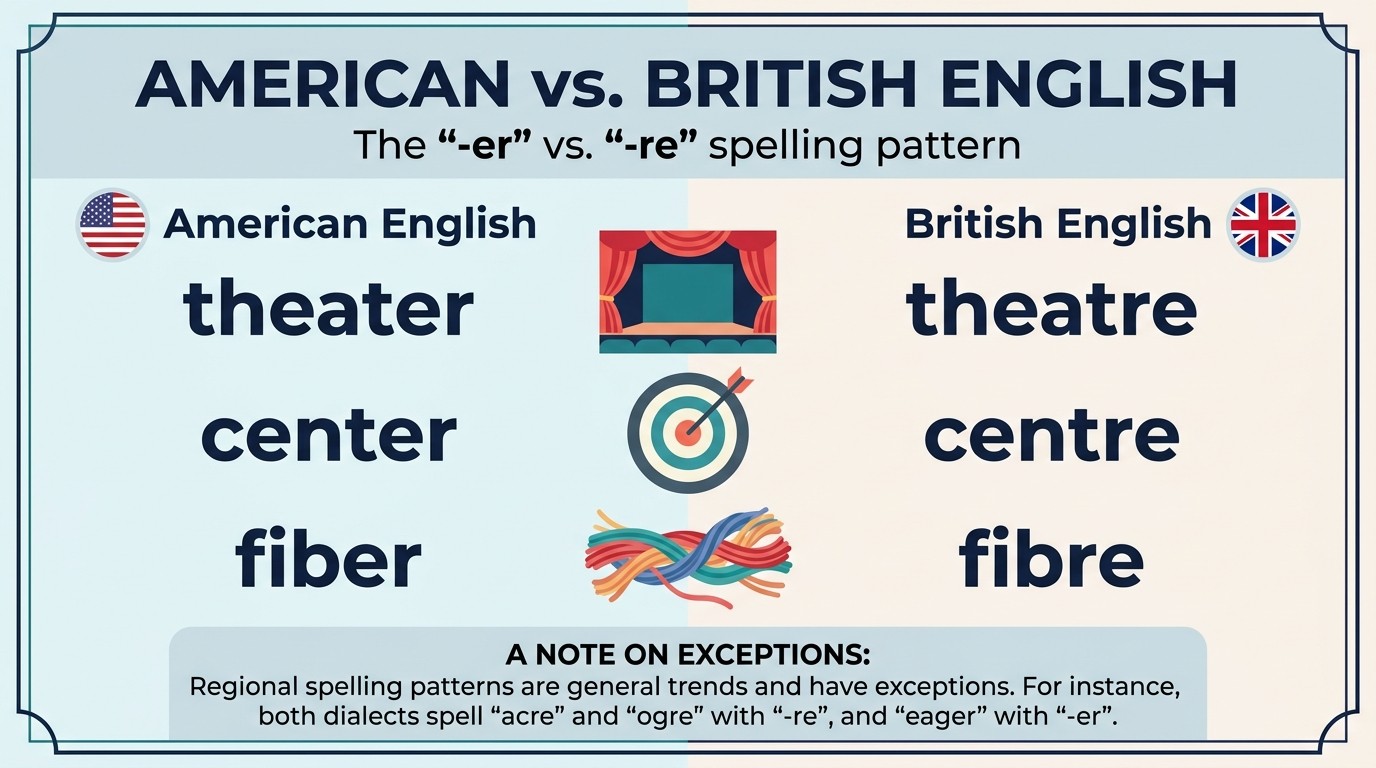
English uses different spelling conventions across regions. The -er ending in American English often corresponds to -re in British English in certain words.
Compare these examples:
| American English | British English |
|---|---|
| Theater | Theatre |
| Center | Centre |
| Meter | Metre |
| Fiber | Fibre |
| Liter | Litre |
These pairs illustrate a recognizable spelling pattern, but they do not mean that every word ending in -er should be changed to -re. For example, teacher remains teacher in both varieties.
There are also words such as meter and metre whose meanings can differ by context. Meter is the usual American spelling for the unit of length and a measuring device; British English commonly distinguishes metre for length from meter for a measuring instrument. That distinction is separate from the straightforward regional spelling difference between theater and theatre.
When to Use Theater
Use theater when writing in American English or following an American organization’s spelling preferences.
1. American English Writing
Choose theater for American school assignments, articles, business documents, and general writing.
Examples:
- The theater will host a new musical this weekend.
- Our school is organizing a theater competition.
- She wants to pursue a career in theater.
- The old movie theater has been converted into a restaurant.
2. American Academic and Professional Contexts
American universities, arts organizations, and professional publications often use theater in their own names and materials.
Examples:
- The university offers a theater studies program.
- He works in theater production.
- The theater department is preparing its annual performance.
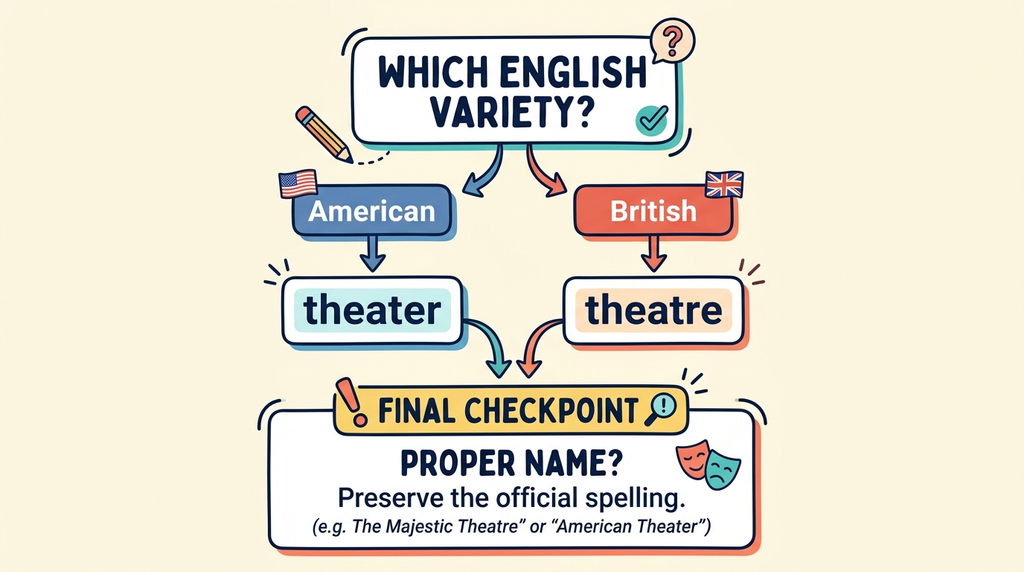
When referring to a specific institution, preserve its official spelling, even if it differs from your usual writing style.
3. American Film and Entertainment Contexts
The expression movie theater is widely used in the United States.
Examples:
- We bought tickets at the movie theater.
- The new film opens in theaters on Friday.
- The theater has six screens and a small snack counter.
These are natural American English expressions.
When to Use Theatre
Use theatre when writing in British English or following a British-English style guide.
1. British English Writing
Choose theatre for British-oriented articles, schoolwork, professional communication, and publications.
Examples:
- The theatre will present a Shakespeare play next month.
- Our school has a small theatre for student performances.
- She is interested in theatre history.
- The theatre company is recruiting young actors.
2. British Academic and Professional Contexts
British universities and arts organizations commonly use theatre in program descriptions and institutional names.
Examples:
- He is studying theatre and performance.
- The theatre department is producing a new play.
- She completed a course in theatre design.
3. British Cultural and Entertainment Contexts
In Britain, theatre is especially associated with live performances. For films, cinema is generally the more usual everyday term.
Examples:
- We booked seats at the theatre.
- The theatre’s new production received excellent reviews.
- They spent the evening watching a play at a local theatre.
The word theatre can also appear in the official names of cinemas, performance venues, and organizations. Such names should be reproduced accurately rather than changed to match a general rule.

Theater or Theatre? Examples by Context
The easiest way to understand the difference is to see both forms used in comparable sentences.
Everyday Conversation
| American English | British English |
|---|---|
| Let’s go to the theater. | Let’s go to the theatre. |
| The theater is around the corner. | The theatre is around the corner. |
| We arrived at the theater early. | We arrived at the theatre early. |
| Is the theater open tonight? | Is the theatre open tonight? |
Both columns are grammatically correct. The spelling reflects the variety of English being used.
Education and Academic Writing
| American English | British English |
|---|---|
| She studies theater at college. | She studies theatre at university. |
| The theater course includes acting. | The theatre course includes acting. |
| He wrote an essay about modern theater. | He wrote an essay about modern theatre. |
| The theater department is presenting a play. | The theatre department is presenting a play. |
Notice that college and university also vary in common usage between regions. These are vocabulary preferences rather than consequences of the spelling of theater or theatre.
Entertainment and Performance
| American English | British English |
|---|---|
| The theater is showing a new production. | The theatre is staging a new production. |
| The actors arrived at the theater. | The actors arrived at the theatre. |
| The theater seats 500 people. | The theatre seats 500 people. |
| She has worked in musical theater for years. | She has worked in musical theatre for years. |
The choice between showing and staging is a matter of context and phrasing, not a grammatical requirement imposed by the spelling.
News and Business Writing
| American English | British English |
|---|---|
| The theater will reopen in June. | The theatre will reopen in June. |
| Local theaters are attracting new audiences. | Local theatres are attracting new audiences. |
| The theater announced its next season. | The theatre announced its next season. |
| The company invests in theater production. | The company invests in theatre production. |
In a publication, use its house style consistently. A British publication may quote an American institution whose official name uses Theater, and an American publication may refer to a British institution named Theatre.
Film Versus Live Performance
The meaning can depend on the expression around the word.
- Movie theater: A common American expression for a cinema.
- Dinner theater: A venue where an audience can eat while watching a live performance.
- Community theatre: A British-style spelling commonly used for local dramatic performance groups, although American organizations may also choose theatre.
- Theatre studies: An academic field concerned with dramatic performance and its history.
The word itself does not always tell you whether a venue presents films or live performances. The surrounding words provide the context.

Theater vs Theatre: Common Mistakes
Both spellings are correct, but some uses can still be incorrect or inconsistent.
Mistake 1: Treating One Spelling as Universally Correct
Incorrect claim: “Theatre is always correct, and theater is a misspelling.”
Correction: Both are standard spellings in their respective regional conventions.
Why it matters: American English generally uses theater, while British English generally uses theatre. The intended audience and style guide determine the best choice.
Mistake 2: Mixing Regional Spellings Without a Reason
Inconsistent example:
“Our school theater is near the town centre, and the theatre program starts next week.”
This sentence is not necessarily grammatically wrong, but it mixes American theater with British centre and theatre without an obvious reason.
More consistent American English:
“Our school theater is near the town center, and the theater program starts next week.”
More consistent British English:
“Our school theatre is near the town centre, and the theatre programme starts next week.”
Why it matters: Consistency helps readers recognize the intended variety of English. However, do not alter proper names or direct quotations just to make them conform.
Mistake 3: Incorrect Plural Forms
Incorrect: “Several theatrs are opening this year.”
Correct American English: “Several theaters are opening this year.”
Correct British English: “Several theatres are opening this year.”
Why it matters: The plural is formed by adding -s to the appropriate spelling.
Mistake 4: Assuming the Pronunciation Must Change
Incorrect assumption: “Theatre and theater must sound different because they are spelled differently.”
Correction: In ordinary modern English, the two forms are generally pronounced the same within a given accent.
Why it matters: Regional spelling differences do not automatically indicate pronunciation differences.
Mistake 5: Changing an Official Name
Suppose a venue’s official name includes Theatre. Replacing it with Theater may make the name inaccurate, even in American writing.
Correct approach: Preserve the official name, such as The Old Vic Theatre, when referring to that institution.
Why it matters: Proper names follow the organization’s established spelling, not necessarily the writer’s general regional convention.
Mistake 6: Assuming Theatre Always Means Live Drama
Incorrect assumption: “Theatre can never refer to a film venue.”
Correction: The word’s meaning depends on context and naming conventions. Nevertheless, movie theater is the usual American expression, and cinema is the more common everyday British term for a place to watch films.
Why it matters: Regional vocabulary preferences can be as important as spelling.
Theatre or Theater: A Simple Memory Trick
Use this quick memory aid:
- TheatER → AmERican English. The shared letters provide a reminder, not a strict linguistic rule.
- TheatRE → BRItiSH English. Think of the -re ending in British spellings such as centre.
This trick is useful for remembering the common regional preference, but it should not replace checking a publication’s style guide or an institution’s official name.
The 10-Second Spelling Test
Before submitting an article, essay, email, or website page, ask yourself:
- Am I writing primarily in American or British English?
- Does my spelling match that variety?
- Have I used the same convention throughout the document?
- Am I referring to an official name that must retain its original spelling?
- If I mean a place to watch films, would movie theater or cinema be more natural for my audience?
If you can answer these questions, choosing the correct spelling should be straightforward.
Formal vs Casual and Regional Notes
Is Theater or Theatre More Formal?
Neither spelling is inherently more formal. Both are suitable for academic, professional, and casual writing when they match the relevant language convention.
For example:
- Formal American English: “The theater will introduce its revised performance schedule in January.”
- Formal British English: “The theatre will introduce its revised performance schedule in January.”
- Casual American English: “Let’s meet outside the theater.”
- Casual British English: “Let’s meet outside the theatre.”
Formality comes from the sentence structure, vocabulary, purpose, and audience—not from choosing -er instead of -re.
What Is the British Spelling of Theater?
The standard British spelling is theatre.
For example:
- American: The theater is fully booked.
- British: The theatre is fully booked.
British English generally uses centre, metre for a unit of length, and fibre, but regional spelling conventions contain exceptions.
What About Pakistan, India, Australia, and Other Countries?
Many English-language institutions in Pakistan, India, Australia, New Zealand, and other Commonwealth contexts follow British spelling conventions. In those settings, theatre is often the natural choice.
However, usage is not identical across every country, school, publication, or organization. American media, international brands, university departments, and official names may use theater.
For formal writing, follow the language convention required by your school, employer, publisher, or examination board.
Theater or Theatre in SEO and Website Content
For website owners and content writers, the best choice depends on the intended audience and the wording people are likely to search for.
- A page targeting American readers will generally use theater.
- A page targeting British readers will generally use theatre.
- A page serving an international audience should choose a consistent spelling and may mention the alternative naturally when it helps clarify the topic.
Avoid repeatedly inserting both spellings into every heading or paragraph. Search relevance is better served by clear, useful writing than by unnatural repetition.
Frequently Asked Questions
1. Is it theater or theatre?
Both are correct. Theater is the standard American English spelling, while theatre is the standard British English spelling.
2. How do you spell theater?
In American English, spell it theater: T-H-E-A-T-E-R.
In British English, the usual spelling is theatre: T-H-E-A-T-R-E.
3. How do you spell theatre in British English?
The standard British spelling is theatre, ending in -re.
4. What is the difference between theatre and theater?
The main difference is regional spelling. Both words can refer to a performance venue, the dramatic arts, or related academic subjects. Their grammar and basic meanings are the same.
5. Is there a difference between theatre and theater in meaning?
Usually, no. The two spellings have the same core meanings. Context can affect whether the word refers to a venue, the performing arts, or a field of study, but that distinction is not determined by the spelling alone.
6. Is theatre more correct than theater?
No. Theatre is standard in British English, and theater is standard in American English. The correct choice depends on the language variety and any applicable style guide.
7. Should I write theaters or theatres?
Use theaters in American English and theatres in British English. Both are regular plural forms.
Examples:
- American: The city has four theaters.
- British: The city has four theatres.
8. Is theater British or American spelling?
Theater is primarily the standard American spelling. The standard British spelling is theatre, although official names and individual organizations may differ.
9. Are theater and theatre pronounced differently?
Generally, no. They are usually pronounced the same within the same accent, despite the different spellings. Pronunciation can vary slightly across English accents.
10. Which spelling should I use in an academic essay?
Follow the English variety required by your institution or instructor. Use theater for American English and theatre for British English, unless a prescribed style guide or proper name requires otherwise.
11. Is “movie theatre” correct?
Yes. Movie theatre is a valid expression, particularly in British-influenced English and in the official names of some venues. In the United States, movie theater is more common. In Britain, cinema is generally the more usual everyday term.
12. Why do some organizations spell it Theatre even in America?
An organization may retain a traditional spelling, adopt a particular artistic identity, or use a name established when it was founded. Proper names do not have to follow the dominant spelling convention of the country in which they operate.
13. Can I use both theater and theatre in one article?
Yes, when there is a legitimate reason, such as quoting a source or reproducing an official name. Otherwise, choose one regional convention and use it consistently.
14. Is “theatre” a more sophisticated spelling?
No. The spelling does not make the writing more refined or artistic. Both forms are standard, and neither is inherently more prestigious.
Final Takeaway
The difference between theater and theatre is primarily regional spelling, not meaning or grammar.
Remember these three rules:
- American English: theater, theaters.
- British English: theatre, theatres.
- Official names and quotations: preserve the original spelling.
If you are writing for a British-English audience in Pakistan, theatre is generally the safest default. If you are writing for an American audience, choose theater. Above all, remain consistent and follow the relevant style guide.