Smoky or Smokey: Which Is Correct?
Quick Answer
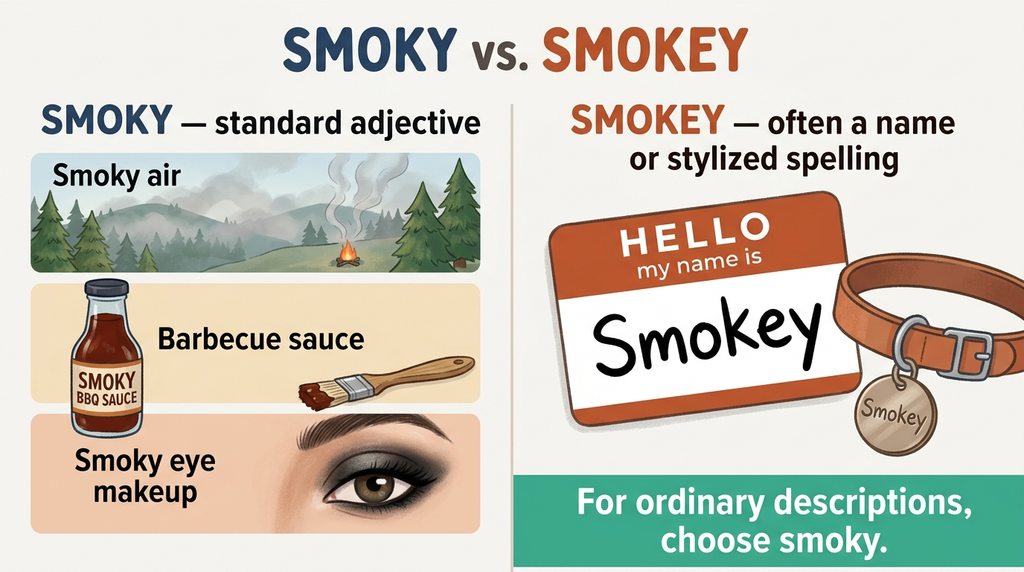
Smoky is the standard spelling of the adjective meaning filled with smoke, producing smoke, or having a flavor or smell reminiscent of smoke. Smokey is also a recognized spelling, but it is less common as a general adjective and frequently appears in proper names, such as Smokey Bear.
If you are describing smoky air, a smoky room, smoky eyes, or a smoky flavor, choose smoky. In standard British and American English, smoky is the preferred spelling for these uses.
Examples:
- Correct: The kitchen was smoky after the food burned.
- Correct: The sauce has a rich, smoky flavor.
- Correct: She wore smoky eye makeup.
- Correct as a proper name: Smokey Bear is a well-known fire-prevention mascot.
The key distinction is that smoky is the usual descriptive adjective, while Smokey is often a name or an intentional stylistic spelling.
At-a-Glance Table
| Feature | Smoky | Smokey |
|---|---|---|
| Standard adjective | Yes | Less common |
| Meaning | Smoky, smoke-filled, or smoke-flavored | Usually the same intended descriptive meaning when used as a variant |
| American English | Preferred spelling | Often a proper name or stylistic variant |
| British English | Preferred spelling | Less usual for the general adjective |
| Formal writing | Recommended | Use only when justified by a name or established spelling |
| Food descriptions | Smoky flavor, smoky barbecue | Less standard |
| Air and surroundings | Smoky room, smoky atmosphere | Less standard |
| Makeup | Smoky eyes, smoky eye makeup | Less standard |
| Proper names | Depends on the official name | Common in certain names, such as Smokey Bear |
| Best everyday choice | Smoky | Use selectively |
Bottom line: If you are unsure whether to spell the word smoky or smokey, use smoky for ordinary descriptive writing.
Detailed Difference Between Smoky and Smokey
1. What does smoky mean?
Smoky is an adjective. It describes something that contains smoke, produces or resembles smoke, or has a smoky smell, appearance, or flavor.
The word has several related meanings:
- Containing smoke: The smoky air made it difficult to see across the street.
- Producing smoke: A smoky fire filled the outdoor cooking area with haze.
- Having a smoke-like appearance: The artist used smoky shades of gray in the painting.
- Having a flavor associated with smoke: The chef added smoky paprika to the soup.
- Describing a characteristic sound or atmosphere: The singer had a smoky voice, meaning a voice with a husky, textured quality.
In each example, smoky adds a descriptive quality to a noun. The word does not always mean that actual smoke is physically present; its meaning depends on context.
2. What does smokey mean?
Smokey is an alternative spelling of the adjective smoky, but it is not the usual choice in standard edited English for ordinary descriptions.
You may encounter smokey in:
- Personal names, nicknames, and character names.
- Established brand names or titles.
- Informal writing where the author deliberately prefers that spelling.
- Occasional nonstandard spelling in general descriptive prose.
For example, Smokey Bear retains its established name spelling. Changing it to Smoky Bear would incorrectly alter the name.
When smokey is used as a general adjective, readers will usually understand the intended meaning. However, understanding a spelling does not make it the preferred spelling in formal writing.
3. Why is smoky the standard spelling?
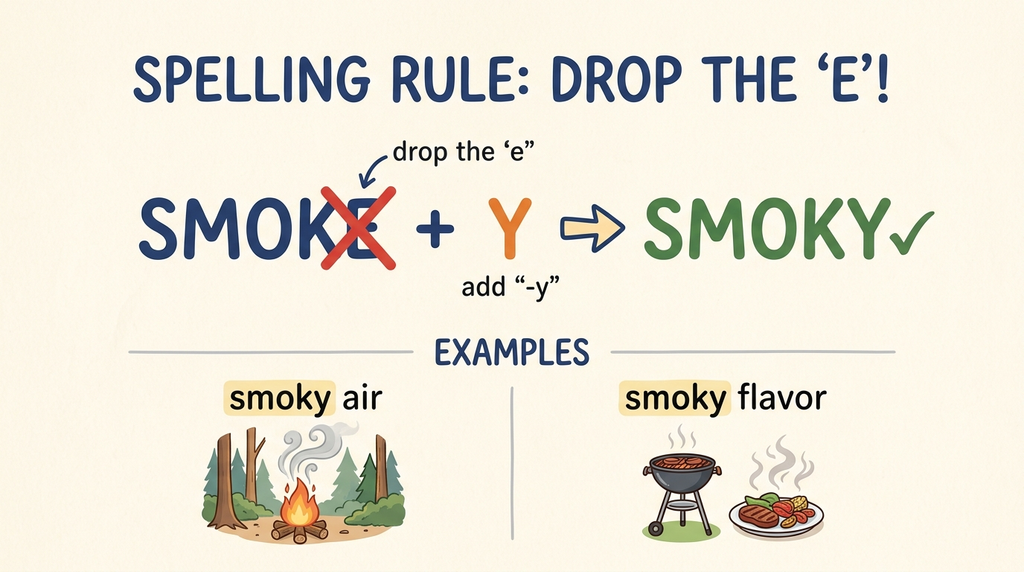
English often forms adjectives by adding -y to a noun. The noun smoke becomes the adjective smoky, meaning characterized by smoke or resembling it.
Compare these familiar formations:
| Noun | Standard adjective |
|---|---|
| Smoke | Smoky |
| Cloud | Cloudy |
| Rain | Rainy |
| Wind | Windy |
| Sun | Sunny |
The spelling of each adjective follows its own established conventions. In smoky, the final e in smoke is dropped before the y is added.
This explains the standard form: smoke becomes smoky, not usually smokey, when used as a general adjective.
When to Use Each Spelling
When to use smoky
Use smoky when describing smoke, a smoke-like appearance, or a flavor or quality associated with smoke. This is the safest choice for school assignments, business writing, journalism, recipes, and general publication.
Examples:
- The smoky air lingered over the campsite.
- We enjoyed a smoky barbecue sauce with dinner.
- The fireplace created a smoky smell throughout the room.
- The photograph had a smoky background.
- He spoke in a deep, smoky voice.
- The chef used smoked peppers to create a smoky flavor.
In these sentences, smoky describes a quality of the noun that follows it. The spelling is standard regardless of whether the description is literal or figurative.
When to use smokey
Use Smokey when it is the established spelling of a person’s name, nickname, fictional character, brand, or other proper noun. If the spelling is part of an official name, preserve it.
For example:
- Smokey Bear is the official name of the American wildfire-prevention mascot.
- Smokey is the nickname the character uses in the story.
- The café named its signature dish the Smokey Special.
In the last example, Smokey is part of a fictional menu name. It is not a general spelling recommendation for food descriptions.
If you are writing a recipe and simply want to describe the taste, write smoky barbecue sauce. If the restaurant has officially named a dish Smokey Barbecue, retain that name when referring to the dish specifically.
Is smokey ever acceptable as an adjective?
Yes. It can appear as an intentional variant, particularly in informal, branded, or creative contexts. However, it remains less standard than smoky in ordinary edited prose.
Compare:
- Standard descriptive spelling: The room became smoky.
- Nonstandard descriptive variant: The room became smokey.
- Proper name: Smokey arrived early.
The first is the preferred form for a general description. The third is correct when Smokey is the person’s actual name.
Examples of Smoky or Smokey by Context
The best way to understand the difference is to see how each spelling works in realistic sentences.
1. Everyday English
| Less suitable or incorrect in standard prose | Preferred version |
|---|---|
| The kitchen smells smokey. | The kitchen smells smoky. |
| The room was filled with smokey air. | The room was filled with smoky air. |
| A smokey haze covered the valley. | A smoky haze covered the valley. |
| The fire produced a smokey cloud. | The fire produced a smoky cloud. |
| The jacket had a smokey smell. | The jacket had a smoky smell. |
These examples use the adjective to describe a smell, atmosphere, or visible condition. Because no proper name is involved, smoky is the conventional choice.
2. Food, cooking, and drinks
In food writing, smoky often describes a flavor associated with cooking over wood or charcoal, smoking ingredients, or using smoked spices.
Smoky barbecue sauce
The smoky barbecue sauce complemented the grilled vegetables.
Smoky seasoning
Smoked paprika gave the roasted corn a smoky flavor.
Smoky aroma
The tea had a distinctive smoky aroma.
For these descriptions, smoky is the standard spelling. You do not need to write smokey flavor or smokey sauce unless reproducing an established product or menu name.
3. Makeup and beauty
The phrase smoky eyes is the conventional spelling in beauty writing. It describes a makeup technique that blends darker shades around the eyes to create a soft, shaded effect.
Examples:
- She chose smoky eye makeup for the evening event.
- The makeup artist created a smoky effect with gray and brown shadows.
- A smoky eyeliner look can be subtle or dramatic.
- The tutorial explains how to blend colors for smoky eyes.
Although the makeup effect does not require actual smoke, the word smoky works figuratively to describe its hazy, blended appearance.

4. Writing, art, and photography
Smoky can describe visual effects and artistic qualities even when no smoke is present.
Examples:
- The photographer created a smoky background using soft gray tones.
- The painting combines smoky blues with muted greens.
- The designer chose a smoky glass finish for the lamp.
- A smoky shadow softened the edges of the image.
- The stage lighting produced a smoky-looking atmosphere.
These are metaphorical or appearance-based uses. The adjective refers to resemblance, not necessarily the presence of smoke.
5. Music and voice
A voice described as smoky typically sounds husky, warm, textured, or slightly rough. The term is descriptive rather than a technical classification.
Examples:
- The singer has a distinctive smoky voice.
- Her smoky vocals gave the performance an intimate quality.
- The recording paired a smoky vocal tone with a gentle piano arrangement.
Here, smoky is appropriate because it describes a perceived quality associated with the sound.
6. Names, titles, and brands
Names require a different approach because their spelling may not follow the standard spelling of a descriptive adjective.
Examples:
- Smokey Bear — retain the established proper name.
- Smokey — use this spelling if it is someone’s chosen name or nickname.
- Smokey Special — preserve this wording if it is the official name of a dish.
Do not automatically correct a proper name to Smoky. Conversely, do not assume that because Smokey appears in a name, it is the preferred spelling for every descriptive use.

Common Mistakes and Corrected Examples
The most frequent error is assuming that smokey is the normal spelling simply because it looks similar to smoky. Another is changing the spelling of a proper name while editing a sentence.
| Incorrect or less standard | Correct or preferred | Why |
|---|---|---|
| The room is smokey. | The room is smoky. | Standard descriptive adjective |
| I love the smokey taste. | I love the smoky taste. | Conventional food description |
| She applied smokey eye shadow. | She applied smoky eye shadow. | Standard beauty terminology |
| The sky looked smokey. | The sky looked smoky. | Standard spelling for appearance |
| We made a smokey sauce. | We made a smoky sauce. | Standard descriptive usage |
| Smoky Bear is the mascot’s name. | Smokey Bear is the mascot’s name. | Preserve the established proper name |
The word smokey is not necessarily a spelling error in every context. The issue is whether you are using it as an ordinary adjective or reproducing a specific name or deliberate spelling.
Other mistakes to avoid
Mistake 1: Treating the two spellings as equally standard everywhere.
While both forms exist, smoky is the conventional choice in standard descriptive prose.
Mistake 2: Assuming British English uses smokey.
British English generally uses smoky, just as American English does. The extra e is not a standard British-versus-American distinction.
Mistake 3: Using capitalization to solve the spelling problem.
Capitalizing Smokey does not make it the correct descriptive spelling. Capitalization is appropriate for proper names and at the beginning of sentences, not as a substitute for standard spelling.
Mistake 4: Changing an official name during proofreading.
An editor should preserve the established spelling of names, even when it differs from the usual adjective.
A Memory Trick and Practical Spelling Test
The easy memory trick
Remember this:
Smoke → smoky. Drop the final e, then add y.
Think of other familiar adjectives such as cloudy and rainy. The standard descriptive form is smoky, without the extra e.
A second trick is to associate the two forms with their most common roles:
- Smoky = description
- Smokey = often a name
This is a useful shortcut, not an absolute rule: smokey can appear as an adjective, and Smoky could occur in a proper name.
The three-second decision checklist
Before choosing a spelling, ask yourself:
- Am I describing something? Choose smoky.
- Am I writing a person’s name, nickname, brand, or title? Check and preserve its established spelling.
- Am I following a house style or quoting a source? Follow the required spelling for that context.
If none of the special cases applies, smoky is the correct default.
Test your spelling
Smoky vs. Smokey quiz
0 of 5
1. The chef prepared a ___ tomato soup.smokysmokey
2. The room filled with ___ air.smokeysmoky
3. The fire-prevention mascot is called ___ Bear.SmokySmokey
4. She created a ___ eye makeup look.smokeysmoky
5. The character’s nickname is ___, according to the story.SmokeySmoky
Check answers
A practical proofreading test
Search your document for smokey.
For every occurrence, check whether it is:
- A descriptive adjective that should normally be changed to smoky.
- A proper name that must retain its established spelling.
- A deliberate brand, title, quotation, or stylistic choice.
For example, in a sentence such as “The Smokey Mountains looked smokey at sunset,” you would need to check both uses separately. If the intended place is the Great Smoky Mountains, use that established place name; if the second word describes a hazy appearance, use smoky.
This is more reliable than a blanket search-and-replace because names and descriptive words may appear in the same document.

Formal vs. Casual Usage and Regional Notes
Formal and academic English
Use smoky in essays, reports, formal correspondence, academic writing, recipes, and edited publications when you need the descriptive adjective.
Examples:
- Smoke from the industrial site created a smoky haze.
- The experiment produced a smoky odor.
- The sample exhibited a smoky coloration.
These examples use the standard spelling regardless of whether the tone is technical or descriptive.
If you are discussing a product, publication, or person whose official name includes Smokey, preserve that spelling.
Casual and creative English
In informal messages, social media posts, fictional dialogue, or creative branding, smokey may be an intentional choice.
For example:
- “That sauce has a really smokey taste!”
- A fictional character called Smokey.
- A product name deliberately styled as Smokey BBQ.
The first example is understandable but uses a less standard spelling for the adjective. The second and third may be entirely appropriate when the spelling is intentional.
Is it smoky or smokey in UK English?
In British English, smoky is the standard spelling for the adjective. The same is true in American English.
| Context | British English | American English |
|---|---|---|
| Air containing smoke | Smoky air | Smoky air |
| Flavor | Smoky flavor | Smoky flavor |
| Makeup | Smoky eyes | Smoky eyes |
| Official name | Preserve the official spelling | Preserve the official spelling |
There is no general rule that British English prefers smokey while American English prefers smoky. Both varieties use smoky as the normal descriptive form.
Pronunciation of smoky and smokey
In ordinary English usage, smoky and smokey are generally pronounced the same way when the latter is used as an adjective.
A simple pronunciation guide is:
- Smoky: SMOH-kee
- Smokey: SMOH-kee
The first syllable rhymes approximately with go, and the second sounds like key. The spelling difference does not ordinarily signal a different pronunciation.
Because the two forms are homophones in this usage, pronunciation alone cannot tell you which spelling to write. You need to consider meaning, context, and whether a proper name is involved.
Frequently Asked Questions
1. Is it correct to say smokey?
Yes, in certain contexts. Smokey is a recognized spelling used in proper names and as an occasional variant adjective. However, smoky is the standard choice when describing smoke, flavor, smell, or appearance in ordinary writing.
2. Is it smoky or smokey?
Use smoky for the standard adjective. Use Smokey when that is the established spelling of a name, title, or other proper noun. In general descriptive prose, smoky is preferable.
3. How do you spell smoky?
The standard spelling is s-m-o-k-y: smoky. It has five letters and no e between the k and y.
4. How do you spell smokey?
The variant spelling is s-m-o-k-e-y: smokey. It has six letters. Use it when the spelling is required by a name or intentional styling; otherwise, choose smoky for the adjective.
5. What is the spelling of smokey in British English?
British English generally uses smoky for the adjective. Smokey can still appear in names, titles, and intentional variants, but it is not the standard British alternative to smoky.
6. What does smoky mean?
Smoky means containing or producing smoke, resembling smoke, or having a flavor, smell, appearance, or other quality associated with smoke. For example, smoky air contains smoke, while smoky flavor describes a taste associated with smoke.
7. What does smokey mean?
When used as an adjective, smokey generally conveys the same intended meaning as smoky. It is simply a less standard spelling for general descriptive writing. In a proper name, its meaning depends on the person, character, brand, or title.
8. Is smoky the correct spelling in the UK and the US?
Yes. Smoky is the conventional spelling in both British and American English. The extra e in smokey is not a standard regional spelling difference.
9. Should I write smoky eyes or smokey eyes?
Write smoky eyes in standard beauty writing. Smokey eyes may appear in product names or informal content, but smoky eyes is the conventional expression.
10. Is it smoky flavor or smokey flavor?
Smoky flavor is the preferred spelling. Use smokey only when reproducing a product’s official name or following a deliberate naming choice.
11. Is smoky an adjective?
Yes. Smoky is an adjective because it describes a noun, as in smoky air, smoky sauce, smoky voice, and smoky atmosphere.
12. Is smokey a real word?
Yes. The spelling exists in English, particularly in names and as a variant form. However, its existence does not mean it is equally preferred in every context. The standard adjective is smoky.
13. Is smoky ever used in a proper name?
Yes. Proper names can use Smoky, Smokey, or other established spellings. Always verify the actual name rather than applying a general adjective rule to it.
14. What is the difference between smoky and smokey in a sentence?
In an ordinary descriptive sentence, the difference is usually spelling rather than meaning. For example, “The room is smoky” is the standard form. In a sentence mentioning Smokey Bear, however, Smokey is part of a proper name and should not be changed.
15. How can I remember the correct spelling?
Remember smoke → smoky. Drop the final e before adding y. When describing something, choose smoky unless the context specifically requires a different established spelling.
Final Takeaway
The answer to “smoky or smokey, which is correct?” is straightforward for most writing: smoky is the standard adjective in both British and American English.
Use smoky for smoke-filled air, smoky food, smoky eyes, smoky colors, and smoky voices. Use Smokey when it is the established spelling of a proper name, such as Smokey Bear, or when a particular title or brand intentionally uses that form.
When proofreading, do not rely on pronunciation or perform an automatic replacement. Check whether each occurrence describes something or belongs to a name. That simple distinction will help you choose the correct spelling consistently.