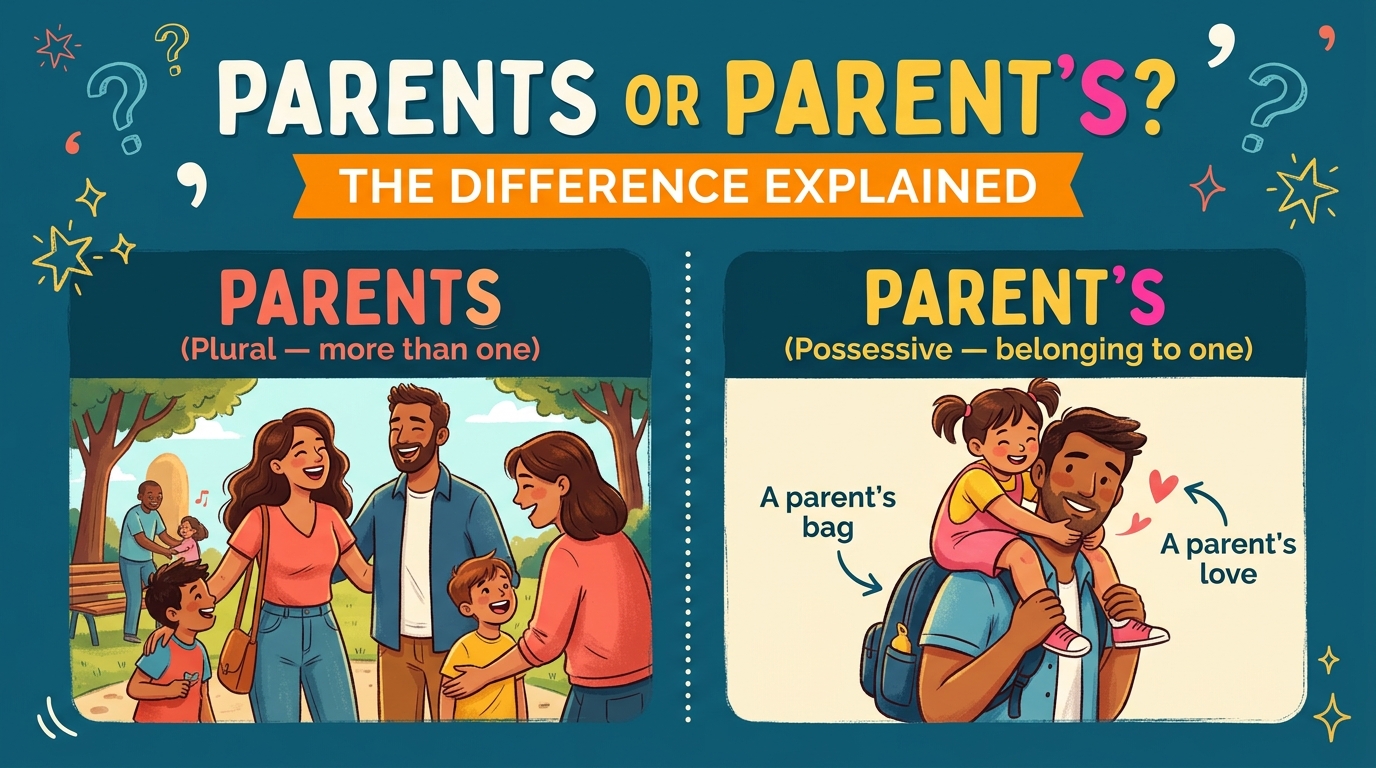
Parents or Parent’s? The Difference Explained
Quick Answer
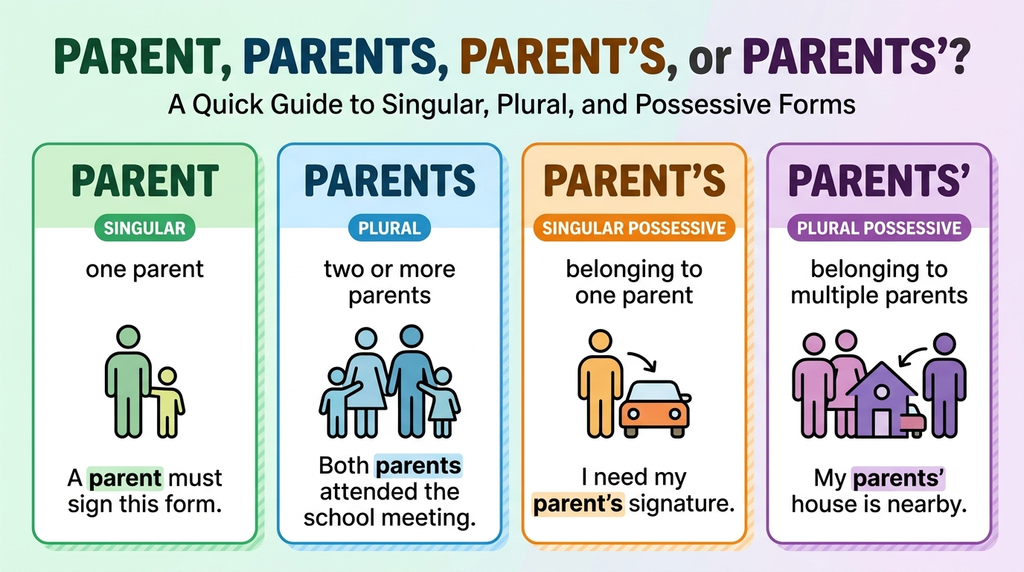
“Parents” is the plural of “parent,” while “parent’s” is the singular possessive form. “Parents’” is the plural possessive form. These three forms have different grammatical functions, even though they look and sound almost identical.
- Parent: One mother or father, or one person in a parental role.
- Parents: Two or more parents.
- Parent’s: Something belonging to one parent.
- Parents’: Something belonging to two or more parents.
The correct choice depends on whether you mean one parent, multiple parents, or ownership.
Examples:
- My parent is waiting outside. (One parent)
- My parents are waiting outside. (Two or more parents)
- My parent’s car is outside. (One parent owns the car.)
- My parents’ car is outside. (Two or more parents own or share the car.)
The wording “parents or parents” in the primary keyword is identical on both sides. If you are deciding which spelling to use, the real distinction is usually parents vs. parent’s vs. parents’.
At-a-Glance Table
| Form | Part of speech or function | Meaning | Example |
|---|---|---|---|
| Parent | Singular noun | One parent | My parent lives nearby. |
| Parents | Plural noun | Two or more parents | My parents live nearby. |
| Parent’s | Singular possessive | Belonging to one parent | My parent’s phone is ringing. |
| Parents’ | Plural possessive | Belonging to multiple parents | The parents’ meeting starts at six. |
| Parents’s | Nonstandard possessive spelling | Not the standard form | Write parents’, not parents’s. |
| Parentses | Incorrect standard plural | Not the standard plural of parent | Write parents. |
The most important distinction is between number and possession. Number tells you whether you are talking about one parent or more than one. Possession tells you that something belongs to, relates to, or is associated with someone.
What Is the Difference Between Parents and Parent’s?
Although the words share almost all their letters, the apostrophe changes the grammatical meaning.
Parents: The plural form of parent
Parents is the regular plural of parent. It refers to two or more people who are parents.
Examples:
- My parents are visiting this weekend.
- Both parents attended the school meeting.
- Her parents live in another city.
- The parents welcomed the new teacher.
- Many parents worry about their children’s education.
In these sentences, parents does not indicate ownership. It simply identifies more than one parent.
The plural form is made by adding -s to the singular noun:
Parent → Parents
This is the normal spelling pattern for most English nouns ending in a consonant or vowel other than certain special cases.
Parent’s: The singular possessive form
Parent’s is used when something belongs to, is associated with, or relates to one parent.
Examples:
- My parent’s car needs repairs.
- The parent’s signature is missing.
- A parent’s support can make a difference.
- I found my parent’s old photographs.
- The parent’s decision surprised the teacher.
In each example, the noun after parent’s identifies something connected to one parent.
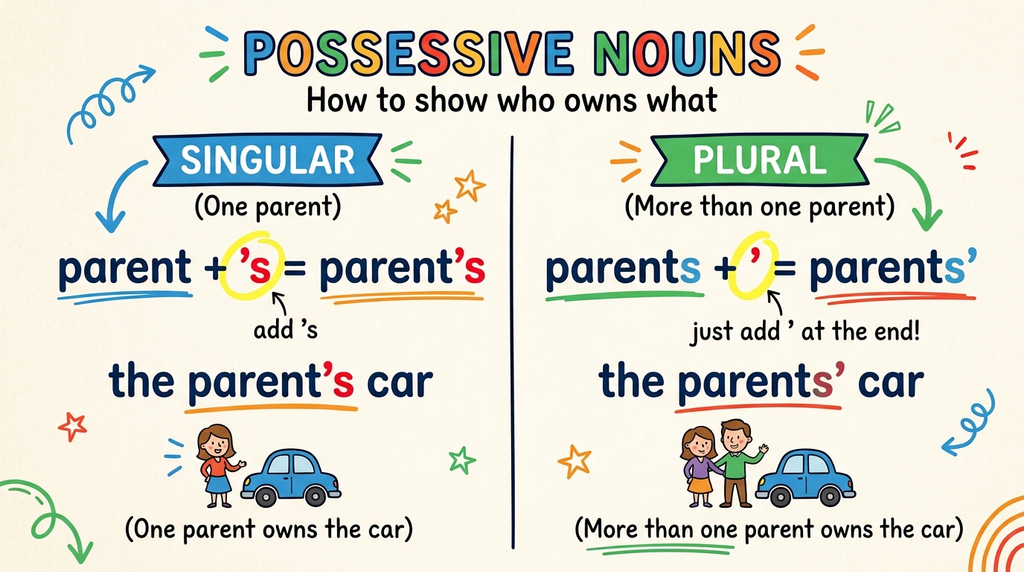
The apostrophe comes before the s because the possessive noun is singular:
Parent + ’s → Parent’s
Notice the difference:
- My parent’s house is large. (One parent)
- My parents have a large house. (Multiple parents; no possession is marked on the word parents itself.)
The second sentence can describe the same household, but its grammar is different.
Parents’: The plural possessive form
Parents’ indicates possession or association involving two or more parents.
Examples:
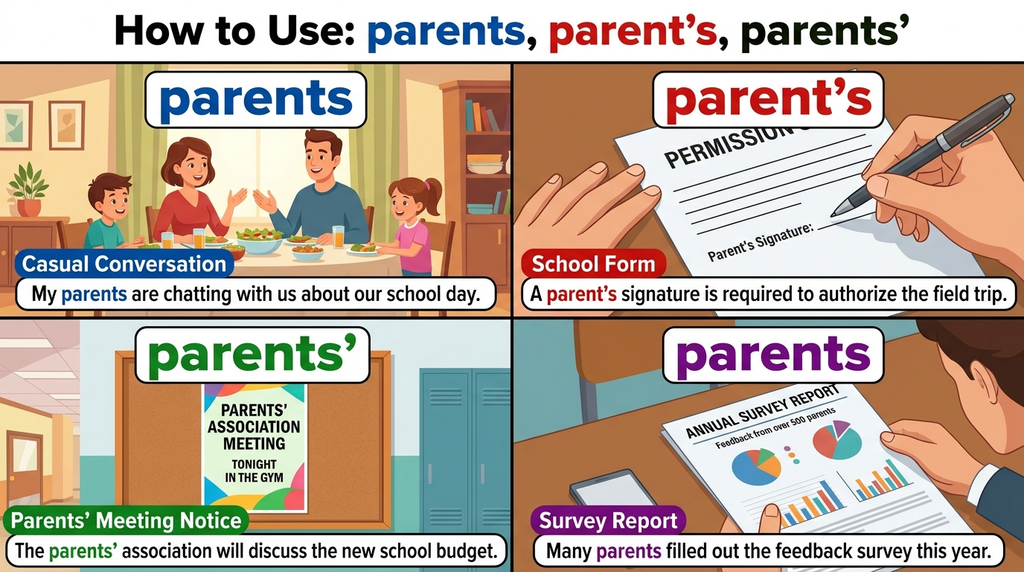
- The parents’ meeting begins at 7 p.m.
- The parents’ cars filled the parking lot.
- The parents’ opinions were considered.
- We discussed the parents’ concerns.
- The parents’ responsibilities extend beyond the classroom.
The noun parents is already plural and ends in s. To form its possessive, add an apostrophe after the existing s.
Parents + ’ → Parents’
This rule is why parents’s is not the standard spelling. You do not normally add another s after the apostrophe when a regular plural noun already ends in s.
When to Use Each Form
Choosing the right form becomes much easier when you identify the meaning you want to express before writing.
Use parent when you mean one person
Use the singular noun parent when referring to one mother, father, guardian, or person fulfilling a parental role.
Examples:
- Every parent received a notice.
- A parent must sign the permission form.
- One parent volunteered to help.
- Each parent has a different perspective.
- The parent spoke to the principal.
Words such as each, every, one, and a commonly indicate that the singular form is appropriate.
For instance, “Each parent is responsible for signing the form” is correct because each treats the parents individually.
Use parents when you mean more than one person
Use parents when referring to multiple parents.
Examples:
- The parents are waiting in the hall.
- My parents work in healthcare.
- Both parents agreed to the arrangement.
- Some parents prefer printed notices.
- Her parents encouraged her to apply.
Remember that the plural noun does not automatically require an apostrophe. An apostrophe is needed only if you are expressing possession or another possessive relationship.
Correct: The parents attended the event.
Incorrect for the intended meaning: The parent’s attended the event.
The second version incorrectly uses a possessive form where an ordinary plural noun is required.
Use parent’s when one parent owns or is associated with something
Use parent’s when the relationship involves one parent.
Examples:
- The parent’s name appears on the form.
- My parent’s advice helped me.
- A parent’s permission is required.
- The parent’s office is on the first floor.
- We respected the parent’s wishes.
The possessive relationship can be literal ownership, but it does not have to be. A parent’s advice is advice given by or associated with a parent, rather than an object physically owned by that person.
Use parents’ when multiple parents share the relationship
Use parents’ when the noun refers to more than one parent and the following item or idea belongs to or concerns them collectively.
Examples:
- The parents’ association organized the event.
- The parents’ concerns were discussed.
- We reviewed the parents’ feedback.
- The parents’ bedroom was upstairs.
- The parents’ rights were explained.
A useful distinction is whether the noun is singular or plural before you add the apostrophe.
- The parent’s concern: one parent.
- The parents’ concerns: multiple parents.
Both forms are grammatically correct, but they express different relationships.
Examples of Parents in Sentences
Seeing the forms in natural sentences is one of the easiest ways to understand their differences.
Everyday conversation
| Sentence | Why it is correct |
|---|---|
| My parents are home. | Parents is plural. |
| My parent is home. | Parent is singular. |
| My parent’s at home. | The apostrophe marks the contraction parent is. |
| My parents’ home is beautiful. | The home belongs to or is associated with multiple parents. |
| My parent’s home is beautiful. | The home belongs to or is associated with one parent. |
The third example deserves special attention. In informal English, parent’s can represent parent is or parent has, depending on the sentence.
For example:
- My parent’s coming later. = My parent is coming later.
- My parent’s already left. = My parent has already left.
These contractions are grammatically possible, though many writers prefer the full forms in formal writing for clarity.
By contrast, parents without an apostrophe is not a contraction of parents are. The standard contraction is parents’ in certain contexts, as in “My parents’ coming later would help,” but this construction is uncommon and potentially confusing. In everyday writing, use “My parents are coming later.”
School and education
School-related writing often uses all three forms.
- Parents must submit the forms by Friday.
- Every parent must sign the form.
- The parent’s signature is missing.
- The parents’ meeting will be held in the library.
- The parents’ committee reviewed the proposal.
In “the parents’ meeting,” the meeting is associated with multiple parents. In “the parent’s meeting,” the meeting is associated with one parent, although the intended context may need clarification.
If the meeting is intended for parents generally, parents’ meeting is usually the appropriate choice.
Family and personal relationships
- My parents have always supported me.
- My parent’s birthday is tomorrow.
- My parents’ anniversary is next week.
- I called my parent after work.
- We visited my parents’ house during the holidays.
The meaning of a possessive depends on the number of people involved, not on whether the sentence sounds more formal or casual.
If one parent owns the house, write “my parent’s house.” If the house is shared by both parents, write “my parents’ house.”
Work, research, and public information
- Parents often seek reliable information about education.
- The parent’s response was recorded separately.
- The parents’ responses were analyzed together.
- Each parent completed an individual survey.
- The parents’ survey results were published in the report.
In research and professional writing, accurate noun forms matter because they can affect how readers interpret the number of participants or the ownership of data.
Common Mistakes and How to Correct Them
The most common errors happen when writers confuse plural nouns with possessive nouns or place apostrophes incorrectly.
Mistake 1: Writing parent’s when you mean multiple parents
Incorrect: My parent’s are visiting tomorrow.
Correct: My parents are visiting tomorrow.
Why: The sentence refers to multiple people, and no possession is being expressed. The apostrophe is unnecessary.
Mistake 2: Writing parents when you mean ownership
Incorrect: My parents house is nearby.
Correct: My parents’ house is nearby.
Why: The sentence describes a house associated with multiple parents. Since parents is already plural and ends in s, the apostrophe goes after the final s.
Mistake 3: Writing parents’s
Incorrect: The parents’s decision was final.
Correct: The parents’ decision was final.
Why: The plural noun already ends in s. Add only an apostrophe to form the standard plural possessive.
If you mean one parent, write “the parent’s decision.”
Mistake 4: Using a singular verb with parents
Incorrect: My parents is at home.
Correct: My parents are at home.
Why: Parents is a plural noun, so it normally takes a plural verb. The singular version is “My parent is at home.”
Mistake 5: Confusing parent’s with parents’
Incorrect: Both parents’s opinions mattered.
Correct: Both parents’ opinions mattered.
Why: Both indicates two people. The plural possessive is therefore appropriate.
If only one parent’s opinion mattered, write “The parent’s opinion mattered.”
Mistake 6: Adding -es to make the plural
Incorrect: The parentses attended the event.
Correct: The parents attended the event.
Why: Parent forms its regular plural by adding -s, not -es. The form parentses is not standard English.
Mistake 7: Treating parent’s as the ordinary plural
Incorrect: Three parent’s attended the meeting.
Correct: Three parents attended the meeting.
Why: A number greater than one generally requires the plural noun. No apostrophe is necessary unless possession is intended.
Mistake 8: Using an apostrophe for an ordinary plural
Incorrect: The parent’s received the notice.
Correct: The parents received the notice.
Why: Apostrophes do not generally form English plurals. They mark possession or certain contractions.
Mistake 9: Confusing parents’ and parent’s house
Compare these sentences:
- My parent’s house is near the station.
- My parents’ house is near the station.
Both are correct. The first refers to one parent; the second refers to multiple parents.
The error occurs only when the spelling does not match the intended meaning.
Mistake 10: Assuming parents always means mother and father
In everyday usage, parents often refers to a child’s mother and father, but the word can also describe two or more people who serve as parents or legal guardians. The exact relationship depends on context.
For example, a child may have adoptive parents, two mothers, two fathers, or other parental arrangements. The grammatical distinction remains unchanged.

Is Parents Singular or Plural?
Parents is plural. Parent is singular.
This distinction affects articles, demonstratives, pronouns, and verb agreement.
| Singular | Plural |
|---|---|
| A parent | Two parents |
| This parent | These parents |
| That parent | Those parents |
| The parent is here. | The parents are here. |
| The parent has arrived. | The parents have arrived. |
A singular parent can be identified by a, an where appropriate, one, each, or every. Plural parents commonly appear with many, both, several, and two or more.
For example:
- Every parent is welcome.
- All parents are welcome.
- One parent has responded.
- Both parents have responded.
The verb changes because the subject’s grammatical number changes.
Is it parents is or parents are?
In standard English, parents are is correct when parents is the subject.
Correct:
- My parents are supportive.
- The parents are waiting outside.
- Both parents are responsible for the decision.
Incorrect in ordinary standard usage:
- My parents is supportive.
- The parents is waiting outside.
However, the verb is can appear elsewhere in a sentence that contains the word parents.
For example: “The problem is that the parents are unavailable.”
Here, is agrees with the singular subject problem, not with parents.
Should I write my parents are or my parents is?
Write “My parents are” because parents refers to more than one person.
Examples:
- My parents are travelling tomorrow.
- My parents are proud of me.
- My parents are at work.
- My parents are planning a visit.
Use “My parent is” when referring to just one parent.
What Is the Possessive Form of Parents?
The possessive form depends on whether the noun is singular or plural.
- Singular: parent’s
- Regular plural: parents’
- Irregular plural without final s: the plural noun usually takes ’s, as in children’s.
The third example illustrates why English possessives cannot be formed by blindly adding an apostrophe after every plural. You need to check how the noun’s plural is spelled.
What is the plural possessive of parents?
The plural possessive of parent is parents’.
Strictly speaking, parents is already the plural noun, and parents’ is its plural possessive form.
Examples:
- The parents’ meeting.
- The parents’ opinions.
- The parents’ responsibilities.
- The parents’ shared property.
Is it parents’ or parents’s?
Use parents’, not parents’s, in standard English.
The usual rule is:
- Write the plural noun: parents.
- Add an apostrophe after the final s: parents’.
- Do not add another s.
This rule applies to regular plural nouns ending in s, including teachers’, students’, and workers’.
Is it parent’s or parents’ house?
Both forms are possible, but the intended number determines which is correct.
- The parent’s house: one parent.
- The parents’ house: two or more parents.
If you are talking about a home shared by your mother and father, “my parents’ house” is generally the natural choice.
If you are referring to one parent’s home, “my parent’s house” is correct.
What about a parent’s parents?
The phrase “a parent’s parents” is grammatically correct. It refers to the parents of one person who is themselves a parent.
For example:
“My parent’s parents live in another country.”
The sentence means that the grandparents of the speaker’s generation, or the speaker’s grandparents through that parent, live abroad. More simply, these are the parents of one parent.
Compare:
- My parent’s parents: the parents of one parent.
- My parents’ parents: the parents of multiple parents.
Both are grammatical, although the second phrase may need additional context to clarify the family relationships.
Quick Decision Rule and Proofreading Test
When you are unsure whether to write parents, parent’s, or parents’, follow this checklist.
Choose the correct form
1. How many parents are you referring to?One parentTwo or more parents
2. Are you showing possession or association?No — I am simply talking about the parent or parents.Yes — something belongs to or is associated with them.
Your correct form
parents
Example: My parents are waiting.
The replacement test
You can also check the sentence by replacing the disputed form with a clearer phrase.
Test 1: Can you replace it with “more than one parent”?
If yes, you probably need parents.
- Parents are waiting.
- More than one parent is waiting.
The second sentence uses a different subject construction, but the meaning helps you recognize the plural.
Test 2: Can you replace it with “belonging to one parent”?
If yes, use parent’s.
- My parent’s bag is missing.
- The bag belonging to one parent is missing.
Test 3: Can you replace it with “belonging to multiple parents”?
If yes, use parents’.
- The parents’ room is locked.
- The room belonging to multiple parents is locked.
The replacement test is especially useful when proofreading emails, school notices, reports, and essays.
Pronunciation: Do Parents, Parent’s, and Parents’ Sound Different?
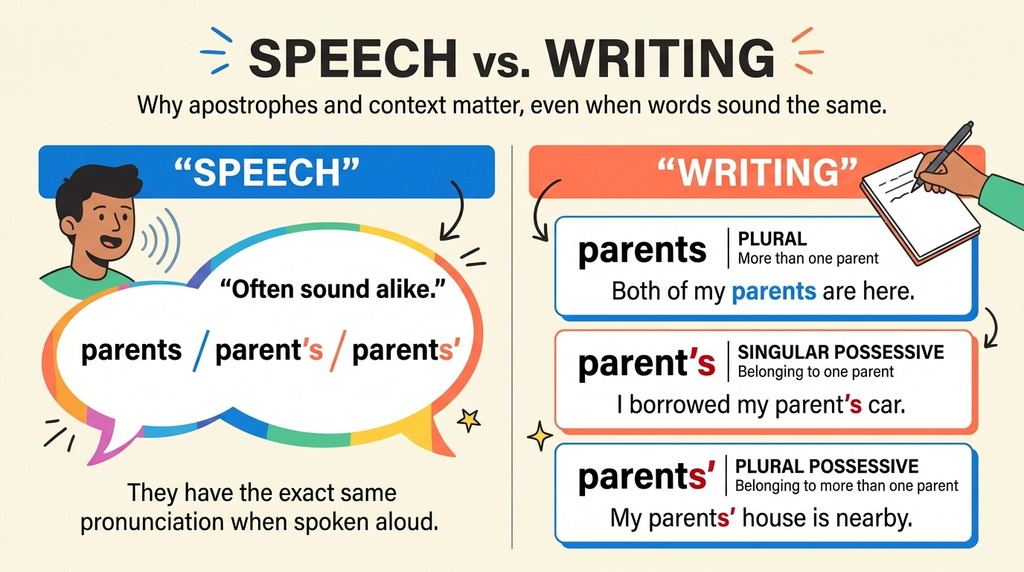
In most ordinary English speech, parents, parent’s, and parents’ sound the same or nearly the same. The apostrophe is a written grammatical marker, not a separate sound.
The pronunciation of parent varies across English accents. Some speakers pronounce it with two clearly audible syllables, while vowel sounds and stress can differ between regions.
The important distinction is that the possessive forms are generally not differentiated by pronunciation alone.
Consider:
- My parents arrived.
- My parent’s arrived.
The second sentence can mean “My parent has arrived” or “My parent is arrived” in certain constructions, although the latter is not natural in most contemporary standard English. Context helps the listener interpret the intended meaning.
In writing, however, the apostrophe carries grammatical information. Readers can distinguish the forms even when speakers cannot hear a difference.
Formal, Casual, British, and American Usage
The basic spelling rules for parent, parents, parent’s, and parents’ are the same in standard British and American English.
There is no general British-American difference that changes the possessive rule.
Formal writing
In formal writing, use the form that matches the intended number and grammatical relationship.
Examples:
- Parents are required to attend the orientation.
- A parent’s consent must be obtained.
- The parents’ concerns were recorded.
- Each parent is entitled to receive a copy.
Formal writing also benefits from avoiding contractions when they could create confusion. For instance, “My parent’s coming” could mean “My parent is coming.” The full version is clearer in a formal report.
Casual conversation and messaging
In casual messages, writers sometimes omit apostrophes or use punctuation inconsistently. However, informal communication does not change the standard spelling rules.
Standard: “My parents’ house is nearby.”
Common informal error: “My parents house is nearby.”
The intended meaning may be obvious, but the apostrophe is still required in edited English.
British versus American English
Both varieties use:
- parent for one parent
- parents for more than one parent
- parent’s for the singular possessive
- parents’ for the plural possessive
Differences in accent may affect how parent is pronounced, but not how its plural or possessive forms are written.
The main exception worth understanding is not regional but stylistic: organizations and publications sometimes follow house styles for possessives involving proper names or unusual constructions. Those style decisions do not change the ordinary rule for parents’.
Edge Cases That Cause Confusion
“Parents” as a general category
In a sentence such as “Parents need access to clear information,” the noun refers to parents generally rather than to a specific pair of people.
No apostrophe is needed because the sentence is not expressing possession.
“Parents’” in a compound phrase
Consider “parents’ evening,” a term used in some British educational settings for a scheduled meeting between parents and teachers.
The apostrophe indicates that the event is associated with parents. Similar expressions include parents’ association and parents’ meeting.
“Parent’s” in a contraction
The form parent’s can represent a possessive noun or a contraction of parent is or parent has.
- The parent’s signature is missing. (Possessive)
- The parent’s waiting outside. (Parent is)
- The parent’s already spoken to the teacher. (Parent has)
The contraction meaning depends on the words that follow and the intended sentence structure.
A singular noun with a plural meaning
Sometimes parent appears in a sentence about a group because the writer is considering each person separately.
For example: “Each parent must bring their identification.”
Although the sentence concerns a group, each parent is grammatically singular. The verb is therefore must bring, not must brings or must bring with a plural auxiliary distinction.
The pronoun their is widely accepted as a singular, gender-neutral pronoun in contemporary English.
Shared versus individual possession
Possessive wording can also communicate whether something is shared or individually owned.
- The parents’ room: a room associated with multiple parents.
- The parents’ rooms: multiple rooms associated with multiple parents.
- The parent’s rooms: multiple rooms associated with one parent.
The possessive noun tells you who is associated with the item, while the noun after it tells you whether there is one item or more than one. These are separate grammatical decisions.
Frequently Asked Questions
Is it parents or parent’s?
Use parents for two or more parents. Use parent’s for something belonging to or associated with one parent, or as a contraction of parent is or parent has.
What is the difference between parent’s and parents’?
Parent’s is singular possessive; parents’ is plural possessive. The first refers to one parent, while the second refers to two or more parents.
How do you spell parents?
The correct plural spelling is parents: P-A-R-E-N-T-S. There is no apostrophe in the ordinary plural.
What is the plural of parent?
The plural of parent is parents. Add -s to the singular noun.
Is parents singular or plural?
Parents is plural. Its singular form is parent. Use plural verbs such as are and have when parents is the subject.
Is it parents are or parents is?
Use parents are in standard English because parents is plural.
Correct: “My parents are at home.”
Incorrect: “My parents is at home.”
Is it parents’ or parents’s?
The standard plural possessive is parents’. Do not add another s after the apostrophe.
Can parents’ and parent’s be used in the same sentence?
Yes. For example: “The parent’s request was considered alongside the parents’ feedback.”
The first possessive refers to one parent, and the second refers to multiple parents.
Is “parents house” correct?
In standard edited English, use parent’s house for one parent or parents’ house for multiple parents. The version without an apostrophe omits the possessive marker.
What does “parents’ parents” mean?
It refers to the parents of multiple parents. Depending on the family relationships, these people may be grandparents of the children being discussed. The phrase “parent’s parents” refers to the parents of one parent.
Is “parentses” a word?
Parentses is not the standard plural of parent. The correct plural is parents.
What does “parents or parents” mean?
The phrase repeats the same word, so there is no spelling difference between the two sides. If you are comparing grammatical forms, the useful comparison is usually parents or parent’s, or parent’s or parents’.
How do you use parents in a sentence?
Use parents as a plural noun: “My parents are visiting this weekend.” If you want to show possession, write “My parents’ house is nearby.”
Is “parent or parents” correct?
Both are correct, depending on number. Use parent for one person and parents for two or more people.
What is the difference between parent plural and plural possessive?
The plural is parents, which means more than one parent. The plural possessive is parents’, which shows possession or association involving multiple parents.
What about “Scotty with the Body parents”?
If you are referring to a person known as “Scotty with the Body,” the phrase by itself does not establish which parents or family relationship you mean. The general grammar rule remains the same: use parents for multiple parents, parent’s for one parent’s possession, and parents’ for the possession or association of multiple parents.
Final Takeaway
The difference between parents, parent’s, and parents’ comes down to number and possession.
- Parent = one parent.
- Parents = two or more parents.
- Parent’s = belonging to one parent, or a contraction of parent is or parent has.
- Parents’ = belonging to or associated with two or more parents.
Remember that apostrophes do not normally make nouns plural. They mark possession or contractions. When in doubt, first decide how many parents you mean, then decide whether you need to express possession.
That two-step check will help you choose the correct form in school assignments, emails, reports, and everyday messages.