Segway or Segue: Which Word Is Correct?
Quick Answer
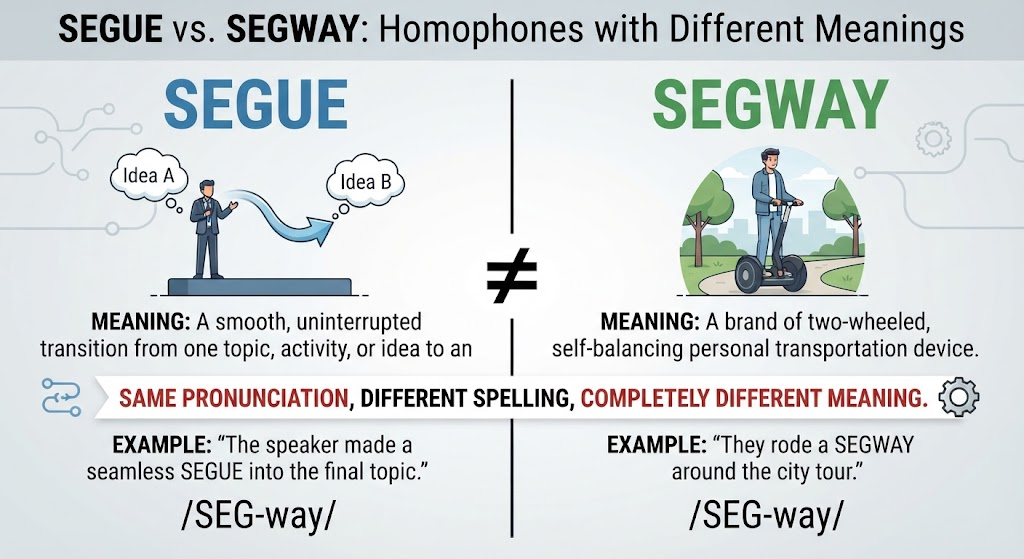
If you mean a smooth transition from one topic, idea, activity, or subject to another, the correct word is segue.
- Segue = a smooth transition or a transition without interruption.
- Segway = a brand name for a type of self-balancing personal transporter. It is also commonly used informally when people accidentally spell segue as Segway.
So, if you want to say:
“She segueed into a discussion about her new project.”
The standard spelling is:
“She segued into a discussion about her new project.”
Segue is pronounced approximately “SEG-way,” which explains why the spelling is so often confused with Segway. The two words sound alike in ordinary English, but they have different meanings and grammatical uses.
At-a-Glance Table
| Feature | Segue | Segway |
|---|---|---|
| Basic meaning | A smooth transition | A personal transportation brand |
| Pronunciation | “SEG-way” | “SEG-way” |
| Part of speech | Noun and verb | Proper noun/trademark |
| Common use | Conversation, writing, music, presentations | Transportation products and the brand |
| Example | “That was a natural segue into the next topic.” | “They toured the city on a Segway.” |
| Can mean “transition”? | Yes | No, in standard English |
| Can be a verb? | Yes: “She segued into another subject.” | Not normally as a standard verb for changing topics |
| Capitalization | Usually lowercase | Usually capitalized |
| Origin | Italian musical instruction | Brand name introduced in 2001 |
| Correct for “transition” | Segue | Not Segway |
The important distinction is therefore not pronunciation but meaning, spelling, grammatical function, and capitalization.
What Does “Segue” Mean?
Segue means a smooth transition from one thing to another. It can describe a transition between topics in a conversation, sections of a presentation, scenes in a performance, musical passages, or related ideas.
As a noun, segue refers to the transition itself:
“The question about education was a natural segue into the discussion of school funding.”
Here, segue means a smooth movement from one subject to another.
As a verb, segue means to transition smoothly:
“The speaker segued from the history of the company to its plans for the future.”
The verb is especially useful when one topic develops naturally into another rather than changing abruptly.
The word originally appeared as a musical instruction. It comes from Italian segue, meaning roughly “now follows,” and was used to indicate that the following musical section should continue without a break. The broader English sense of a transition without interruption developed later.
Is “Segue” a French Word?
No. Segue is Italian, not French.
The word entered English from the Italian musical instruction segue, related to the Italian verb seguire, “to follow.” That ultimately traces back to Latin sequi, also meaning “to follow.”
So if you see someone describing segue as a French word, that is inaccurate.
What Does “Segway” Mean?
Segway is primarily a brand name associated with self-balancing personal transportation devices.
The name was selected because of its similarity to segue and the idea of moving smoothly from one place to another. The word Segway has been in use as a trademark name since 2001.
For example:
“The tourists explored the old town on Segway vehicles.”
The distinction is simple:
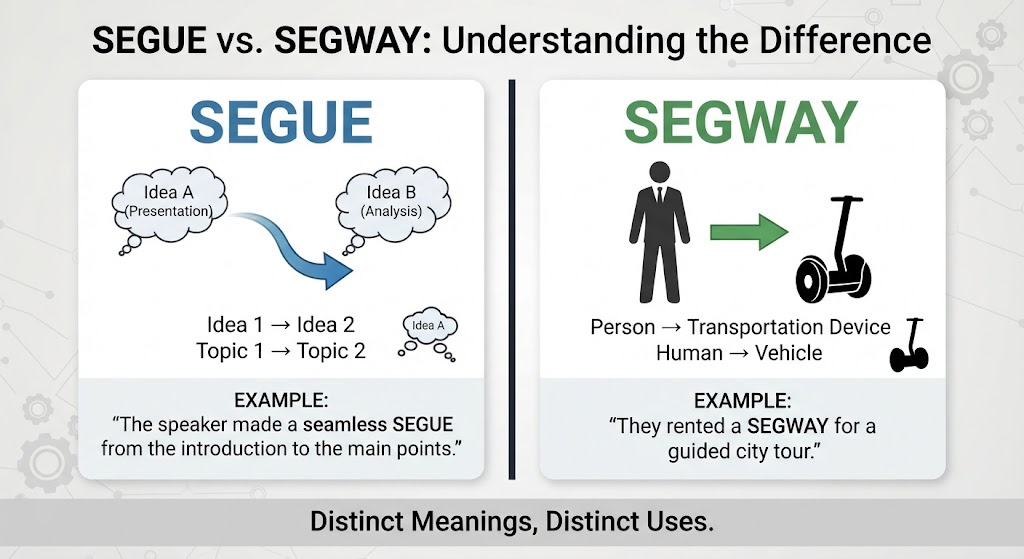
segue → transition
Segway → transportation brand
The similarity in sound is what creates the confusion.
Segway is also a registered trademark, so in contexts where the brand is specifically intended, the capitalization matters. Official Segway materials identify Segway® as a registered trademark.
Segue vs. Segway: The Detailed Difference
The easiest way to understand segue vs. Segway is to ask what kind of “movement” you are describing.
If the movement is conceptual, use segue.
If you are referring to the transportation brand, use Segway.
Segue as a Noun
As a noun, segue describes a transition.
“His joke provided a good segue into the next part of the presentation.”
“The documentary makes a smooth segue from childhood memories to adult life.”
“That question was an interesting segue into the larger issue.”
In each case, the word describes a connection between two subjects.
Segue as a Verb
Segue can also function as a verb.
“The conversation segued into politics.”
“She segued from the introduction into the main argument.”
“The presentation segued naturally into the results.”
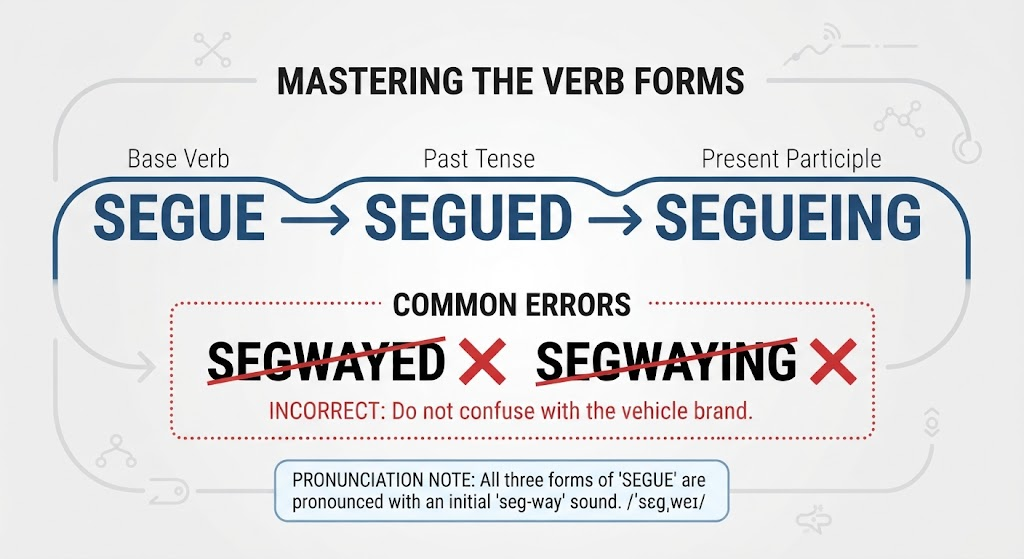
The past tense is segued, not segwayed.
The present participle is segueing, although the spelling may look unusual at first.
“The discussion is segueing into a more technical subject.”
Segway as a Proper Noun
Segway normally refers to the brand or its products.
“The group rented Segway vehicles for the tour.”
“He learned how to ride a Segway during the city tour.”
It does not mean “transition” in standard edited English.
When Should You Use “Segue”?
Use segue when you mean a smooth change or transition.
Common contexts include:
Conversations
“That question is a perfect segue into what happened next.”
“We somehow segued from weekend plans into a discussion about careers.”
Presentations
“Now I’ll segue into the second part of the presentation.”
“The final slide provides a natural segue into the recommendations.”
Writing
“The final paragraph creates a segue into the next section.”
Although transition is often clearer in formal writing, segue is perfectly legitimate.
Music and Performance
The word has a particularly strong historical connection with music.
“The pianist segued directly into the next movement.”
“The performance used a seamless segue between the two songs.”
The original musical sense involved continuing into what follows without a break.
How Do You Spell “Segway” as in Transition?
If you mean transition, spell it:
segue
Not:
segway
Not:
segwey
Not:
segwe
Not:
seguay
Not:
segueway
The correct spelling can look surprising because the pronunciation is straightforward:
segue → “SEG-way”
This is one of those English spelling patterns where pronunciation does not transparently reveal the spelling.
“Segwayed” vs. “Segued”
This is one of the most common mistakes associated with the word.
If you mean “transitioned smoothly,” use:
segued
Correct:
“The discussion segued into a debate about technology.”
Incorrect in standard edited English:
“The discussion segwayed into a debate about technology.”
The mistake happens because people hear segue as “seg-way.” They then naturally create the apparent past tense segwayed. But the spelling of the verb is based on segue, so its past tense is segued.
What About “Segwaying”?
For the same reason, the standard form is:
segueing
“The conversation is segueing toward a completely different issue.”
Not:
“The conversation is segwaying toward a completely different issue.”
If you want to avoid the visually unusual form segueing, simply use transitioning:
“The conversation is transitioning toward a completely different issue.”
That may also be preferable in highly formal writing.
“Segue Into” Meaning
Segue into means to move smoothly from one subject, activity, or idea into another.
For example:
“The host segued into a discussion of the new policy.”
Here, segues into means transitions smoothly into.
The construction is especially common with topics:
- segue into a conversation
- segue into a discussion
- segue into a new topic
- segue into the next section
- segue into another subject
- segue into an explanation
Is “Segway Into Something” Correct?
If you mean “transition into something,” the standard spelling is:
segue into something
For example:
“The article segues into a discussion of workplace communication.”
Not:
“The article segways into a discussion of workplace communication.”
The second spelling incorrectly substitutes the transportation brand for the transition word.
“Segue in a Sentence”: Natural Examples
Here are several ways to use segue naturally.
As a noun
“That story was a great segue into the main topic.”
“The question provided a natural segue into the next discussion.”
“There was no obvious segue between the two sections.”
As a verb
“She smoothly segued into a discussion of her research.”
“The conversation segued from travel to food.”
“The presenter segued from the problem to the proposed solution.”
With “into”
“He used the example to segue into his main argument.”
“The interview segued into a conversation about family.”
With “from … to …”
“The lecture segued from basic concepts to advanced applications.”
This from … to … structure is particularly useful because it makes the two ends of the transition explicit.
“Segway Conversation” vs. “Segue Conversation”
If someone searches for “segway conversation” or “segway conversation definition,” they are usually asking about a conversational transition.
The standard expression is therefore segue, not Segway.
For example:
“That question was a nice segue into a deeper conversation.”
The phrase “a nice segue” means a smooth or convenient transition.
You can also say:
“That was a great segue.”
This means that something just said created a useful or natural transition to another subject.
“A Nice Segway” Is Usually a Spelling Error
If someone writes:
“That was a nice segway.”
when they mean “That was a nice transition,” they almost certainly intend:
“That was a nice segue.”
The transportation brand is not what they mean.
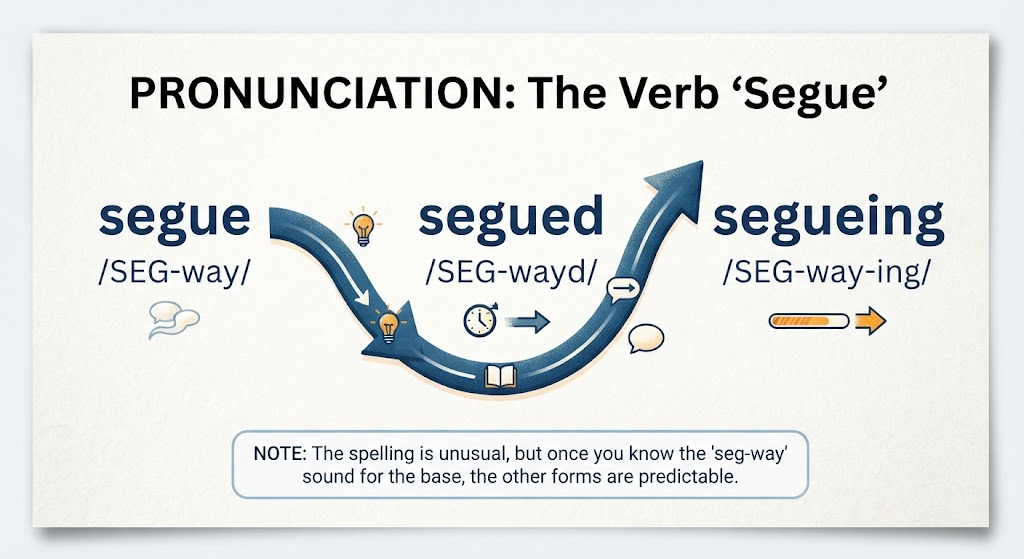
Segue Pronunciation
Segue is generally pronounced:
/ˈsɛɡ.weɪ/
An easy approximation for English speakers is:
SEG-way
That is exactly why the word gets confused with Segway.
The pronunciation does not provide a useful distinction between the two. Spelling and context do.
How Do You Pronounce “Segue”?
Say it like:
SEG + way
Not:
- “seg-yoo”
- “see-gue”
- “seh-goo”
- “seg”
- “sway”
The final sound is the same general “way” sound heard in way.
How Do You Pronounce “Segued”?
Segued is pronounced approximately:
“SEG-wayd”
For example:
“The speaker segued into another subject.”
The spelling looks much stranger than the pronunciation.
Common Mistakes With Segue and Segway
Mistake 1: Using “segway” for a transition
Incorrect:
“Let’s segway into the next topic.”
Correct:
“Let’s segue into the next topic.”
Mistake 2: Writing “segwayed”
Incorrect:
“She segwayed into another question.”
Correct:
“She segued into another question.”
Mistake 3: Writing “segwaying”
Incorrect:
“The conversation is segwaying into politics.”
Correct:
“The conversation is segueing into politics.”
Mistake 4: Assuming “segue” is pronounced as it looks
A reader unfamiliar with the word might try to pronounce it from the spelling. But English has many words whose spelling does not directly reveal their pronunciation.
Remember:
segue = SEG-way
Mistake 5: Treating “segue” as exclusively a noun
Segue is both a noun and a verb.
Noun:
“That was a smooth segue.”
Verb:
“The discussion segued into another subject.”
Mistake 6: Capitalizing “segue”
Unlike the brand name Segway, the ordinary English word segue is normally lowercase.
Correct:
“The segue was effective.”
Not:
“The Segue was effective.”
unless the capitalization is required for some unrelated reason.
Is “Segway” a Verb?
This requires a little nuance.
Segway is primarily a trademarked brand name, not the standard English verb for “transition.” In informal writing, people sometimes create forms such as segwayed, segwaying, or segways when they mean segued, segueing, or segues.
You may encounter those forms online because the spelling confusion is widespread. That does not make them the preferred forms in careful edited English.
If your intended meaning is “transition,” use the established verb:
segue
“The conversation segued into another topic.”
For professional, academic, educational, or published writing, this distinction is especially important.
“Segway” vs. “Segue” in Formal and Casual Writing
In formal writing, the distinction should be maintained carefully.
Formal
“The report then segues into an analysis of the financial data.”
Neutral
“The discussion segues into the next topic.”
Casual
“That’s a good segue into what I wanted to ask.”
All three use segue correctly.
However, in very technical or highly formal prose, transition, move, shift, or proceed may sometimes be clearer:
“The report then transitions to an analysis of the financial data.”
That does not mean segue is incorrect. It simply means that style and audience matter.
British vs. American English
There is no major British-American spelling distinction between segue and Segway.
Both varieties of English use:
- segue for a transition
- Segway for the brand
The pronunciation and spelling confusion can occur on either side of the Atlantic.
What can vary is frequency and style preference. Some writers may prefer transition in formal prose because it is more direct and less conversational. Others use segue comfortably in essays, presentations, journalism, and everyday speech.
The core distinction remains the same.
Is “Segue” Slang?
No. Segue is not slang.
It is a standard English word used as both a noun and verb.
You may see searches for:
- segway slang meaning
- meaning of segway slang
- segway in conversation definition
- segway meaning in English
But when the intended meaning is “a smooth transition,” the standard word is segue, not Segway.
For example:
“That is a natural segue into the next subject.”
This is ordinary standard English, although it can have a somewhat conversational tone depending on context.
What Is Another Word for “Segue”?
Depending on context, possible alternatives include:
- transition
- shift
- move
- progression
- connection
- bridge
- passage
- changeover
- transition smoothly
- move smoothly into
But these are not always exact substitutes.
For example:
“The speaker segued into the next subject.”
can become:
“The speaker transitioned into the next subject.”
The second version is often more straightforward, while segue emphasizes the smoothness or continuity of the movement.
Segue vs. Transition
The distinction is subtle.
Transition is the broader and more general term.
Segue often suggests that one thing flows naturally into another.
Compare:
“The presentation transitions to the results.”
This simply tells us that the presentation moves to another section.
“The presentation segues into the results.”
This suggests a smoother connection between the preceding material and the results.
That distinction is useful when choosing between the words in polished writing.
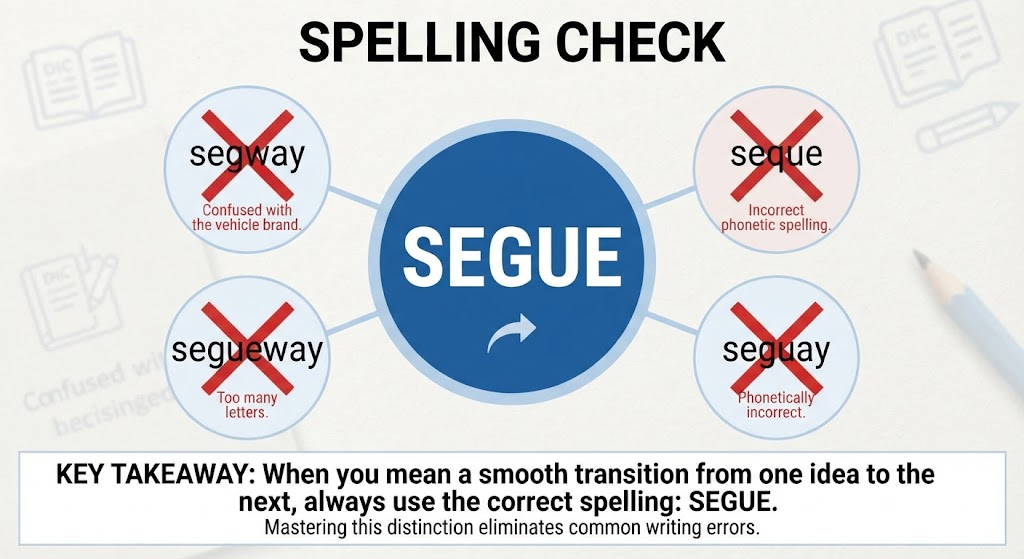
“Seque,” “Segueway,” “Seguay,” and Other Spellings
Several incorrect or nonstandard spellings appear because people hear the word rather than seeing it.
Common misspellings include:
- seque
- segueway
- segue way
- seguay
- segwe
- swgue
- sequeway
- sagway
If you mean a smooth transition, the standard spelling is:
segue
The spelling seque is not the normal spelling of the English transition word.
Likewise, segueway is not the standard form.
A Fast Decision Rule
When deciding between segue and Segway, use this test:
Are you talking about a transition?
Use segue.
“She segued into another topic.”
Are you talking about the transportation brand?
Use Segway.
“They toured the city on a Segway.”
Are you still unsure?
Replace the word with transition.
If the sentence still makes sense, you almost certainly need segue.
For example:
“She segwayed into the topic.”
Replace segwayed with transitioned:
“She transitioned into the topic.”
That tells you the intended word is segued.
The Practical Proofreading Test
Here is a particularly reliable proofreading method.
Step 1: Identify the meaning
Ask:
Am I describing movement between ideas, topics, activities, or sections?
If yes, choose segue.
Step 2: Check the grammatical form
If it is a noun:
“a smooth segue”
If it is a verb:
“she segues”
Past tense:
“she segued”
Present participle:
“she is segueing”
Step 3: Check capitalization
If it means the transition, write:
segue
If it refers to the brand, write:
Segway
Step 4: Read the sentence aloud
Both words sound essentially alike, so pronunciation alone cannot solve the problem.
Instead, focus on meaning.
Transition = segue.
Transportation brand = Segway.
Memory Trick: “Segue Keeps Ideas Moving”
A simple way to remember the spelling is:
SEGUE = a smooth movement from one idea to the next.
Think:
Segue = ideas go
Meanwhile:
Segway = a way to go
The second phrase is only a memory aid, not the actual etymology of the brand. The brand name was chosen for its resemblance to segue and its association with smooth movement; way may have influenced the naming.
Another useful trick:
If you can replace it with “transition,” use SEGUE.
That single substitution test handles most cases.
Frequently Asked Questions
What does segue mean?
Segue means a smooth transition from one subject, idea, activity, musical passage, or section to another.
What does Segway mean?
Segway is a brand name associated with self-balancing personal transportation products. It is not the standard spelling of the word meaning “transition.”
Is it “segue or Segway” for a conversation?
Use segue.
“That was a natural segue into a deeper conversation.”
How do you spell Segway as in transition?
You spell it segue when you mean a transition.
Is “segwayed” correct?
Not when you mean “transitioned.” The standard past tense of segue is segued.
Is “segueing” correct?
Yes. Segueing is the standard present participle of segue.
“The conversation is segueing into another topic.”
What is the correct “segue in a sentence” usage?
You can use it as either a noun or verb:
“That was a smooth segue into the next topic.”
or:
“The speaker segued into the next topic.”
What is the definition of segue?
A segue is a smooth transition or continuation from one thing to another; as a verb, segue means to make such a transition.
How do you pronounce segue?
It is pronounced approximately “SEG-way.”
Is segue a French word?
No. It comes from Italian, where segue was used as a musical instruction meaning roughly “now follows.”
What is the difference between segue and segueing?
Segue can be the noun or base verb. Segueing is its present participle.
“The segue was smooth.”
“The conversation is segueing into another subject.”
What does “segue into” mean?
Segue into means to transition smoothly into another subject, activity, idea, or section.
“The speaker segued into the final part of the presentation.”
What is the meaning of “a great segue”?
“A great segue” means a very effective or natural transition.
“That question was a great segue into the main issue.”
Is “segway” ever correct?
Yes, when referring to Segway, the transportation brand. It is not the standard word for a conversational or conceptual transition. Segway is a registered trademark.
Relevant Internal-Link Suggestions
For a broader English word-choice and usage section, useful internal links could include:
- [Weather vs. Whether vs. Wether] — another commonly confused set of English words
- [Choose vs. Chose] — understanding verb tense and spelling
- [Fiancé vs. Fiancée] — distinguishing similar-looking borrowed words
- [Full-Time vs. Full Time] — compound-word spelling and grammar
- [Cannot vs. Can Not] — understanding standard English usage
- [Of Course: Meaning and Correct Usage] — everyday expression and register
- [Your Sincerely vs. Yours Sincerely] — common writing and email mistakes
Final Takeaway
The answer to “segway or segue?” depends entirely on what you mean.
If you mean a smooth transition between ideas, topics, conversations, activities, or sections, the correct word is segue.
“The conversation segued into a discussion of the new project.”
If you mean the personal transportation brand, use Segway.
“They explored the city on a Segway.”
The most important forms to remember are:
- segue = transition
- segues = transitions
- segued = transitioned
- segueing = transitioning
- Segway = transportation brand
So when you are tempted to write “segwayed into a conversation,” stop and apply the simple test:
Could I replace this word with “transitioned”?
If yes, write “segued.”
That distinction will solve virtually every ordinary segue vs. Segway spelling problem.