Bear With Me or Bare With Me? The Correct Spelling and Meaning
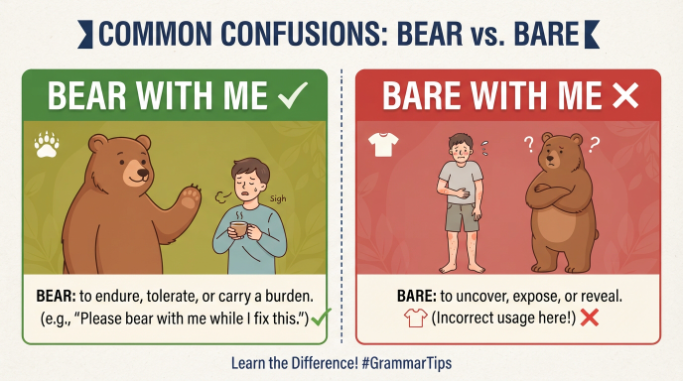
If you are asking someone to be patient, the correct phrase is “bear with me.” “Bare with me” is usually a spelling mistake in this context.
Please bear with me while I check the details. ✓
Here, bear means to tolerate, endure, or be patient with something. Bare, on the other hand, means uncovered or exposed, or it can mean to uncover or reveal something. The two words sound alike in standard English, which is why this mistake is so common.
At-a-Glance: Bear With Me vs. Bare With Me
| Expression | Meaning | Correct for asking for patience? | Example |
|---|---|---|---|
| bear with me | Be patient with me | Yes | Please bear with me while I finish. |
| bear with us | Be patient with us | Yes | Please bear with us during the delay. |
| bare with me | Uncover/expose with me | No, not for this meaning | This is normally a mistaken spelling. |
| bare | Uncovered; or uncover/expose | No | The room had bare walls. |
| bearing with me | Being patient with me | Yes | Thank you for bearing with me. |
| baring | Uncovering or revealing | No | She was baring her feelings. |
What Does “Bear With Me” Mean?
Bear with me means “please be patient with me.”
You use it when you need someone to wait, tolerate a temporary inconvenience, listen to an explanation, or give you additional time.
For example:
Please bear with me while I find the document.
This means:
Please be patient with me while I find the document.
You could also say:
Bear with me for another minute.
Please bear with me while I explain this.
Bear with me here; there is an important point I need to clarify.
The expression is natural in both everyday conversation and professional communication.
Why Is “Bear” Correct?
The verb bear has several meanings. One of them is to endure, tolerate, or deal with something difficult.
That meaning is the basis of bear with.
When you say:
Please bear with me.
you are essentially asking the other person to tolerate the delay or situation patiently.
The phrase is therefore connected to the verb bear, not to bare.

What Does “Bare With Me” Mean?
When someone writes “bare with me” intending to say “please be patient with me,” the spelling is incorrect.
The word bare is a real English word, but it has a different meaning.
As an adjective, bare can mean uncovered or without the usual covering:
He walked across the floor with bare feet.
The room had bare walls.
The shelves were almost bare.
As a verb, bare means to uncover or expose something:
The dog bared its teeth.
She bared her arms.
He eventually bared his feelings.
None of these meanings gives bare with me the conventional meaning “please be patient with me.”
So if your intended meaning is patience, use bear.
Why Do People Confuse Bear and Bare?
The main reason is pronunciation.
Bear and bare are homophones in standard varieties of English. They have the same or essentially the same pronunciation but different spellings and meanings.
This means that someone can hear:
“Please bear with me.”
and later remember the sound without knowing which spelling was used.
The same kind of problem occurs with other English homophones:
- their / there
- your / you’re
- to / too
- right / write
- sale / sail
Because spellcheckers recognize bare as a legitimate English word, a sentence such as:
Please bare with me.
may not be flagged as a simple spelling error. Context is required to identify the problem.
Bear With Me or Bare With Me?
The easiest way to decide is to ask what you mean.
If you mean:
- be patient
- wait for me
- give me a moment
- tolerate the delay
- let me finish explaining
use:
bear with me
If you mean:
- uncover
- expose
- reveal
then bare may be the appropriate word.
For example:
Please bear with me while I check the figures.
versus:
The investigation may bare details that were previously hidden.
The words are pronounced alike, but they do completely different jobs.
Please Bear With Me
Please bear with me is the standard expression.
It is especially useful when you need additional time.
Please bear with me while I look into this issue.
Please bear with me for a moment.
Please bear with me while I prepare the report.
Please bear with me as I explain the process.
It can also soften an explanation that might otherwise feel complicated.
Please bear with me while I explain why these two examples are different.
The expression does not necessarily imply that something has gone wrong. Sometimes it simply tells the listener that the speaker needs a little time.
Please Bear With Us
When speaking on behalf of a company, organization, website, or group, use bear with us.
Please bear with us while we update the website.
Please bear with us as we make these changes.
We appreciate your patience and ask you to bear with us during the transition.
The meaning is:
Please be patient with us.
The same rule applies:
Please bear with us. ✓
Please bare with us. ✗

Bear With Me Here
The expression bear with me here is also correct.
It is particularly common in explanations and conversations.
Bear with me here; the answer becomes clearer in the next step.
Bear with me here while I explain the background.
Bear with me here because this part is slightly complicated.
The word here adds conversational emphasis. It does not change the meaning of bear with me.
Bearing With Me or Baring With Me?
When the phrase changes into a form ending in -ing, the correct form is:
bearing with me
not:
baring with me
For example:
Thank you for bearing with me.
This means:
Thank you for being patient with me.
Bearing is the present participle of bear.
By contrast, baring comes from bare and means uncovering or exposing.
Compare:
Thank you for bearing with me during the delay.
She was baring her feelings during the conversation.
These are completely different meanings.
| Word | Base word | Meaning |
|---|---|---|
| bearing | bear | enduring or tolerating |
| baring | bare | uncovering or revealing |
Common Mistakes
“Please bare with me”
Incorrect when you mean “please be patient.”
Correct:
Please bear with me while I check.
“Please bare with us”
Incorrect when asking customers or readers to be patient.
Correct:
Please bear with us while we resolve the issue.
“Thanks for baring with me”
Incorrect when thanking someone for their patience.
Correct:
Thanks for bearing with me.
“Thank you for bare with me”
This construction is incorrect for two reasons.
After thank you for, use the -ing form:
Thank you for bearing with me.
Not:
Thank you for bear with me.
and not:
Thank you for bare with me.
“Bear me with”
This is also not the standard construction.
The established expression is:
bear with me
The preposition with is part of the expression.
Examples by Context
In a Work Email
Please bear with me while I review the information.
Kindly bear with me while I confirm the final details.
Thank you for bearing with me while I worked through the issue.
During a Meeting
Please bear with me while I pull up the presentation.
Bear with me for a moment while I find the relevant slide.
Bear with me here; I want to clarify one important point.
In Customer Service
Please bear with us while we investigate the issue.
We appreciate your patience and ask you to bear with us during the update.
Thank you for bearing with us while we work to restore service.
In Teaching
Please bear with me while I explain this example.
Bear with me while we work through the calculation.
Bear with me here because the distinction is easier to understand with an example.
In Casual Conversation
Just bear with me for a second.
Bear with me; I’m almost finished.
Bear with me here—I think I know what happened.
Is “Bear With Me” Formal or Casual?
Bear with me works across several levels of formality.
It is perfectly acceptable in professional writing:
Please bear with me while I review your request.
It is also natural in casual conversation:
Bear with me for a second.
For particularly formal communication, you can use alternatives such as:
Thank you for your patience while I review the matter.
Please allow me a moment to verify the information.
I appreciate your patience while we complete the necessary checks.
These alternatives are not more “correct” than bear with me. They simply have a different tone.
Is “Kindly Bear With Me” Correct?
Yes.
Kindly bear with me while I complete the review.
Kindly makes the request more explicitly polite.
However, please bear with me often sounds more natural in modern everyday professional English.
Compare:
Please bear with me while I check the information.
Kindly bear with me while I check the information.
Both are grammatically correct.
Is “Thank You for Bearing With Me” Correct?
Yes.
This is a very common and natural expression.
Thank you for bearing with me while I sorted everything out.
Thank you for bearing with me during the delay.
I appreciate you bearing with me while we worked through the problem.
The grammar is straightforward:
thank you for + -ing form
Therefore:
Thank you for bearing with me.
not:
Thank you for bare with me.
and not:
Thank you for bear with me.
British English vs. American English
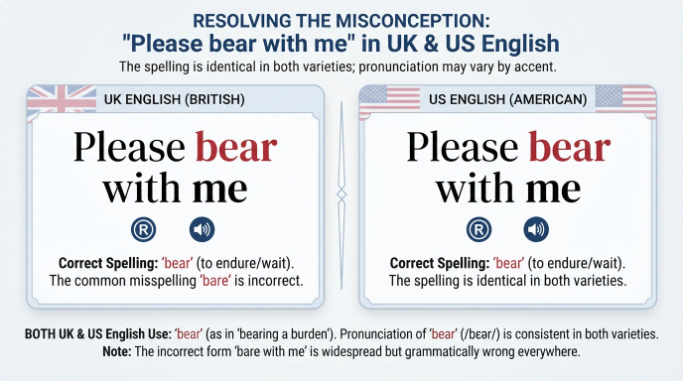
There is no difference in spelling between British and American English here.
British English:
Please bear with me.
American English:
Please bear with me.
The phrase has the same basic meaning in both varieties.
Pronunciation can vary by accent, but bear and bare remain a homophone pair in standard British and American pronunciation.
Therefore, if you are searching for “bear with me or bare with me UK,” the answer is still bear with me.
Writing for a British audience does not make bare with me correct.
Pronunciation of Bear and Bare
In standard English, bear and bare are pronounced alike.
This is precisely why the written distinction can be difficult.
The spelling must therefore be learned through meaning and context rather than sound alone.
A useful pronunciation reminder is:
bear = bare
in sound, but:
bear ≠ bare
in meaning.
This is a spelling issue, not a pronunciation distinction.
The Origin of “Bear With Me”
The expression comes from the older verb sense of bear meaning to endure, tolerate, or sustain.
It is therefore related to other uses of bear that involve carrying or enduring something:
bear a burden
bear the pain
bear the responsibility
bear the consequences
In bear with me, the sense is one of patiently tolerating a situation.
The expression has been used in English for centuries and is not a recent phrase created by modern business communication.
The important point for modern writers is that its meaning comes from bear = endure/tolerate, not from bare = uncover.
A Simple Memory Trick
Use this rule:
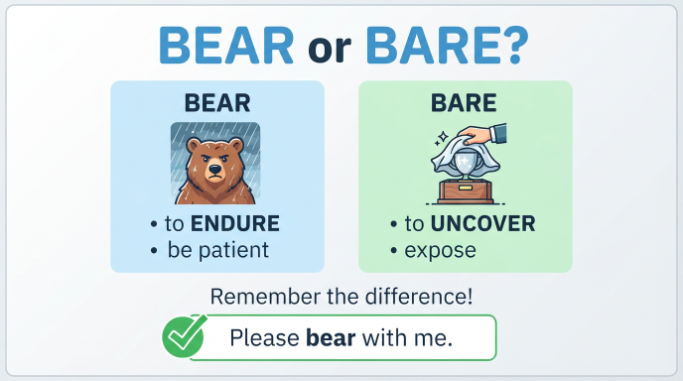
BEAR = ENDURE
BARE = UNCOVER
If someone needs to endure your delay, you ask them to:
bear with me
If something is uncovered, it can be:
bare
You can also use the replacement test.
Take:
Please bear with me while I finish.
Replace bear with me with:
Please be patient with me.
The sentence still means exactly what you intended.
That tells you that bear is the correct word.
The Three-Second Proofreading Test
Before publishing an email, article, notice, or message, ask:
Am I asking someone to be patient?
If yes:
bear with me
Am I asking someone to uncover or expose something?
If yes:
bare
Then check the grammatical form.
| Intended meaning | Correct form |
|---|---|
| Ask for patience | bear with me |
| Ask a group for patience | bear with us |
| Thank someone for patience | bearing with me |
| Uncover something | bare |
| Previously uncovered | bared |
| Currently uncovering | baring |
This test is more reliable than relying on spellcheck because both bear and bare are legitimate English words.
FAQs
Is it bear with me or bare with me?
It is bear with me when you mean “please be patient with me.”
How do you spell bear with me?
The correct spelling is:
B-E-A-R: bear with me
What does bear with me mean?
It means please be patient with me, especially while someone waits, explains something, or deals with a temporary problem.
What does bare with me mean?
It is normally an incorrect spelling when the intended meaning is “please be patient with me.” Bare relates to being uncovered or exposing something.
Is “please bear with me” correct?
Yes. Please bear with me is standard English.
Is “please bare with me” correct?
No, not when asking someone to be patient. Use please bear with me.
Is “please bear with us” correct?
Yes. It means please be patient with us.
Is “bare with us” correct?
Not when you mean asking a group to be patient. The correct expression is bear with us.
Is “bearing with me” correct?
Yes.
Thank you for bearing with me.
It means “thank you for being patient with me.”
Is “baring with me” correct?
Not when you mean patience. Baring means uncovering or revealing.
Is “bear with me here” correct?
Yes. It is a natural way to ask someone to be patient while you explain something.
Is “kindly bear with me” correct?
Yes. It is grammatical and polite.
Is “bear with me” used in the UK?
Yes. Bear with me is standard in British English as well as American English.
Why do people say “bare with me”?
Because bear and bare sound alike. This makes the error particularly easy to make, especially when someone has learned the phrase primarily through speech.
What is the difference between bear and bare?
Bear can mean endure, tolerate, or carry. Bare means uncovered or can mean uncover or expose.
What is the difference between bearing and baring?
Bearing comes from bear and can mean enduring or tolerating. Baring comes from bare and means uncovering or revealing.
Final Takeaway
When you want to ask someone to be patient, wait, tolerate a delay, or listen while you explain something, use:
Please bear with me.
When speaking for a group, use:
Please bear with us.
When thanking someone afterward, use:
Thank you for bearing with me.
Remember the core distinction:
Bear = endure or tolerate.
Bare = uncover or expose.
So the correct spelling is:
Bear with me. ✓
Not:
Bare with me. ✗
The confusion exists because the two words sound alike, but they are not interchangeable in writing. If you can replace the expression with “be patient with me,” you should choose bear.