
Is It Correct to Say “Thank You All”?
Quick Answer
Yes. “Thank you all” is completely correct and natural English. It is a standard way to thank a group of people directly.
For example:
- Thank you all for coming.
- Thank you all for your support.
- Thank you all for helping me.
- Thank you all so much!
Here, you all means all of you. The word all emphasizes that the speaker is addressing every person in the group.
The expression is especially common in speeches, meetings, social-media posts, emails, classrooms, presentations, and group conversations.
There is also an important distinction between “thank you all” and “thank you to all.” The first directly addresses the people being thanked:
Thank you all for your support.
The second normally introduces the people as the recipients of thanks in a more formal construction:
Thank you to all the volunteers who helped.
Both can be grammatical, but they are structured differently.

Rule in Plain English
The simplest rule is:
Use “thank you all” when you are speaking directly to a group of people and want to thank every person in that group.
The structure is:
thank you + all
Here, thank you is the conventional expression of gratitude, while all adds emphasis to the group being addressed.
Compare:
| Expression | Meaning | Natural? |
|---|---|---|
| Thank you. | I am thanking you. | Yes |
| Thank you all. | I am thanking everyone in the group. | Yes |
| Thank you everyone. | I am thanking everyone. | Yes |
| Thank you all of you. | I am thanking every one of you. | Yes, but emphatic |
| Thank you to all of you. | Thanks are directed to everyone in the group. | Yes |
| Thanks all. | Thanks, everyone. | Yes, informal |
| Thanks you all. | Intended as “thank you all.” | Incorrect |
The crucial point is that all does not make thank you grammatically incorrect. It simply specifies or emphasizes the group being addressed.
“Thank you all” vs. “thank you everyone”
Both are correct:
Thank you all for being here.
Thank you everyone for being here.
The difference is mainly one of style and emphasis.
Thank you all sounds especially natural when the speaker is clearly addressing a group. Thank you everyone is also very common and can sound slightly more explicit.
In most situations, either is an excellent choice.
Core Grammar Explanation
What kind of expression is “thank you”?
Historically, thank you comes from a fuller construction meaning something like “I thank you.” In modern English, however, thank you functions as a conventional expression of gratitude.
That means speakers do not normally analyze it in everyday conversation as though they were constructing a completely ordinary sentence from scratch.
You can still see the underlying verb in sentences such as:
I thank you for your patience.
But in ordinary communication, we usually say:
Thank you for your patience.
When all is added:
Thank you all for your patience.
the word all identifies the whole group being addressed.
Why “you all” is grammatical
English uses you for both singular and plural reference.
That can sometimes create ambiguity.
For example:
Thank you for helping me.
This could be addressed to one person or several people.
Adding all makes the plural meaning unmistakable:
Thank you all for helping me.
The phrase you all therefore functions as a plural form of address.
In many varieties of English, speakers also use you all in ordinary sentences:
Are you all ready?
Did you all enjoy the presentation?
I hope you all have a wonderful evening.
The construction is particularly widespread in American English, where y’all is also an established informal form in many varieties. But you all is not limited to American English.
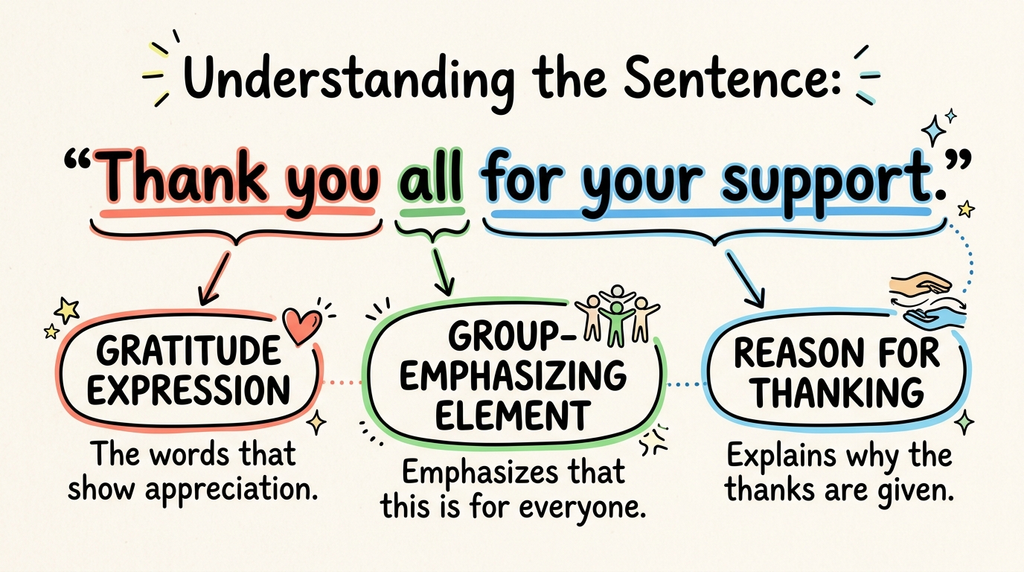
A simple sentence structure
You can think of the basic pattern like this:
[Thank you] + [all] + [reason/context]
For example:
Thank you → expression of gratitude
all → identifies the whole group
for your support → explains what the group is being thanked for
So:
Thank you all for your support.
can be understood structurally as:
Thank you
↓
all = every person being addressed
↓
for your support = reason for the thanks
Examples of Correct Usage
“Thank you all” by itself
You can use thank you all as a complete expression:
Thank you all!
This is perfectly natural after a presentation, celebration, event, speech, or group discussion.
“Thank you all for…”
This is probably the most useful pattern.
Thank you all for coming.
Thank you all for your patience.
Thank you all for the kind messages.
Thank you all for your support.
Thank you all for helping us reach our goal.
Thank you all for making today so special.
The preposition for introduces the reason for the gratitude.
“Thank you all so much”
This is also natural:
Thank you all so much for your support.
The phrase so much intensifies the gratitude.
You can also say:
Thank you all very much.
This is slightly more formal or restrained than thank you all so much, although both are common.
“Thank you all of you”
This is grammatical but more emphatic:
Thank you, all of you, for being here.
The commas can matter because all of you is functioning as a direct-address element.
In ordinary situations, however, thank you all is usually smoother:
Thank you all for being here.
“Thank you everyone”
This is another standard option:
Thank you everyone for your help.
Thank you everyone for coming.
Thank you everyone for the wonderful wishes.
It is not necessary to add all:
Thank you everyone all for coming. ❌
That combination is normally awkward because everyone already expresses the complete group.
“Thanks All” and Other Short Forms
Is “thanks all” correct?
Yes, “thanks all” can be correct, especially in informal communication.
For example:
Thanks all for your help!
Thanks all — really appreciate it.
It is particularly common in online discussions, group chats, emails, and quick messages.
However, thank you all is more complete and works comfortably across both formal and informal settings.
Compare:
| Expression | Register | Example |
|---|---|---|
| Thank you all. | Neutral | Thank you all for coming. |
| Thanks all. | Informal | Thanks all for the help! |
| Thank you everyone. | Neutral | Thank you everyone for your support. |
| Thanks, everyone. | Informal/neutral | Thanks, everyone, for coming. |
| Many thanks to everyone. | Polished/formal | Many thanks to everyone who contributed. |
Is “thanks you all” correct?
No.
Thanks you all. ❌
The problem is that thanks and thank you are different constructions.
You can say:
Thanks, everyone. ✅
or:
Thank you all. ✅
but not normally:
Thanks you all. ❌
What about “thank all you”?
This is also generally incorrect:
Thank all you. ❌
The standard direct expression is:
Thank you all. ✅
If you are using the verb thank in a full sentence, however, all can occur elsewhere:
I want to thank all of you. ✅
That is a different grammatical structure.
“Thank You All” vs. “Thank You Everyone”
Both are correct, so the choice usually depends on style rather than grammar.
Thank you all
Thank you all for attending today’s meeting.
This sounds warm, direct, and natural.
Thank you everyone
Thank you everyone for attending today’s meeting.
This is equally grammatical and perhaps slightly more explicit for some speakers.
Thank you, everyone
With punctuation in writing, you will often see:
Thank you, everyone.
The comma reflects direct address: the speaker is saying “everyone” directly to the people present.
The same principle applies to:
Thanks, everyone.
Good morning, everyone.
Congratulations, everyone.
In informal digital writing, punctuation is sometimes omitted:
Thank you everyone!
This is extremely common and should not automatically be treated as an error. In carefully edited prose, however, the comma can make the direct-address structure clearer.

“Thank You All” vs. “Thank You to All”
This distinction causes considerable confusion.
Thank you all
Thank you all for your help.
This directly addresses the people being thanked.
The implied structure is essentially:
I am expressing thanks to all of you.
Thank you to all
Thank you to all the volunteers who helped.
This construction uses to to introduce the people receiving the thanks.
It is especially common in speeches, announcements, acknowledgments, and written messages.
Compare:
Thank you all for your hard work.
and:
Thank you to all the people who worked behind the scenes.
Both are correct.
The first speaks directly to the group. The second presents the group as the recipients of thanks.
“Thank you to all of you”
This is also possible:
Thank you to all of you who supported us.
It can sound somewhat more formal or deliberate than:
Thank you all for supporting us.
Neither is inherently superior.
“Thanks to All” Has Another Meaning
The phrase thanks to can be confusing because it has two related but distinct uses.
Thanks to = gratitude directed toward someone
Thanks to all the volunteers who helped.
Here, the phrase means approximately:
We are grateful to all the volunteers who helped.
Thanks to = because of
Thanks to can also introduce a cause, sometimes positive and sometimes ironic:
Thanks to your advice, I solved the problem.
This can mean your advice helped cause the successful result.
But:
Thanks to the heavy traffic, we arrived late.
can be sarcastic or can simply mean the traffic caused the delay.
Therefore, “thanks to all” is not always interchangeable with “thank you all.”
Thank you all is a direct expression of gratitude.
Thanks to all introduces the people or circumstances associated with the gratitude or result.
“Thanking You All”
The phrase “thanking you all” can also be correct, but it is not normally a complete sentence by itself.
For example:
I am thanking you all for your support.
Grammatically, thanking is the present participle of thank, and the phrase occurs inside a larger construction.
You may also encounter:
Thanking you all in advance, I look forward to your response.
This is possible in formal correspondence, although it can sound old-fashioned or formulaic. In modern professional English, a clearer alternative is often:
Thank you all in advance. I look forward to your response.
The short version is usually more direct.
“To Thank You All”
To thank you all is also grammatical, but it is an infinitive phrase rather than an expression of gratitude by itself.
For example:
I wanted to thank you all for your help.
Here:
to thank = infinitive
you all = the people receiving the thanks
Another example:
We organized this event to thank you all.
This means the event was organized for the purpose of expressing gratitude to the group.
So to thank you all is not a replacement for thank you all in every context.
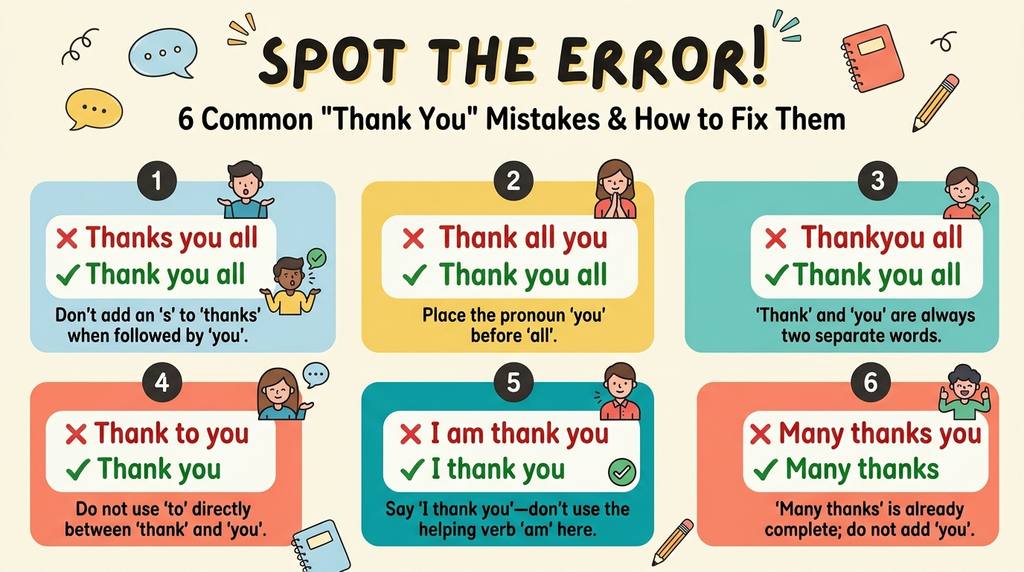
Common Learner Errors
Error: “Thanks you all”
Thanks you all for helping. ❌
Use:
Thank you all for helping. ✅
or:
Thanks, everyone, for helping. ✅
Error: “Thank all you”
Thank all you for coming. ❌
Use:
Thank you all for coming. ✅
or:
Thank all of you for coming. ✅
The second sentence uses all of you, not all you.
Error: “Thank you to all of you” used mechanically everywhere
This phrase is grammatical:
Thank you to all of you for your support.
But it can be unnecessarily wordy when a simpler direct form works:
Thank you all for your support.
Good editing often favors the shorter construction when the meaning is unchanged.
Error: “Thankyou all”
Thankyou all. ❌
In standard English, thank you is written as two words.
The spelling thankyou is not the standard form of the expression.
This remains true even in phrases such as:
Thank you all.
Thank you so much.
Thank you everyone.
Error: “Thank you all of you”
This is not necessarily ungrammatical, but it can sound awkward without punctuation or an appropriate context.
Compare:
Thank you all of you for your help.
with:
Thank you, all of you, for your help.
and:
Thank you all for your help.
The third is generally the most natural.
Error: “Thank you so much all of you”
This can occur in speech, especially with pauses:
Thank you so much, all of you.
But the smoother general-purpose version is:
Thank you all so much.
or:
Thank you so much, everyone.
Minimal Pairs
Minimal pairs are useful because they show how a small change affects grammatical structure or meaning.
| Less suitable / different | Better or intended form | Why |
|---|---|---|
| Thanks you all. | Thank you all. | Standard expression is “thank you.” |
| Thank all you. | Thank you all. | “all” follows “you” here. |
| Thank you all. | Thank you, everyone. | Both are correct; punctuation reflects direct address. |
| Thank you everyone. | Thank you all. | Both are correct. |
| Thank you to all. | Thank you to all the volunteers. | “to all” normally needs an appropriate complement or context. |
| Thank all of you. | I thank all of you. | Full verb construction normally needs a subject. |
| Thankyou all. | Thank you all. | “thank you” is two words. |
| Thanks all. | Thanks, everyone. | Both can be informal; punctuation clarifies direct address. |
Register: Formal, Neutral, and Informal
Neutral
These work almost everywhere:
Thank you all for your support.
Thank you everyone for coming.
Thank you all for your time.
Formal
For formal writing, especially acknowledgments and professional communication, you might use:
I would like to thank you all for your assistance.
We would like to thank everyone who contributed to the project.
Our sincere thanks to all those who supported the initiative.
These forms create more distance and formality.
Informal
In casual conversation:
Thanks, everyone!
Thanks all!
Thanks, guys!
Thanks, y’all!
The last expression is strongly associated with particular varieties and regional styles of English, especially American English. It can be perfectly natural in the right context but is not the best universal choice for formal international communication.
Is “Appreciate Y’all” Correct?
“Appreciate y’all” is common informal English, especially in American speech and online communication.
For example:
Appreciate y’all coming out tonight.
The fuller version is:
I appreciate you all coming out tonight.
In informal speech, English frequently omits the subject I:
Appreciate it.
Appreciate you all being here.
This is conversational rather than formal written English.
For professional international communication, use:
I appreciate you all being here.
or:
Thank you all for being here.
What Does “Thank You All” Mean?
The basic meaning of thank you all is:
I am expressing my gratitude to every person in this group.
It does not necessarily mean that every individual performed the same action.
For example:
Thank you all for the birthday wishes.
The people may have sent different messages at different times, but the speaker is thanking the entire group collectively.
Likewise:
Thank you all for coming.
means the speaker is expressing gratitude to everyone who came.
The word all emphasizes inclusiveness.
“Thank You All” in Different Contexts
Social media
Thank you all for the birthday wishes!
Very natural.
A presentation
Thank you all for your attention.
Natural and professional.
A classroom
Thank you all for participating today.
Natural.
A workplace email
Thank you all for your contributions to the project.
Natural and professional.
A speech
Thank you all for being here tonight.
Very natural.
A group chat
Thanks all for the help!
Natural and informal.
A formal acknowledgment
We would like to thank everyone who contributed to this project.
Often preferable when a more formal tone is required.
A Practical Test You Can Apply
When you are unsure whether “thank you all” is correct, use this simple substitution test.
Test 1: Replace “all” with “everyone”
If the sentence works with everyone, thank you all will usually work too.
Thank you everyone for your support.
Therefore:
Thank you all for your support. ✅
Test 2: Replace “all” with “all of you”
If the intended meaning is “every person in this group,” the construction is probably appropriate.
Thank you all for coming.
≈
Thank you, all of you, for coming.
The second version is more emphatic, but the basic meaning is the same.
Test 3: Ask whether you are directly addressing the group
If you are speaking directly to the people you want to thank, thank you all is usually a strong choice.
Thank you all for joining us today.
If you are talking about the people rather than directly addressing them, another construction may be more suitable:
We would like to thank all the volunteers who helped.
Test 4: Check the spelling
Remember:
thank you ✅
not:
thankyou ❌
Test 5: Check whether “thanks” has accidentally been combined with “thank”
Choose one:
Thanks, everyone. ✅
or:
Thank you all. ✅
Not:
Thanks you all. ❌
Advanced Grammar Notes
Is “all” a pronoun, determiner, or adverb here?
The grammatical analysis can vary depending on the framework being used.
In you all, all can be analyzed as a quantifier or pronoun-like element associated with the plural group represented by you. Traditional grammar may describe it differently from modern syntactic frameworks.
For ordinary learners, the important fact is simpler:
all identifies the entire group represented by you.
The construction behaves naturally as a plural form of address.
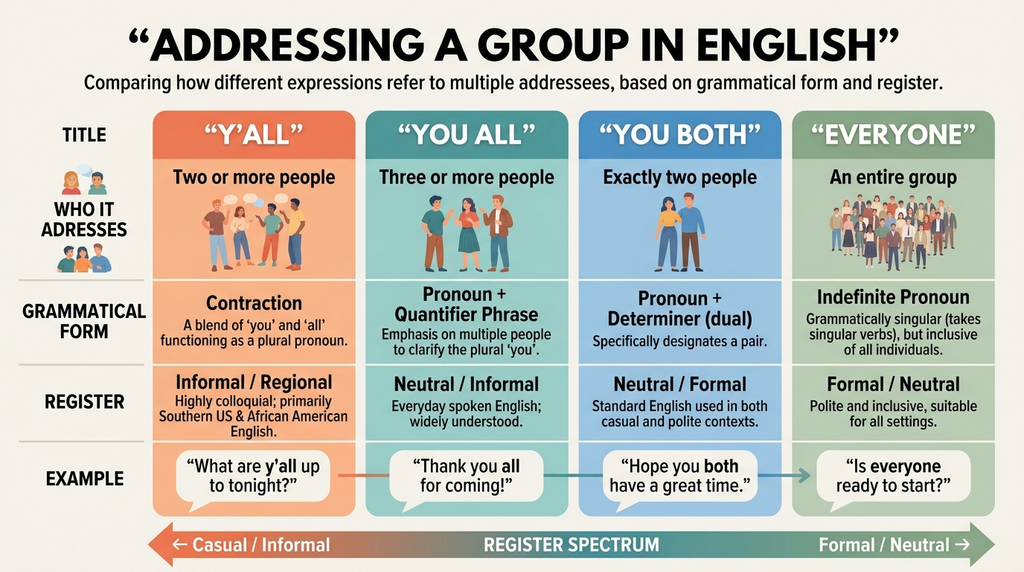
“You all” and “y’all”
You all and y’all can overlap in meaning, but they are not identical in register.
You all did a great job.
is widely understandable and relatively neutral.
Y’all did a great job.
is more strongly associated with informal American English, although its use has expanded considerably through media and online communication.
Importantly, y’all should not be treated simply as an incorrect spelling of you all. It is an established form in varieties of English.
“You all” can be the subject too
The construction is not limited to expressions of thanks.
You all did excellent work.
Are you all ready?
I hope you all enjoyed the event.
In these sentences, you all clearly functions as a plural subject.
Compare:
Thank you all.
Here, you all is associated with the people receiving the gratitude.
The grammatical behavior changes according to the larger construction, but the basic plural meaning remains.
Why “thank you all” sounds so natural
English often places a group-oriented modifier immediately after you:
Thank you both.
Thank you three.
Thank you everyone.
Thank you all.
The construction is therefore part of a broader pattern in English in which the addressee is identified or quantified after you.
Compare:
I appreciate you both.
I appreciate you all.
I appreciate everyone.
This makes thank you all entirely consistent with ordinary English syntax.
FAQs
Is “thank you all” grammatically correct?
Yes. Thank you all is grammatically correct and highly natural. It means that the speaker is thanking everyone in the group being addressed.
Is it better to say “thank you all” or “thank you everyone”?
Neither is universally better. Both are correct. Thank you all is concise and emphasizes the whole group, while thank you everyone explicitly uses everyone to identify the group.
Is “thanks all” correct English?
Yes, particularly in informal communication. Thanks all is a shortened, conversational way of saying thanks, everyone or thank you all.
Can I say “thank you to all”?
Yes, but the construction works differently from thank you all. For example:
Thank you to all the volunteers who helped.
For direct address, thank you all is usually simpler:
Thank you all for helping.
What is the meaning of “thanks to all”?
It can mean that gratitude is being expressed toward a group:
Thanks to all who participated.
But thanks to can also mean because of, depending on context:
Thanks to your advice, we succeeded.
Is “thanking you all” correct?
Yes, but it is normally part of a larger grammatical structure:
I am thanking you all for your help.
It can also appear in formal phrases such as thanking you all in advance, although more direct modern wording is often preferable.
Is “thank you all of you” correct?
It can be grammatical, but it is often more emphatic than necessary. In most contexts, thank you all is more natural. If you want strong emphasis, Thank you, all of you, for your help is possible.
Is “thank you so much all of you” correct?
It can work with appropriate punctuation and speech rhythm:
Thank you so much, all of you.
But the more natural alternatives are:
Thank you all so much.
or:
Thank you so much, everyone.
Is “thank all you” correct?
No, not in the intended construction. Say thank you all or thank all of you.
Is “thank you all” formal or informal?
It is neutral and flexible. It can be used in casual conversation, professional communication, speeches, presentations, and public messages. More formal alternatives include I would like to thank you all and We would like to thank everyone who contributed.
Is “thank you all” better than “thanks everyone”?
Both are correct. Thank you all is somewhat fuller and can work more comfortably in formal contexts. Thanks, everyone is common in casual or semi-formal communication.
Is “thankyou all” one word?
No. The standard spelling is thank you all, with thank and you as separate words.
What is the correct spelling: “tahnk you all” or “thank you all”?
Thank you all is correct. Tahnk is simply a spelling error.
If You Remember One Rule
“Thank you all” is correct whenever you are directly thanking a whole group of people.
Think of it this way:
Thank you all = Thank you, every one of you.
Use these forms confidently:
- Thank you all. ✅
- Thank you all for your support. ✅
- Thank you everyone. ✅
- Thank you, everyone. ✅
- Thanks, everyone. ✅
- Thanks all. ✅ Informal
- Thank all of you. ✅ Usually with a subject, such as “I want to thank all of you.”
- Thanks you all. ❌
- Thank all you. ❌
- Thankyou all. ❌
The important distinction is not whether all can follow thank you—it absolutely can. The real question is which grammatical construction you are using and whether you are addressing the group directly or referring to the people being thanked.

Summary
Thank you all is standard, grammatical, and natural English. It is especially useful when you want to thank every person in a group directly.
The main alternatives are also useful, but they serve slightly different purposes:
- Thank you all — direct, natural, neutral.
- Thank you everyone — direct and explicit.
- Thank you, everyone — direct address with punctuation.
- Thanks, everyone — common and informal.
- Thanks all — short and informal.
- Thank all of you — grammatical within a full verb construction.
- Thank you to all the volunteers — introduces the group receiving the thanks.
- Thanks to all — can express gratitude, while thanks to can also mean “because of.”
If you are simply standing in front of a group and want to express your gratitude, “Thank you all” is an excellent choice.