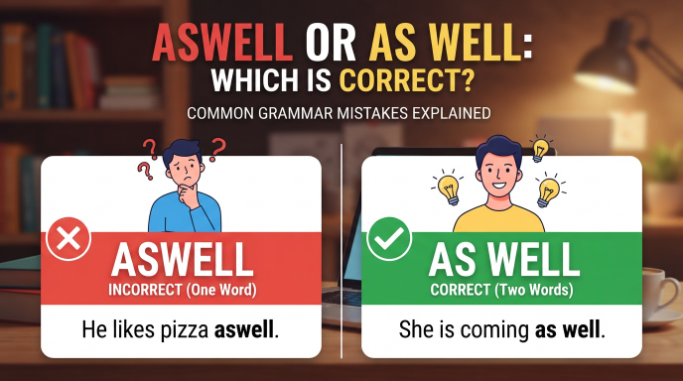
Aswell or As Well: Which Is Correct?
Quick Answer
As well is the correct spelling in standard English. It is written as two separate words.
Aswell is not the standard spelling of the phrase and should generally be treated as a spelling error. This is true in both British English and American English.
Use as well when you mean “also,” “too,” or “in addition.”
- I want to come as well.
- She speaks Spanish as well.
- You can bring your friend as well.
There is one important distinction to remember: as well as is also written as separate words. It can mean “in addition to” or introduce a second item in a comparison or construction.
- She plays tennis as well as swimming.
- As well as the report, he submitted the supporting documents.
So, if you are wondering “is aswell one word?”, the answer is no in standard English. If you are wondering “is as well one word?”, the answer is also no: it is a two-word expression.

At-a-Glance Table
| Form | Correct? | Main use | Example |
|---|---|---|---|
| as well | Yes | Also, too, in addition | I would like some tea as well. |
| aswell | No, in standard English | Usually a spelling error | ❌ I would like some tea aswell. |
| as well as | Yes | In addition to; also | She studies as well as working part-time. |
| aswell as | No | Incorrect spelling | ❌ She studies aswell as working. |
| aswel | No | Misspelling | ❌ I want to go aswel. |
| as weel | No | Misspelling | ❌ He came as weel. |
| asswell / aswel | No | Misspellings | ❌ We can invite them asswell. |
The central rule is simple: write “as well” as two words. The more complicated part is understanding how as well functions in a sentence and when as well as should be used instead.
What Does “As Well” Mean?
As well usually means “also,” “too,” or “in addition.” It adds another person, thing, action, or fact to something already mentioned.
For example:
Maya is attending the meeting as well.
This means Maya is attending too. Someone else is already understood to be attending.
Another example:
I ordered dessert as well.
This means the speaker ordered dessert in addition to something else.
The expression can therefore add information without repeating the entire previous statement.
Compare:
- Daniel is coming. Priya is coming as well.
- Daniel is coming. Priya is coming too.
- Daniel is coming. Priya is also coming.
All three sentences communicate essentially the same additional idea.
“As Well” as an Adverbial Expression
In ordinary usage, as well functions as an adverbial expression. It modifies or adds information to the clause rather than acting as a single lexical word.
That is why the spelling matters. As and well retain their separate grammatical identities even though together they have a common meaning.
For example:
I would like to join you as well.
Here, as well adds the meaning “also” to the sentence.
It is therefore better to think of as well as a fixed two-word expression rather than trying to turn it into a single word.

As Well vs Aswell
The difference is primarily one of standard spelling.
| Feature | as well | aswell |
|---|---|---|
| Standard English spelling | Yes | No |
| Written as two words | Yes | No |
| Means “also” or “too” | Yes | Intended, but incorrectly spelled |
| Used in British English | Yes | No, in standard usage |
| Used in American English | Yes | No, in standard usage |
| Suitable for formal writing | Yes | No |
| Suitable for professional writing | Yes | No |
If you see aswell in a text message, social media post, informal comment, or user-generated content, the writer may simply have omitted the space. It does not establish aswell as an accepted alternative spelling.
The same principle applies to related misspellings such as aswel, as weel, and asswell.
Why Is “Aswell” Incorrect?
English contains many words that have developed by combining historically separate elements. That can make it tempting to assume that a frequently used expression such as as well should eventually be written as one word.
But frequency does not automatically determine standard spelling.
In contemporary standard English, dictionaries and established editorial conventions use as well, not aswell, for the meaning “also” or “too.”
Therefore:
- Correct: She wants to come as well.
- Incorrect: She wants to come aswell.
The same applies when the phrase appears at the beginning or in the middle of a sentence:
- As well, we should check the figures.
- We should as well check the figures.
- She as well wants to participate.
However, word position can affect whether a sentence sounds natural, which is a separate issue from spelling.
How to Spell “As Well”
The standard spelling is:
A-S + W-E-L-L → as well
There is a space between as and well.
A useful way to remember it is to replace as well with too.
I want to come as well.
I want to come too.
If too works naturally, as well is likely the expression you need.
Another test is to replace it with also:
She speaks French as well.
She also speaks French.
The exact placement may change, but the meaning remains closely related.
When to Use “As Well”
1. To Mean “Also”
This is the most common use.
Marcus is attending as well.
I bought the blue notebook as well.
We should invite Sarah as well.
The phrase adds another person or thing to information already established.
2. To Mean “Too”
At the end of a sentence, as well can often be replaced by too.
I enjoyed the concert as well.
I enjoyed the concert too.
They want to participate as well.
They want to participate too.
The two expressions are not identical in every stylistic context, but they frequently perform the same function.
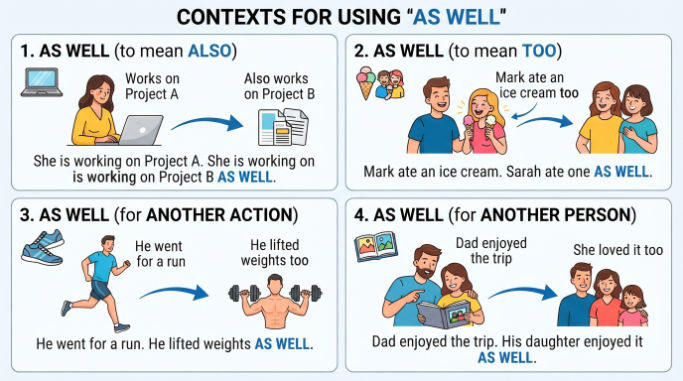
3. To Add Another Action
He writes articles as well.
She teaches online as well.
We sell notebooks as well.
In each case, another activity or service is being added to the information already given.
4. To Add Another Person or Group
Liam is coming as well.
The marketing team will attend as well.
Her parents were invited as well.
The phrase signals that the subject belongs to an additional group of participants.
As Well vs As Well As
This is an important distinction because as well as contains the correctly spelled phrase as well, but the entire construction has a different grammatical role.
“As Well”
Usually means also or too.
Nina is coming as well.
Here, the phrase adds Nina to a group of people who are already coming.
“As Well As”
Usually means in addition to and can connect two elements.
Nina is bringing her brother as well as her sister.
Here, as well as connects her brother and her sister.
Another example:
He speaks German as well as French.
The phrase connects two languages.
The two structures should therefore not be confused:
She is attending as well.
She is attending as well as her colleague.
In the first sentence, as well means “too.” In the second, as well as introduces an additional person.
Is “As Well As” One Word?
No.
As well as consists of three separate words.
Correct:
She works as well as studies.
Incorrect:
She works aswell as studies.
Also incorrect:
She works aswel as studies.
And:
She works aswellas studies.
The standard form remains as well as.
A Grammar Point About “As Well As”
As well as can connect nouns, noun phrases, gerunds, and other grammatical elements.
The course covers grammar as well as vocabulary.
She enjoys reading as well as writing.
As well as the presentation, he prepared a handout.
Its exact grammatical analysis can vary according to its construction, so it is better not to reduce every occurrence to a single simplistic rule. What remains constant for spelling is that as, well, and as are separate words.
Where Should “As Well” Go in a Sentence?
Position depends partly on what you want to emphasize.
At the End of a Sentence
This is extremely common:
I would like to attend as well.
She ordered coffee as well.
We need to check the second file as well.
This position is natural in many conversational and neutral contexts.
After the Subject
In some sentences, as well can occur after the subject:
James as well wanted to attend.
This is grammatical in certain contexts but can sound more marked or literary than the usual conversational alternative:
James wanted to attend as well.
Because English has several ways to position additive expressions, correct spelling does not automatically make every placement equally natural.
Near the Verb
Depending on the sentence, an additive meaning may be expressed with also instead:
She also teaches mathematics.
She teaches mathematics as well.
Both are natural, but their placement differs.
This is why replacing as well mechanically with also is not always a perfect grammatical transformation.
“As Well” in British and American English
There is no standard British-versus-American spelling difference here.
British English:
I would like to come as well.
American English:
I would like to come as well.
Both use the same two-word spelling.
So searches such as “aswell or as well UK” and “as well or aswell UK” have the same answer: standard UK English uses as well.
American English also uses as well.
The expression is therefore not like spelling pairs such as colour/color or organise/organize, where regional conventions may differ.

Pronunciation of “As Well”
In ordinary speech, as well is pronounced as two words, although the words may run together naturally in connected speech.
A common pronunciation is approximately:
/əz ˈwel/
The first word is often weakly pronounced in fluent speech, while well carries the stronger stress.
The important point is that natural spoken connectedness does not change the written form.
For example, a speaker may say:
I want to come as well.
quickly enough that the boundary between the words is less noticeable. That does not make aswell a standard written word.

Examples of “As Well” in Different Contexts
Everyday Conversation
I’ll have a sandwich as well.
Are you going as well?
She wants to come as well.
Work and Professional Writing
Please send the revised figures as well.
The report should include the supporting data as well.
We need to notify the finance department as well.
Academic Writing
In formal academic prose, also, additionally, or furthermore may sometimes be preferable depending on context, but as well is not inherently incorrect or informal.
The study examines sleep duration as well as dietary patterns.
The researchers considered age as well as employment status.
Email Writing
Please confirm the meeting time as well.
Could you send the attachment as well?
I have copied the project manager as well.
Social Media and Informal Writing
I need this jacket as well 😂
You should try this place as well.
We watched the second episode as well.
The spelling remains as well regardless of how casual the context is.
Common Mistakes
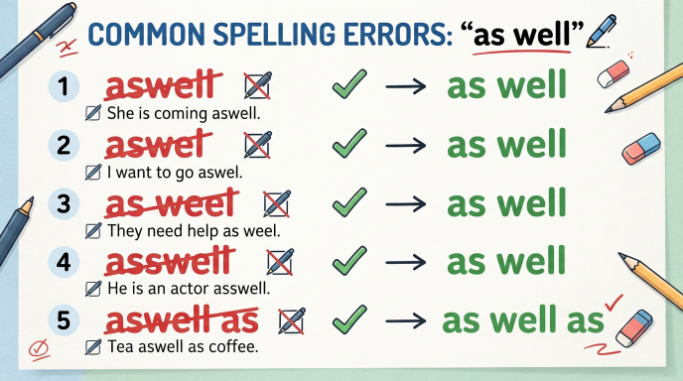
Mistake 1: Writing “Aswell”
❌ I want to go aswell.
✅ I want to go as well.
The missing space is the problem.
Mistake 2: Writing “Aswel”
❌ She came aswel.
✅ She came as well.
This is another common typo, particularly when typing quickly.
Mistake 3: Writing “As Weel”
❌ He wants to join as weel.
✅ He wants to join as well.
Weel is not the correct spelling of well in this expression.
Mistake 4: Writing “Asswell”
❌ Please include Anna asswell.
✅ Please include Anna as well.
The extra s does not belong in the phrase.
Mistake 5: Writing “Aswell As”
❌ The course covers writing aswell as grammar.
✅ The course covers writing as well as grammar.
When as well as means “in addition to,” all three words should remain separate.
A Fast Decision Rule
When you are unsure whether to write aswell or as well, use this three-step test:
Step 1: Do You Mean “Also” or “Too”?
If yes, write:
as well
I want one as well.
Step 2: Are You Adding a Second Element With “As Well As”?
If yes, write:
as well as
She studies as well as working.
Step 3: Never Join the Words
Do not write:
- ❌ aswell
- ❌ aswel
- ❌ as weel
- ❌ asswell
- ❌ aswell as
The safest proofreading rule is simply:
If you mean “also” or “too,” write “as well.”
The Practical Proofreading Test
Try replacing as well with too.
I want to come as well.
→ I want to come too.
The meaning works, so as well is appropriate.
Try another:
She bought a notebook as well.
→ She bought a notebook too.
Again, the substitution works.
For as well as, try thinking “in addition to.”
He plays tennis as well as football.
→ He plays tennis in addition to football.
That signals the longer construction as well as, rather than simply as well.
Is “As Well” Formal or Casual?
As well is neutral and widely accepted. It can appear in conversation, emails, professional communication, journalism, academic prose, and other forms of standard writing.
However, style depends on sentence structure.
Compare:
I would like to attend as well.
with:
I would also like to attend.
Both are perfectly acceptable. The second may fit some formal contexts more smoothly because also can be positioned naturally before the main verb.
There is no general rule that as well is “incorrect in formal writing” or that it should always be replaced with also.
Is “As Well” Ever Written as One Word?
In standard contemporary English, not for the ordinary meaning “also” or “too.”
You may encounter aswell online, in informal writing, usernames, search queries, comments, or typos. Its appearance in those contexts does not make it the standard spelling.
If you are writing an essay, article, email, report, application, business document, or other edited text, use:
as well
“As Well” vs “Also” vs “Too”
These expressions overlap, but they are not interchangeable in every position.
| Expression | Example | Typical position |
|---|---|---|
| also | She also teaches French. | Often before the main verb |
| too | She teaches French too. | Often at the end |
| as well | She teaches French as well. | Often at the end |
For example:
I also want to go.
I want to go too.
I want to go as well.
All three can communicate the same basic additive idea.
The choice often depends on sentence rhythm, emphasis, and register rather than correctness alone.
Edge Case: “As Well” Does Not Always Mean Exactly the Same Thing as “Also”
Although also, too, and as well frequently overlap, they are not interchangeable in every grammatical environment.
For example:
As well as the cost, we considered the delivery time.
You cannot simply replace the entire phrase with also without restructuring the sentence:
We also considered the delivery time.
The meaning is related, but the grammatical structure is different.
This distinction matters because learners sometimes memorize as well = also so rigidly that they assume every occurrence of as well can be moved anywhere that also can go.
English does not work that mechanically.
What About “As Well I”?
Searches such as “as well i” may reflect questions about word order.
Usually, if as well means “also,” it sounds most natural at the end of the clause:
I would like to attend as well.
You can sometimes restructure the sentence:
I would also like to attend.
rather than forcing as well into the position normally occupied by also.
So if you are writing “as well I…”, check whether you actually want “I … as well” or “I also …”.
What About “As Well And”?
A phrase such as “as well and” is not automatically wrong, but its correctness depends entirely on the surrounding sentence.
For example:
She sings as well, and she plays the piano.
Here, as well means “also,” while and begins a new coordinated clause.
By contrast:
She sings as well and plays the piano.
may require a different interpretation and can sound awkward depending on what the writer intends.
The important lesson is that individual words cannot be judged independently of sentence structure.
What About “As Well as Well”?
The sequence “as well as well” can be grammatically possible when the two occurrences have different functions, but it is unusual and potentially confusing.
For example, a carefully constructed sentence might contain:
The machine works as well as the older model, and it is maintained as well.
Here, the first as well as is a comparison/construction, while the second as well means “also.”
The spelling remains separate in both cases.
Is “As Well” a Word?
No. As well is not one word.
It is a two-word expression.
This distinction is useful because questions such as “is aswell a word?” can be answered precisely:
- as well = standard two-word expression
- aswell = not the standard spelling of that expression
Similarly, as well as is a three-word construction.
What Is the Meaning of “As Well”?
The most common meaning is:
also; too; in addition
Examples:
She wants to participate as well.
Meaning: She wants to participate too.
We need to check the figures as well.
Meaning: We need to check the figures in addition to whatever else we have checked.
The exact interpretation depends on context, but the core idea is addition.
Memory Trick
Remember:
“As well” needs space to add something.
Think of the phrase as:
as + well = two words
Then connect it with its common substitute:
as well = too = also
So:
I want to go as well.
not:
I want to go aswell.
For as well as, remember:
Three words, three spaces-separated units: as + well + as.
FAQs
Is “aswell” one word?
No. Aswell is not the standard spelling. The correct form is as well, written as two words.
Is “as well” one word?
No. As well consists of two words.
Is “aswell” a word?
Not as the standard spelling of the English expression meaning “also” or “too.” It is generally a misspelling.
How do you spell “as well”?
Spell it as well: A-S, space, W-E-L-L.
Is it “aswell” or “as well”?
Use as well.
Correct: I want to come as well.
Is “aswell” or “as well” correct in the UK?
Standard British English uses as well. There is no standard British spelling aswell.
Is “aswell” or “as well” correct in American English?
Standard American English also uses as well.
Is “as well as” one word?
No. As well as is three words.
What does “as well” mean?
It usually means “also,” “too,” or “in addition.”
What is the difference between “as well” and “as well as”?
As well usually adds information meaning “also” or “too.”
As well as generally means “in addition to” and connects one element with another.
I want to come as well.
I want to bring Sarah as well as Tom.
Is “aswel” correct?
No. Aswel is a misspelling of as well.
Is “as weel” correct?
No. The standard spelling is as well.
Is “asswell” correct?
No. Asswell is an incorrect spelling. Use as well.
Can “as well” be used in formal writing?
Yes. As well is standard English and can be used in formal, professional, academic, and informal writing. The most appropriate choice between as well, also, and too depends on sentence structure and style.
Final Takeaway
If you remember only one rule, make it this:
Write “as well” as two words. Never write “aswell” in standard English.
Use as well when you mean also, too, or in addition:
I would like to join as well.
Use as well as when you need the longer construction:
She studies as well as working.
British and American English follow the same standard spelling here. Forms such as aswel, as weel, and asswell are misspellings, not accepted regional alternatives.