Inside Of vs Inside: What Is the Difference?
Quick Answer
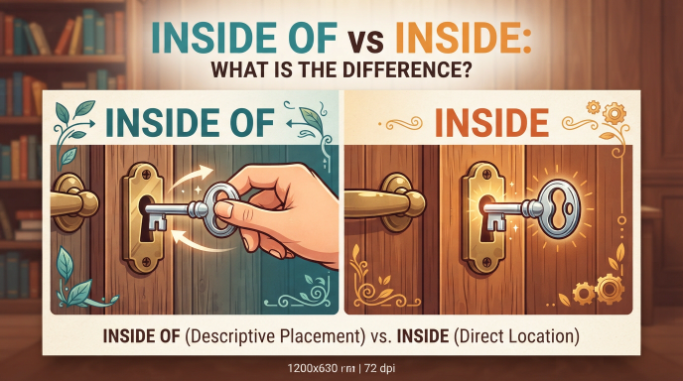
Inside and inside of can both mean “in the interior of something,” and in many sentences they are interchangeable:
- The keys are inside the drawer.
- The keys are inside of the drawer.
However, inside is generally the more concise and neutral choice, especially in formal writing. Inside of is more common in conversational American English and can sound more wordy in contexts where inside works perfectly well.
There is also an important grammatical difference in how inside functions. It can be a preposition, adverb, adjective, or noun, depending on the sentence. Inside of is primarily a prepositional phrase.
A useful rule is:
Use “inside” by default. Use “inside of” when it sounds natural in the context, especially in informal American speech.
Neither form is inherently wrong when it means “within the interior of.”

At-a-Glance Table
| Feature | inside | inside of |
|---|---|---|
| Basic meaning | Within the interior | Within the interior |
| Example | The cat is inside the house. | The cat is inside of the house. |
| Part of speech | Preposition, adverb, adjective, or noun | Prepositional phrase |
| Concision | More concise | More wordy |
| Formal writing | Usually preferred | Less common |
| Everyday speech | Very common | Common, especially in American English |
| Can stand alone? | Yes | Usually needs an object |
| Refers to a location? | Yes | Yes |
| Can describe a time limit? | Yes, in some constructions | Yes, especially “inside of two hours” |
| Always interchangeable? | No | No |
Inside of vs Inside: The Detailed Difference
The central difference is not meaning but grammatical structure, economy, and context.
Inside as a preposition
When inside comes before a noun phrase and shows location, it functions as a preposition:
- The documents are inside the folder.
- She left her umbrella inside the car.
- There is a label inside the box.
- We waited inside the building.
Here, inside establishes a relationship between something and an enclosed space.
You can usually replace it with inside of:
- The documents are inside of the folder.
- She left her umbrella inside of the car.
The meaning remains essentially the same.
Inside of as a prepositional phrase
In inside of the folder, the expression inside of works together as a prepositional phrase.
The word of does not normally add a major difference in location. Compare:
The letter is inside the envelope.
and
The letter is inside of the envelope.
Both tell us that the letter is within the envelope.
Because inside already expresses the required spatial relationship, adding of can make the phrase longer without changing its basic meaning.
That is why inside the envelope is often the cleaner choice in edited prose.

When to Use Inside
Inside is the best default when you simply want to say that something is within an enclosed area, object, or boundary.
Location
- The children are inside the house.
- My wallet is inside my backpack.
- Keep the medicine inside the cabinet.
- Someone is waiting inside the office.
These constructions are short, natural, and standard in both British and American English.
Directions
Inside can also work as an adverb when no object follows it:
- Come inside.
- It’s warmer inside.
- We stayed inside during the storm.
- Please wait inside.
You cannot normally replace these with inside of:
- Come inside of. ❌
- We stayed inside of. ❌
The second form needs an object or complement:
- We stayed inside of the house.
This is one of the clearest reasons the two expressions are not completely interchangeable.
As a noun
Inside can also be a noun:
- The inside of the car needs cleaning.
- The inside was darker than I expected.
- Paint the inside of the cabinet.
Here, inside refers to the interior itself.
The construction inside of can occur in a phrase such as the inside of the car, but the noun is still inside:
the inside of the car
The word of introduces the thing whose interior is being described.
When to Use Inside Of
Inside of is acceptable when it means “within” or “in the interior of.”
For example:
- There is a note inside of the package.
- The puppy is sleeping inside of the basket.
- We found an old photograph inside of the book.
It is particularly natural in some varieties of informal American English.
However, if you are writing an academic paper, business document, technical explanation, or edited article, inside will usually be the more economical choice:
The sensor is located inside the housing.
rather than:
The sensor is located inside of the housing.
This is not because inside of is automatically ungrammatical. It is mainly a matter of style and concision.

Examples by Context
Inside a physical object
Both forms can work:
- The receipt is inside the wallet.
- The receipt is inside of the wallet.
The first is more concise.
Inside a building
- Please wait inside the lobby.
- Please wait inside of the lobby.
Again, both can convey the same location.
Inside a container
- There is water inside the bottle.
- There is water inside of the bottle.
The shorter version is generally preferable when no special conversational effect is intended.
Inside someone’s bag
- I found your keys inside your bag.
- I found your keys inside of your bag.
Both are understandable and grammatical in appropriate contexts.
Inside a specific area
- The restaurant is inside the shopping center.
- The restaurant is inside of the shopping center.
The first sounds more streamlined in formal prose.
Inside as an Adverb
One important search question is whether inside is an adverb.
Yes. It can be.
An adverb can modify a verb by describing where an action occurs:
- Come inside.
- The dog ran inside.
- We stayed inside.
- She looked inside.
In these examples, inside does not take a noun immediately afterward.
Compare:
The dog ran inside.
Here, inside is an adverb.
But:
The dog ran inside the house.
Here, inside functions as a preposition because it introduces the house.
This is why asking “What part of speech is inside?” does not have just one answer. Its part of speech depends on how it is used.
Is Inside a Preposition?
Yes.
Consider:
The children are inside the classroom.
Inside is a preposition because it introduces the noun phrase the classroom and expresses a spatial relationship.
It can also be an adverb:
The children are inside.
And it can be a noun:
The inside of the classroom was brightly decorated.
It can even function adjectivally in some contexts:
an inside pocket
Here, inside modifies pocket.

Inside vs In
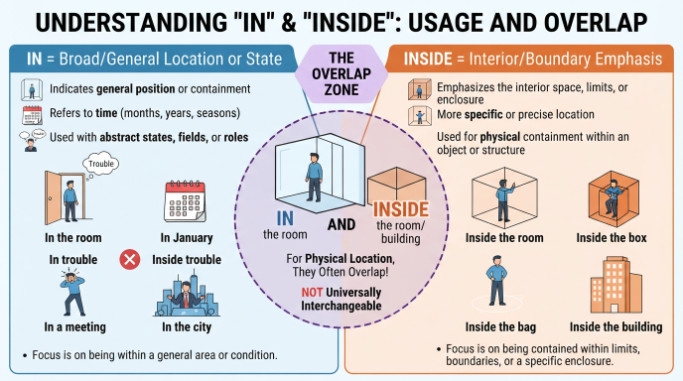
In and inside often overlap, but they are not identical in every context.
Compare:
- The children are in the room.
- The children are inside the room.
Both are correct.
In is usually the more general preposition of location. Inside emphasizes the idea of being within an enclosed space or boundary.
In
She is in the car.
This simply identifies her location.
Inside
She is inside the car.
This can place more emphasis on the fact that she is within the car rather than outside it.
The distinction can become clearer when contrast matters:
Please stay inside the building until the alarm stops.
Here, inside creates a clear contrast with outside.
In many ordinary sentences, however, in is perfectly sufficient:
He is in the kitchen.
There is no grammatical need to change it to:
He is inside the kitchen.
The latter is possible, but it can sound more spatially emphatic depending on context.
In or Inside: A Practical Difference
Use in when you simply need to express location, membership, or inclusion:
- She lives in London.
- The keys are in the drawer.
- There are ten students in the class.
Use inside when the interior or boundary itself is important:
- Someone is trapped inside the building.
- There is a hidden compartment inside the desk.
- Please remain inside the marked area.
There are also many uses of in where inside would not work naturally:
- in January
- in 2026
- in trouble
- in love
- in detail
You cannot simply replace in with inside in these expressions.
Inside and Into Are Not the Same
Another common confusion is inside vs into.
The difference is related to state versus movement.
Inside usually describes a location:
The dog is inside the house.
Into normally describes movement toward or to a position within something:
The dog ran into the house.
Compare:
- She is inside the room.
- She walked into the room.
The first tells us where she is.
The second tells us where she moved.
A useful test is:
Where is it? → inside/in
Where is it moving? → into
This is a simplified test, but it works for many everyday examples.
Inside the House vs Inside of the House
Both are possible:
The children are inside the house.
The children are inside of the house.
The first is normally the cleaner choice.
But don’t confuse this with:
The children are inside.
Here, inside stands alone as an adverb.
And:
The inside of the house needs painting.
Here, inside is a noun, while of the house specifies whose interior is meant.
These three structures look similar but have different grammar:
| Sentence | Function of inside |
|---|---|
| The children are inside the house. | Preposition |
| The children are inside. | Adverb |
| The inside of the house is dark. | Noun |
Inside Which
The phrase inside which is grammatically possible when which refers to something containing or enclosing another thing.
For example:
We entered a room inside which several paintings were displayed.
This is grammatically formal and relatively literary.
In everyday English, speakers often choose a more natural alternative:
We entered a room where several paintings were displayed.
Or:
We entered a room, and several paintings were displayed inside it.
The construction inside which is therefore not wrong. It is simply more formal and structurally specific.
Inside Their, Inside a, and Similar Structures
Inside can be followed by many different noun phrases:
- inside their house
- inside a box
- inside my car
- inside the building
- inside our office
- inside an envelope
For example:
They left their bags inside their apartment.
The possessive determiner their tells us whose apartment is being discussed.
The structure is:
inside + possessive determiner + noun
Likewise:
She found a note inside her jacket.
There is no grammatical requirement to add of:
She found a note inside of her jacket.
That version is possible, but the shorter form is usually more efficient.
“Inside of the” — Is It Correct?
Yes, inside of the can be grammatically correct when inside of is being used as a prepositional expression.
Examples include:
- The toy is inside of the box.
- A light is hidden inside of the cabinet.
- The documents were placed inside of the folder.
However, inside the is normally more concise:
- The toy is inside the box.
- A light is hidden inside the cabinet.
- The documents were placed inside the folder.
So the question is not simply “Is inside of correct?”
A better question is:
Do I need “of” here?
Usually, if inside can directly introduce the noun phrase, you can omit of without changing the basic meaning.
Inside and Time Expressions
Inside can sometimes be used with periods of time, meaning before a specified amount of time has passed:
Please reply inside 24 hours.
More commonly, especially in standard edited English, you will see:
Please reply within 24 hours.
Inside of can also appear in informal usage:
We should finish it inside of two hours.
But within two hours is often the more natural choice when the intended meaning is “before the two-hour period ends.”
This is an important edge case because replacing in, inside, and within mechanically can create unnatural sentences.
Common Mistakes
Mistake 1: Treating inside of as the only correct form
Incorrect assumption:
“You must say inside of the box.”
Better:
The ball is inside the box.
Inside of is possible, but inside is sufficient.
Mistake 2: Assuming inside of is always wrong
This is equally inaccurate.
The cat is inside of the garage.
This can be grammatical, particularly in conversational American English.
The issue is generally style and economy, not a universal grammar ban.
Mistake 3: Using inside when no interior is intended
Consider:
She lives inside London.
This is possible in some contexts, but ordinary English normally says:
She lives in London.
A city is not normally conceptualized as an enclosed container in everyday location statements.
Mistake 4: Confusing inside and into
He went inside the room.
This can mean he went to a position within the room, but if you specifically want to emphasize movement from outside to inside, into is clearer:
He went into the room.
Mistake 5: Assuming inside always has the same part of speech
Compare:
Come inside.
and:
Come inside the house.
The first uses inside as an adverb; the second uses it as a preposition.
Mistake 6: Adding “of” unnecessarily in formal prose
The cable runs inside of the wall.
More concise:
The cable runs inside the wall.
Unless the longer form serves a particular stylistic or conversational purpose, the shorter construction is generally preferable.
A Fast Decision Rule
When choosing between inside and inside of, use this sequence:
1. Do you mean “within the interior of”?
If yes, both may be possible.
2. Does a noun follow?
- inside the room → yes
- inside of the room → yes
3. Do you want the shortest neutral construction?
Choose inside.
4. Are you writing formal or edited prose?
Prefer inside unless there is a specific reason to use inside of.
5. Is inside standing alone?
Use inside, not inside of:
Come inside.
6. Are you talking about movement into a place?
Consider into:
She walked into the office.
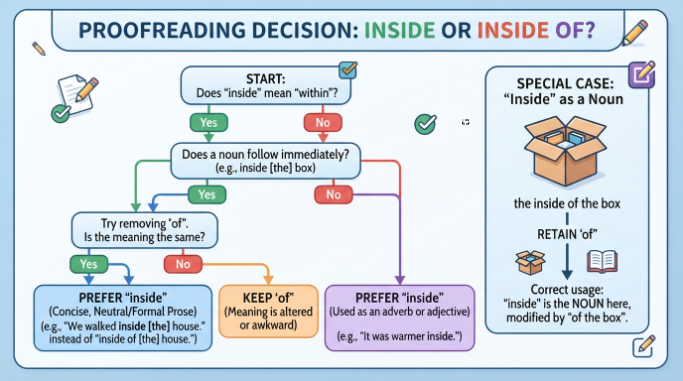
The Proofreading Test
Try removing of.
The documents are inside of the drawer.
Remove of:
The documents are inside the drawer.
If the meaning stays the same and the shorter version sounds natural, inside is usually the better choice.
But don’t apply this test mechanically to every construction. Inside of can have legitimate uses, and of can perform a grammatical role in expressions such as:
the inside of the drawer
Here, inside is functioning as a noun, and of the drawer identifies the interior being discussed.
Formal vs Casual and Regional Notes
There is no simple British-English-versus-American-English rule saying that one form is correct in one country and incorrect in the other.
Both inside and inside of occur in English varieties on both sides of the Atlantic.
However, inside is broadly useful as the concise, neutral form and is especially suitable for formal and edited writing.
Inside of is particularly familiar in conversational American English and can sound natural in speech:
It’s somewhere inside of that building.
In polished prose, many editors would simplify this to:
It’s somewhere inside that building.
This is best understood as a register and style preference, not as a strict dialect boundary.
British English
British English commonly uses:
inside the house
inside the box
come inside
Inside of is understood, but it is generally less necessary than the concise alternative.
American English
American English uses all of the following naturally:
inside the house
inside of the house
come inside
The choice can depend on context, speaker preference, rhythm, and level of formality.
Pronunciation
Inside is pronounced:
/ˌɪnˈsaɪd/
The main stress falls on side:
in-SIDE
Inside of is pronounced approximately:
/ˌɪnˈsaɪd əv/
In connected speech, of is normally unstressed and often sounds like /əv/.
The pronunciation difference is therefore straightforward; the more important distinction is grammatical and stylistic.
Is “Inside” a Noun?
Yes.
For example:
The inside of the refrigerator is spotless.
Here, inside names the interior.
You can also say:
I cleaned the inside.
This is a noun because it refers to the interior as a thing or area.
The expression inside of does not mean that inside stops being a noun in every context. Compare:
the inside of the car
Here, inside is the noun, and of the car is a phrase that identifies its relationship to the car.
Is There an Abbreviation for Inside?
There is no universally standard everyday abbreviation for inside that should be used in normal prose.
In specialized contexts such as diagrams, forms, technical notes, or spatial labels, an organization may establish its own abbreviations. Those should not be treated as universal English spelling rules.
For ordinary writing, simply write inside.
What Does Inside Mean?
The core meaning of inside is within the interior, boundaries, or limits of something.
It can describe:
Physical location
The keys are inside the drawer.
Movement or direction in some constructions
He went inside.
An interior area
The inside is painted white.
A boundary or limit
Keep inside the marked area.
It can also develop more specialized meanings depending on context, so the surrounding words determine its exact grammatical function.
Frequently Asked Questions
Is “inside of” grammatically correct?
Yes. Inside of can be grammatically correct when it means “within the interior of something.” It is often more conversational and wordier than inside.
Is “inside” one word?
Yes. Inside is normally written as one word.
Is “inside of” two words?
Yes. It consists of the two words inside and of.
Should I say “inside or inside of”?
For a neutral sentence, inside is usually the simplest choice:
The book is inside the bag.
Inside of is also possible:
The book is inside of the bag.
Is “inside” a preposition?
It can be. In inside the house, inside functions as a preposition.
It can also function as an adverb, noun, or adjective depending on the sentence.
Is “inside of” a preposition?
It can function as a prepositional expression introducing a noun phrase:
The keys are inside of the drawer.
What is the difference between inside and in?
In is a broader and more general location word. Inside emphasizes being within an interior or boundary.
She is in the office.
She is inside the office.
Both can be correct, but the second can place greater emphasis on the interior location.
What is the difference between inside and into?
Inside generally describes location, while into commonly describes movement toward or into an interior.
The dog is inside the house.
The dog ran into the house.
Is “inside of the house” correct?
Yes. It can be grammatical, especially in conversational usage. Inside the house is generally shorter and more neutral.
Is “come inside of” correct?
Usually, no object follows naturally after come inside when the meaning is simply “come indoors.”
Say:
Come inside.
If you specify a location, you can say:
Come inside the house.
or, in contexts where the longer construction is natural:
Come inside of the house.
Can I say “inside their house”?
Yes.
They were waiting inside their house.
There is no need to insert of.
What part of speech is “inside” in “inside the box”?
It is a preposition.
What part of speech is “inside” in “come inside”?
It is an adverb.
What part of speech is “inside” in “the inside of the box”?
It is a noun.
Which is better in formal writing: “inside” or “inside of”?
Inside is generally preferable because it is concise and neutral. Inside of is not automatically incorrect, but it may be unnecessarily wordy.
Final Takeaway
Inside and inside of can both mean within the interior of, so sentences such as “The keys are inside the drawer” and “The keys are inside of the drawer” can communicate the same basic idea.
The practical distinction is that inside is the shorter, more versatile, and generally more neutral choice. Inside of is also used, particularly in conversational American English, but it often adds words without adding meaning.
Remember three points:
- Use inside by default: The phone is inside the bag.
- Inside of can be grammatical: The phone is inside of the bag.
- Don’t confuse inside with into: She is inside the room describes location, while she walked into the room describes movement.
For proofreading, try removing of. If inside + noun communicates exactly what you mean, the shorter construction will usually be the cleanest choice.