ICL Meaning: What Does ICL Mean in Texting and Slang?
Quick Meaning
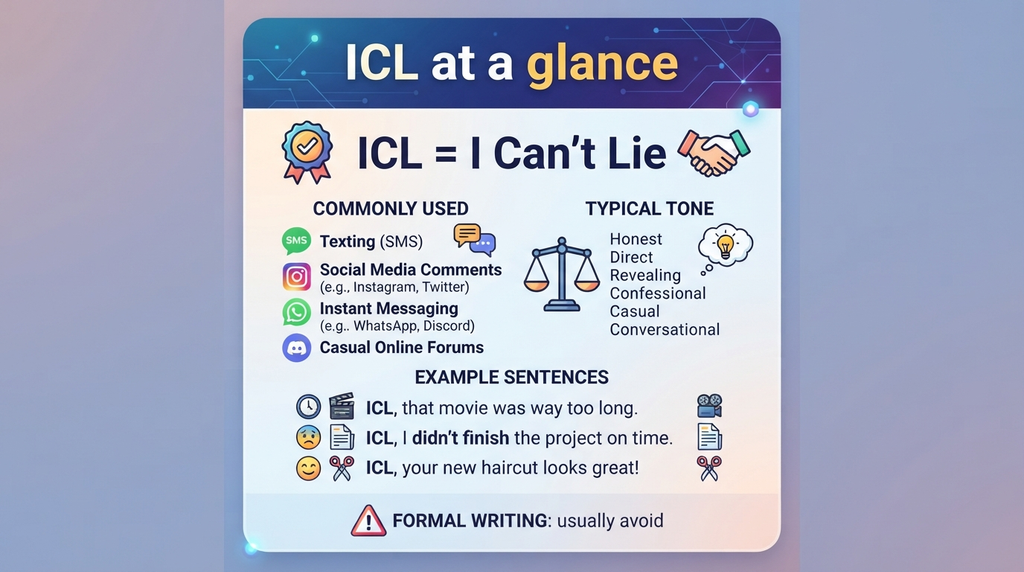
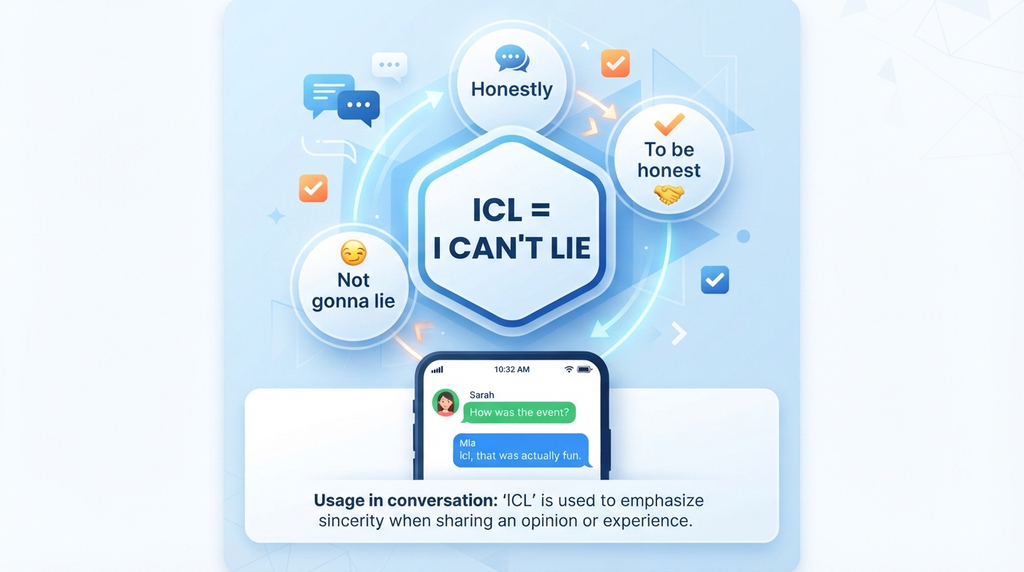
ICL most commonly means “I Can’t Lie” in texting and internet slang. People use it before an honest opinion, confession, reaction, or blunt statement—roughly like “honestly,” “to be honest,” or “not gonna lie.”
For example, “icl, that movie was actually good” means “I can’t lie, that movie was actually good.”
The lowercase form “icl” and uppercase “ICL” generally mean the same thing. In casual online conversation, lowercase is especially natural.
Meaning Table
| Term | Most common meaning | Typical function | Tone |
|---|---|---|---|
| ICL / icl | I Can’t Lie | Introduces an honest or candid statement | Casual, conversational |
| NGL | Not Gonna Lie | Signals honesty or a candid opinion | Casual |
| TBH | To Be Honest | Marks a frank opinion or admission | Casual to neutral |
| IMO | In My Opinion | Identifies something as a personal opinion | Casual/neutral |
| FR | For Real | Shows agreement, emphasis, or sincerity | Very casual |
| No cap | No lie / I’m being truthful | Emphasizes that a statement is genuine | Very casual |
The important distinction is that ICL is not normally a synonym for every possible form of “honesty.” Its usual role is to introduce or emphasize what the writer is about to say. The phrase itself—“I can’t lie”—is also an informal English expression meaning something like “honestly” or “frankly.”
How ICL Is Used
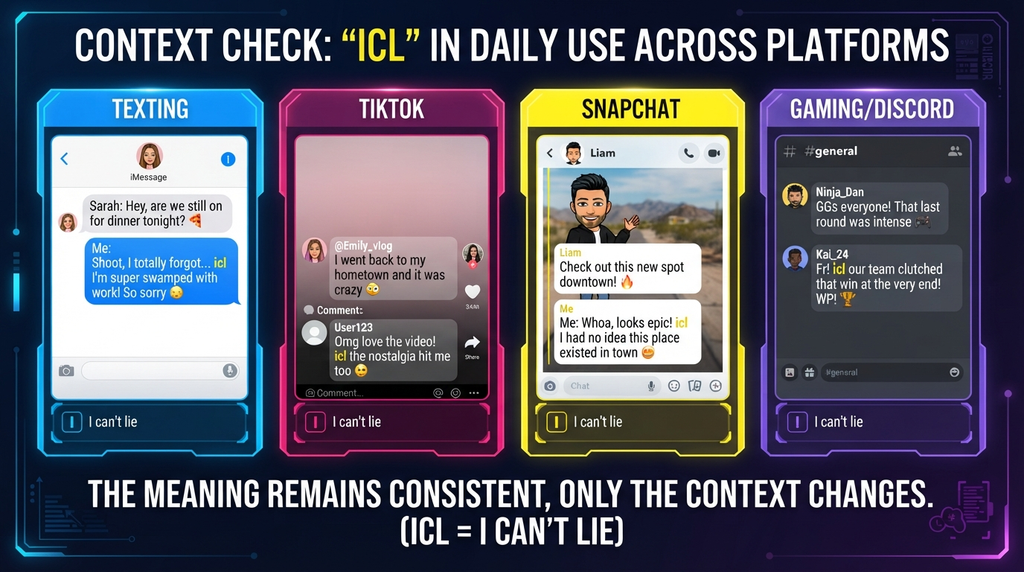
ICL meaning in texting
In texting, ICL commonly appears at the beginning of a sentence:
“icl, I actually liked it.”
“icl you were right.”
“icl, I miss those days.”
It can also appear later in a sentence:
“That was funny icl.”
The meaning remains essentially the same: the writer is emphasizing that the statement is sincere or candid.
It can introduce a positive opinion, a negative opinion, an admission, or simply a strong personal reaction.
“icl, your new haircut looks really good.”
“icl, I thought the ending was terrible.”
“icl, I was nervous too.”
“That game was stressful icl.”
So, despite sometimes being described as a “blunt” expression, ICL does not automatically mean the following statement will be negative.
ICL meaning on TikTok
On TikTok and similar social platforms, icl is commonly used in comments, captions, replies, and text overlays to signal a candid reaction. Contemporary slang references list “I can’t lie” as its established internet-slang meaning.
You might see:
“icl this is actually fire”
“icl she ate”
“icl I expected worse”
“icl this trend is getting old”
Here, ICL adds a conversational “I have to admit…” feeling. It can make a comment sound more spontaneous than a formal statement such as “In my opinion.”
However, there is no need to assume that every occurrence on TikTok has a special TikTok-only definition. In most cases, the platform changes the context, not the basic meaning.
ICL meaning on Snapchat
If someone sends “icl” on Snapchat, the default interpretation is still “I can’t lie.” Slang references specifically document its use on Snapchat and other social platforms.
For example:
Friend: “Do you like this outfit?”
You: “icl yeah, it looks good.”
Or:
Friend: “Was the party fun?”
You: “icl, it was better than I expected.”
The surrounding message usually makes the intended tone obvious.
ICL in gaming
Gamers may use ICL in Discord chats, game chats, comments, or messages when giving an opinion about a game, player, match, update, or strategy.
Examples:
“icl that boss fight was easy.”
“icl your aim was crazy that round.”
“icl this update made the game worse.”
The abbreviation doesn’t have a special gaming definition here. It simply works as casual internet shorthand.
ICL in everyday conversation
ICL is primarily written internet slang, so it is much more natural in a text or comment than in formal spoken English.
Someone might write:
“icl, I didn’t expect you to say that.”
But in speech, they would normally say:
“I can’t lie, I didn’t expect you to say that.”
This distinction matters because abbreviations that are natural on a screen do not necessarily transfer naturally into spoken conversation.
Context Examples
The easiest way to understand ICL is to look at what comes after it.
Honest compliment
A: “Do you like my new shoes?”
B: “icl, they look really good.”
Here, ICL makes the compliment sound sincere.
Honest criticism
A: “What did you think of the movie?”
B: “icl, the first half was boring.”
Here, it prepares the reader for a candid opinion.
Unexpected admission
A: “You hated that restaurant last time.”
B: “icl, I’d actually go back.”
The speaker is admitting that their current opinion differs from what someone might expect.
Emotional statement
A: “Are you still thinking about them?”
B: “icl, yeah.”
In this case, ICL emphasizes sincerity rather than criticism.
Agreement
A: “This update made the app worse.”
B: “icl, you’re right.”
The abbreviation can reinforce agreement with another person’s assessment.
Humor
A: “You really spent three hours fixing that?”
B: “icl, it was worth it.”
The phrase can also introduce a deliberately exaggerated or humorous statement.
ICL at the end of a sentence
ICL doesn’t have to come first:
“That was probably the best episode icl.”
This placement is common enough in casual writing. The meaning is still essentially “I can’t lie / honestly.”

Tone and Who Uses It
ICL is informal. It belongs naturally in texting, social media, group chats, gaming communities, and casual direct messages.
Its tone can range from:
- Friendly
- Sincere
- Playful
- Blunt
- Self-deprecating
- Emotionally honest
- Lightly sarcastic
The surrounding sentence determines the exact effect.
Compare:
“icl, you look amazing.”
with:
“icl, that was a terrible idea.”
The first sounds like a candid compliment. The second sounds like a candid criticism.
Is ICL rude?
Not by itself. ICL does not inherently mean “I’m about to insult you.”
However, because it often introduces a frank statement, the sentence that follows can be blunt:
“icl, your idea doesn’t make sense.”
The abbreviation may actually make the criticism feel more direct, because the writer is explicitly framing it as honesty.
Age and community variation
ICL is strongly associated with contemporary online and youth-oriented slang, particularly social-media and casual messaging environments. Current slang references identify it as internet shorthand for “I can’t lie.”
That does not mean every young person uses it, or that older users will not understand or use it. Internet slang spreads between age groups, countries, platforms, and communities.
Its frequency can also vary considerably by online community.
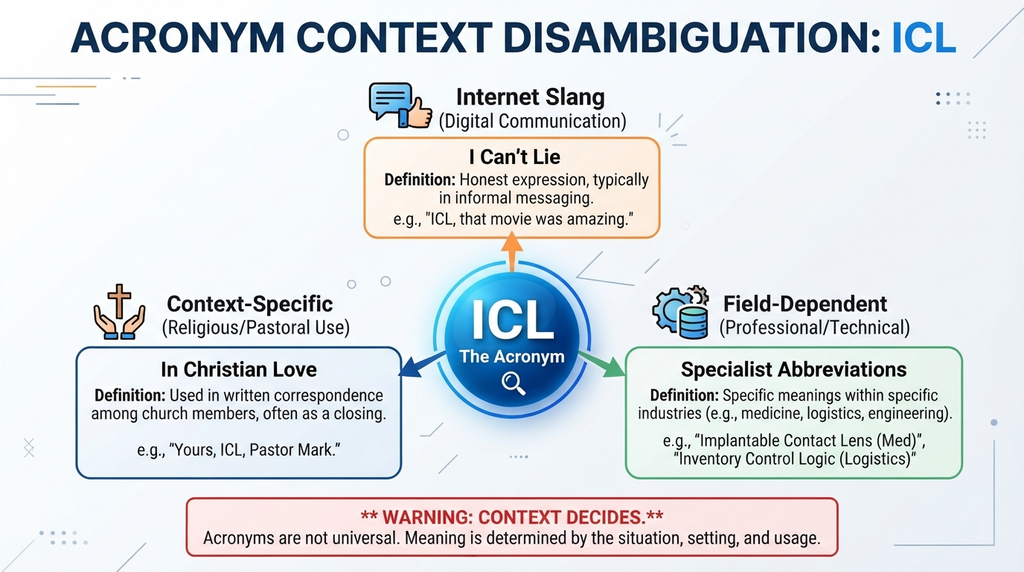
Alternative Meanings of ICL
The meaning “I Can’t Lie” is the dominant interpretation when you’re looking at ordinary texting and social-media slang.
But ICL is also used as an abbreviation outside internet slang, so context matters.
“In Christian Love”
Some slang references document ICL as “In Christian Love.” This is a different, context-specific expansion and is much less likely when ICL appears in ordinary TikTok comments or casual texting.
If the surrounding conversation is explicitly religious or uses a sign-off involving Christian terminology, this alternative may become relevant.
Other specialist meanings
ICL can also occur as an abbreviation or code in specialized fields. For example, icl is the ISO 639-3 code for Icelandic Sign Language.
There are also technical and medical uses of ICL, so capitalization and context can matter outside social media.
For that reason, it would be inaccurate to claim that ICL always means “I Can’t Lie.” It is the standard interpretation when the context is contemporary texting or internet slang, not in every possible field.
What about “I Care Less”?
Some online slang pages list “I Care Less” as another possible interpretation of ICL. However, it is substantially less established than “I Can’t Lie.” If you encounter an apparently indifferent or dismissive message, read the entire sentence before choosing that interpretation.
For example:
“icl about the drama”
could potentially invite an alternative reading depending on the writer’s community, but context should be used rather than automatically replacing the dominant meaning.
Professional vs. Casual Use
Is ICL appropriate at work?
Generally, avoid ICL in formal professional writing unless you already know the communication style is intentionally informal.
It may be perfectly understandable in:
- A casual team chat
- A friendly message to a colleague
- An informal internal conversation
- A social-media community connected to work
But it is usually better to write the complete phrase—or simply express the idea directly—in:
- Formal emails
- Job applications
- Business proposals
- Academic writing
- Official reports
- Customer communications
- Legal or contractual documents
Instead of:
“ICL, this proposal needs more detail.”
A professional message could say:
“Honestly, I think the proposal needs more detail.”
Or, more neutrally:
“I think the proposal would benefit from more detail.”
The issue isn’t that ICL is offensive. It is primarily a question of register: the abbreviation signals casual digital communication.
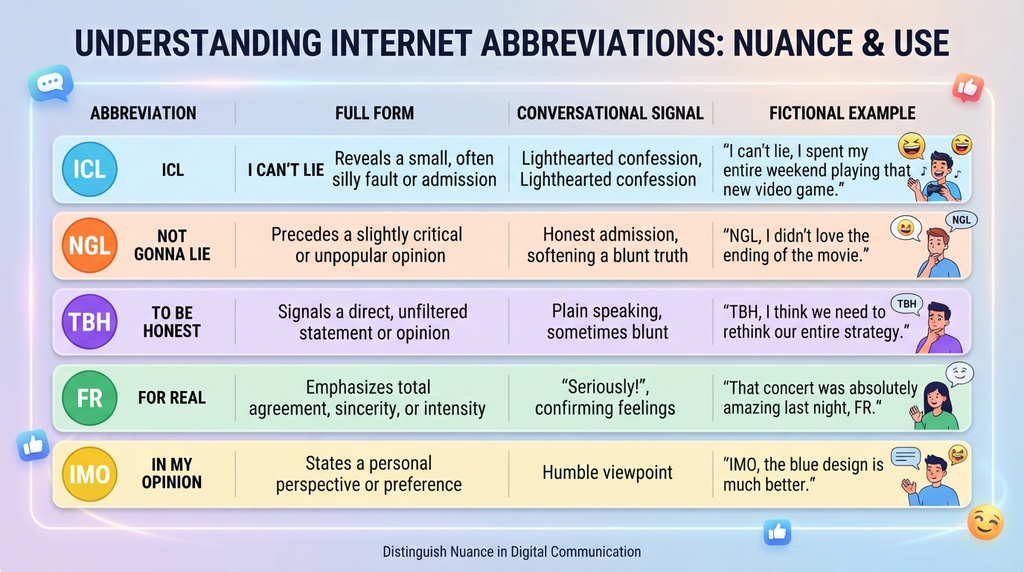
ICL vs. NGL vs. TBH
These expressions overlap, but they are not completely interchangeable in every sentence.
| Expression | Full form | Main effect |
|---|---|---|
| ICL | I Can’t Lie | Emphasizes candidness |
| NGL | Not Gonna Lie | Introduces an honest admission/opinion |
| TBH | To Be Honest | Explicitly frames something as honest |
| FR | For Real | Emphasizes sincerity or agreement |
| IMO | In My Opinion | Identifies a statement as personal opinion |
For example:
“ICL, that song is good.”
“NGL, that song is good.”
Both can work naturally.
But IMO changes the emphasis:
“IMO, that song is good.”
This says “in my opinion” rather than specifically framing the statement as a candid admission.
Common Misunderstandings
“ICL” does not mean “I don’t care”
The dominant texting meaning is “I Can’t Lie.” Don’t interpret it as an expression of indifference simply because another source or community uses the letters differently.
ICL doesn’t guarantee that the statement is objectively true
This is an important nuance.
When someone says:
“icl, this is the best restaurant in town.”
they are signaling their own sincerity, not proving that the restaurant is objectively the best.
ICL means something closer to “I’m being honest about my view” than “what I’m saying is an established fact.”
ICL isn’t necessarily dramatic
Some explanations describe ICL as a warning that a “truth bomb” is coming. That can happen, but ordinary usage is often much simpler:
“icl, I like this.”
There doesn’t need to be a major confession or controversial opinion.
Capitalization doesn’t usually change the meaning
These normally mean the same thing:
- ICL
- icl
- Icl
In casual online writing, icl is especially common because users often type slang in lowercase.
“IKL” is not automatically ICL
Searches for “what does ikl mean?” can arise from mistyping, autocorrect, or confusion between similar-looking abbreviations.
Unlike ICL, IKL does not have one universally established texting meaning that should automatically replace ICL. If someone actually wrote “IKL,” the surrounding conversation is necessary to determine what they intended.
FAQs
What does ICL mean in text?
ICL usually means “I Can’t Lie.” It is used to introduce an honest opinion, reaction, admission, or candid statement.
What does ICL mean on TikTok?
On TikTok, ICL generally means “I Can’t Lie.” It is commonly used in comments, captions, replies, and casual conversations to signal sincerity or an honest reaction.
What does ICL mean on Snapchat?
On Snapchat, ICL usually means “I Can’t Lie.” For example, “icl that was funny” means “I can’t lie, that was funny.”
Is ICL the same as NGL?
They are very similar. ICL means “I Can’t Lie,” while NGL means “Not Gonna Lie.” Both can introduce an honest opinion or admission, although individual speakers may use them with slightly different personal styles.
What does ICL mean in slang?
In contemporary internet slang, ICL most commonly means “I Can’t Lie.” It functions as an informal honesty marker.
Can I use ICL in a professional email?
You can, but it is generally better to avoid it in formal professional communication. Writing “honestly,” “to be frank,” or stating your point directly is usually clearer and more appropriate.
Is ICL rude?
No. ICL itself is not rude. The statement following it determines whether the overall message sounds friendly, critical, sarcastic, or blunt.
Does ICL always mean “I Can’t Lie”?
No. “I Can’t Lie” is the dominant meaning in texting and social-media slang, but ICL can represent other phrases or specialist abbreviations in different contexts.
What does ICL stand for?
In casual internet communication, ICL stands for “I Can’t Lie.”
How do you reply to “ICL”?
You don’t need a special response. Reply naturally to the statement:
“icl, that movie was amazing.”
You could answer:
“Right? I wasn’t expecting it to be that good.”
The best response depends on what the person actually said after ICL.
What does “icl” mean at the end of a sentence?
It still usually means “I can’t lie” or “honestly.” For example, “That was hilarious icl” emphasizes that the writer genuinely thought it was hilarious.
Is ICL an acronym or an initialism?
In everyday descriptions, people often call ICL an acronym, but initialism is more precise because the letters are normally understood individually rather than pronounced as a single word. Slang references commonly describe it as an initialism.
Summary
ICL meaning is usually “I Can’t Lie.” In texting, TikTok comments, Snapchat, gaming chats, and other casual online spaces, it signals that the writer is about to share—or has just shared—something they consider honest, sincere, or candid.
Its closest everyday equivalents include “honestly,” “to be honest,” and “not gonna lie.” The abbreviation can introduce compliments, criticism, confessions, opinions, humor, or emotional statements.
The key is context. ICL is not guaranteed to have one meaning in every community or professional field, and specialist uses exist outside internet slang. But when you see “icl” in an ordinary casual text, “I Can’t Lie” is the natural first interpretation.