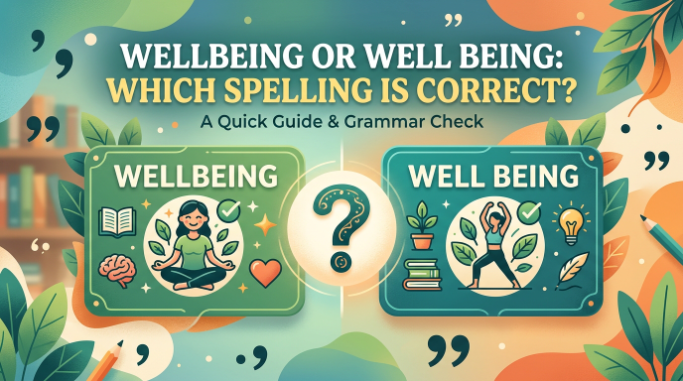
Wellbeing or Well Being: Which Spelling Is Correct?
Quick Answer
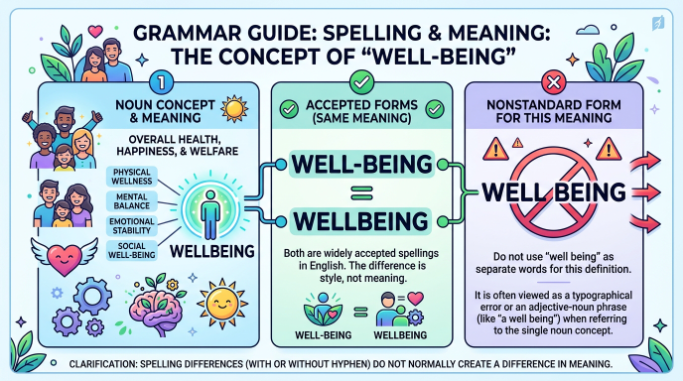
“Wellbeing” and “well-being” are both accepted spellings, but “wellbeing” is increasingly common, especially in British English and modern institutional writing. “Well-being” remains widely used and is preferred by some dictionaries and style guides. “Well being” as two separate words is generally not the standard spelling when referring to a person’s health, happiness, or overall condition.
The best choice depends partly on the dictionary, regional convention, and editorial style you are following.
Quick rule:
- Wellbeing → common modern closed form
- Well-being → traditional and still widely accepted hyphenated form
- Well being → usually avoid when referring to health, happiness, or overall welfare
The most important thing in professional writing is to choose one accepted spelling and use it consistently.
At-a-Glance Table
| Form | Correct? | Typical Use |
|---|---|---|
| wellbeing | Yes | Modern general, institutional, health, education, and workplace writing |
| well-being | Yes | Traditional spelling and style-guide preference in some publications |
| well being | Usually no | Generally not used as the standard noun for health and welfare |
| wellbeing or well-being | Both | Choice depends on house style, dictionary, or regional preference |
What does wellbeing mean?
Wellbeing means a person’s overall state of being healthy, comfortable, safe, happy, or psychologically well.
For example:
- Regular exercise can improve your wellbeing.
- The company introduced policies to support employee well-being.
- Good sleep is important for physical and mental wellbeing.
In these sentences, wellbeing and well-being have the same basic meaning.
The Detailed Difference Between Wellbeing, Well-Being, and Well Being
The confusion exists because English spelling often changes over time.
Many compound expressions follow a familiar pattern: they may begin as two separate words, later become hyphenated, and eventually develop into one closed word through common usage.
That does not mean every compound automatically follows this path or that writers can simply remove hyphens whenever they want. However, wellbeing is an example of a form that has become increasingly established as a single word.
Wellbeing
Wellbeing is a noun.
It refers to someone’s general health, happiness, comfort, security, or quality of life.
Examples:
- Mental wellbeing should be treated as seriously as physical health.
- Financial security can contribute to family wellbeing.
- The school created new programs to support student wellbeing.
- Spending time outdoors may improve overall wellbeing.
The one-word spelling is especially common in modern discussions of:
- mental health
- workplace culture
- education
- healthcare
- public policy
- lifestyle
- social welfare
Well-being
Well-being has the same meaning and grammatical role.
Examples:
- The organization promotes the well-being of its employees.
- Children’s emotional well-being deserves careful attention.
- The policy was designed to protect community well-being.
The hyphen does not create a different meaning. It is primarily a spelling and style choice.
This is an important distinction: wellbeing vs well-being is not usually a question of different definitions. Both forms refer to the same concept.
Well being
When writers mean the noun describing overall health and welfare, well being written as two separate words is generally not the preferred standard form.
For example:
❌ The program focuses on employee well being.
Better:
✅ The program focuses on employee wellbeing.
Also correct:
✅ The program focuses on employee well-being.
The two-word form may occasionally appear because of inconsistent editing, older usage, or a writer treating the expression as separate words. For ordinary modern writing, however, choosing wellbeing or well-being is safer.
When Should You Use Wellbeing?
Use wellbeing when:
- your organization or publication prefers the closed form
- you are following a modern house style
- you want a clean, contemporary spelling
- consistency with other one-word compounds matters in your document
Examples:
- Our workplace prioritizes employee wellbeing.
- Social relationships can affect emotional wellbeing.
- The course explores physical and psychological wellbeing.
- Parents play an important role in children’s wellbeing.
A useful point to remember is that wellbeing is a noun, so it commonly follows adjectives or possessive nouns:
- personal wellbeing
- emotional wellbeing
- student wellbeing
- community wellbeing
- your wellbeing
- overall wellbeing
When Should You Use Well-Being?
Use well-being when:
- your chosen dictionary or style guide uses the hyphenated form
- you are writing for a publication with an established house style
- you want to follow a more traditional spelling convention
- consistency requires the hyphenated version
Examples:
- The charity works to improve children’s well-being.
- Economic conditions can influence public well-being.
- Her daily routine supports her emotional well-being.
There is nothing grammatically wrong with the hyphenated spelling when it is accepted by the style you are following.
The key is consistency. Avoid switching randomly between wellbeing and well-being within the same article unless you are discussing the spelling difference itself.
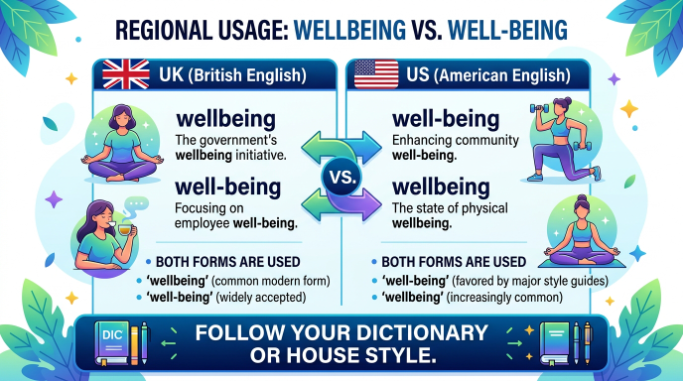
Wellbeing or Well Being in UK English?
A common question is: Is it wellbeing or well-being in UK English?
The answer is both forms can be found and accepted, depending on the dictionary and editorial convention.
British English does not have one universal rule requiring every writer to use either the closed or hyphenated spelling. Modern British organizations frequently use wellbeing as one word, particularly in education, healthcare, workplace, and public-sector contexts.
At the same time, well-being remains a recognized spelling.
So, if you are writing for a British audience, the practical question is usually not:
“Which spelling is the only correct British version?”
Instead, ask:
“Which spelling does my publication, employer, university, or style guide prefer?”
That approach is more accurate than pretending there is a strict UK-only rule.
Wellbeing in American English
American English also uses both well-being and wellbeing, although preferences can vary according to dictionary and editorial style.
Some American publications and style systems have traditionally favored well-being, while the one-word form has become increasingly visible in modern usage.
Therefore, if you are writing for an American publication, follow its editorial style rather than assuming that every American writer uses the same spelling.
This is a good example of the difference between language rules and style conventions.
A grammar rule tells you how words function in a sentence. A style convention may tell you whether a particular compound should be written:
- open
- hyphenated
- closed
Both types of guidance matter, but they are not the same thing.
Meaning and Part of Speech
Whether you write wellbeing or well-being, the word is normally used as a noun.
It describes the overall quality of a person’s condition or life.
Physical wellbeing
Physical wellbeing can include:
- health
- fitness
- rest
- nutrition
- physical comfort
Example:
Regular movement can support physical wellbeing.
Mental wellbeing
Mental wellbeing can involve:
- emotional balance
- resilience
- life satisfaction
- the ability to cope with everyday challenges
Example:
Supportive relationships can contribute to mental well-being.
Social wellbeing
Social wellbeing can involve a person’s relationships, sense of belonging, and connection with others.
Example:
Community activities can strengthen social wellbeing.
Overall wellbeing
This is the broadest use of the term.
Example:
The report examined how housing conditions affect overall wellbeing.
The word often refers to several connected areas of life rather than one specific medical condition.
Wellbeing vs Wellness: Are They the Same?
Wellbeing and wellness are closely related, but they are not always used in exactly the same way.
Wellbeing
Wellbeing is usually the broader concept.
It can include:
- physical health
- mental health
- emotional satisfaction
- social relationships
- safety
- quality of life
Example:
The program aims to improve the wellbeing of older adults.
Wellness
Wellness often appears in discussions about health practices, lifestyle, and active efforts to maintain good health.
Examples include:
- wellness programs
- wellness routines
- wellness activities
- the wellness industry
For example:
The company offers a workplace wellness program.
A wellness program may focus on exercise, nutrition, stress management, or healthy habits. Wellbeing can describe the broader outcome or condition those efforts are intended to support.
The words can overlap, so context matters. They are related terms, not perfect interchangeable synonyms in every sentence.

Examples of Wellbeing and Well-Being by Context
Workplace context
- Flexible schedules can improve employee wellbeing.
- The company invested in staff well-being initiatives.
- Managers should consider the long-term wellbeing of their teams.
Education context
- Schools increasingly discuss student wellbeing.
- Emotional well-being can affect a student’s ability to learn.
- The new policy supports the social and academic wellbeing of children.
Health context
- Sleep plays an important role in overall wellbeing.
- The doctor discussed habits that could support her long-term well-being.
- Access to healthcare can influence community wellbeing.
Family context
- Parents often make decisions with their children’s wellbeing in mind.
- A stable home environment can support a child’s well-being.
Everyday context
- Taking regular breaks can improve your wellbeing.
- He made more time for activities that supported his well-being.
- Good relationships contribute to many aspects of human wellbeing.
Notice that the meaning remains essentially the same whether the accepted one-word or hyphenated spelling is used.
Common Mistakes
Mistake: Assuming only one spelling is correct
❌ Wellbeing is correct, and well-being is always wrong.
This is too absolute.
Better:
✅ Wellbeing and well-being are both accepted, but preferences vary by style and source.
Mistake: Treating the hyphen as a meaning change
❌ Wellbeing and well-being mean different things.
Usually, they do not.
Better:
✅ The difference is generally one of spelling convention and editorial style, not meaning.
Mistake: Using the two-word form by default
❌ We care about employee well being.
Better:
✅ We care about employee wellbeing.
Or:
✅ We care about employee well-being.
Mistake: Mixing spellings without a reason
❌ The company promotes employee wellbeing and provides new well-being programs.
This may look inconsistent if both forms appear in the same document without an editorial reason.
Better:
✅ The company promotes employee wellbeing and provides new wellbeing programs.
Or consistently use:
✅ The company promotes employee well-being and provides new well-being programs.
A Fast Decision Rule
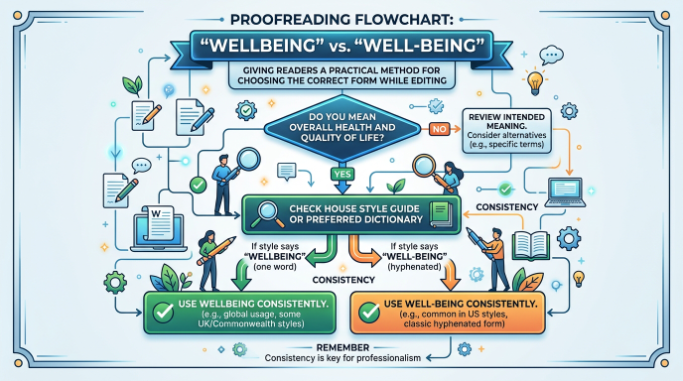
Use this checklist when proofreading:
Step 1: Are you referring to overall health, happiness, or welfare?
If yes, you are probably looking for the noun wellbeing or well-being.
Step 2: Does your style guide specify a spelling?
If yes, follow it.
Step 3: Is there no required style?
Choose one accepted form and use it consistently.
For many modern general-purpose contexts, wellbeing is a practical choice. However, well-being remains appropriate where that spelling is preferred by your dictionary or editorial system.
Step 4: Did you write “well being” as two words?
Check whether you actually mean the established noun relating to health and welfare. If you do, consider changing it to wellbeing or well-being.
A Simple Memory Trick
Think of wellbeing as the name of one broad concept.
Just as words such as happiness and health can describe a general state, wellbeing can describe a person’s overall condition.
If you prefer the traditional hyphenated spelling, remember that well-being represents the same concept.
The most useful memory rule is:
One concept, two widely accepted spellings, but avoid switching between them without a style reason.
This is better than memorizing an oversimplified rule such as “one word is always right.”
A Practical Proofreading Test
When editing your writing, try this test:
Read the sentence and ask:
“Am I referring to someone’s overall health, happiness, comfort, or quality of life?”
If the answer is yes, use the established noun spelling preferred by your style:
- wellbeing
- well-being
Then search your document for the other spelling.
For example, if you choose wellbeing, search for:
- well-being
- well being
This helps you find inconsistent spelling throughout a long article, report, website, or academic document.
Consistency is especially important in:
- professional reports
- academic writing
- websites
- employee policies
- educational materials
- healthcare content
Formal, Casual, and Professional Usage
Formal writing
Both wellbeing and well-being can appear in formal writing, depending on the editorial style.
Examples:
- The policy aims to protect public wellbeing.
- The policy aims to protect public well-being.
Before submitting formal work, check the required style guide.
Casual writing
In everyday writing, readers will generally understand either accepted spelling.
For example:
I’ve been trying to make more time for my own wellbeing.
The one-word form often feels natural in modern digital communication.
Academic and institutional writing
Consistency is particularly important here.
A university, government department, healthcare organization, or employer may have its own terminology standards. If one spelling appears in official documents, follow that established convention.
Website writing
For websites, choose one spelling for the main content and maintain it across:
- headings
- body text
- image alt text where relevant
- navigation labels
- related articles
Do not alternate between wellbeing, well-being, and well being merely to target different search phrases. Natural writing and consistent terminology are more important than artificial repetition.
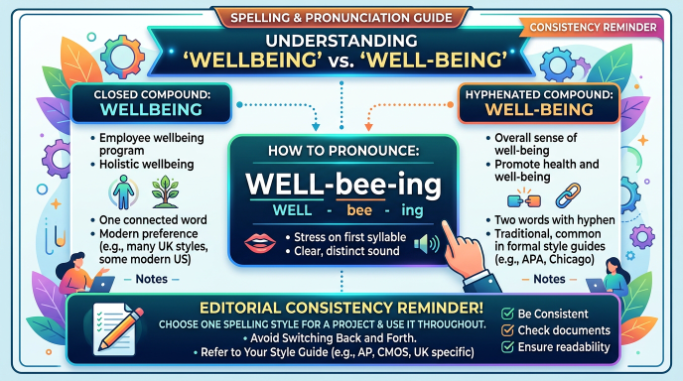
Pronunciation
Wellbeing and well-being are pronounced the same.
A simple pronunciation guide is:
WELL-bee-ing
The spelling changes, but the pronunciation and core meaning do not.
The stress falls naturally at the beginning of the expression:
WELL-being
Is Wellbeing One Word or Two?
This is one of the most common questions.
Wellbeing is one word when you choose the closed spelling.
Well-being is hyphenated when you follow the hyphenated spelling convention.
Writing well being as two separate words is generally not the preferred modern form for the noun meaning overall health and welfare.
So the most accurate answer is not simply:
“It must always be one word.”
Instead:
Use either “wellbeing” or “well-being” according to your preferred dictionary or style guide, and stay consistent.
Is Well-Being Hyphenated?
It can be.
The form well-being is a recognized hyphenated spelling.
However, wellbeing is also widely used as a closed compound.
Therefore, asking whether wellbeing “must” have a hyphen does not have one universal answer across all publications and style systems.
The better question is:
Which spelling does the writing standard I am following prefer?
Frequently Asked Questions
Is it wellbeing or well-being?
Both are accepted spellings. Wellbeing is the closed form, while well-being uses a hyphen. Your choice may depend on your dictionary, region, or editorial style.
Is wellbeing one word?
Yes. Wellbeing is an accepted one-word spelling.
Does wellbeing have a hyphen?
Not necessarily. Wellbeing is written without a hyphen, while well-being is an alternative accepted hyphenated spelling.
Is well-being hyphenated?
Yes. Well-being is the hyphenated version of the word.
Is it well being or wellbeing?
For the noun meaning overall health, happiness, and welfare, wellbeing or well-being is generally preferred over well being as two separate words.
Which spelling should I use in the UK?
Both wellbeing and well-being can be used. Check the style guide, dictionary, organization, or publication you are writing for.
Which spelling should I use in the US?
Usage varies. Well-being has traditionally been common in some American style systems, while wellbeing is also increasingly used. Follow the required editorial style when one exists.
What is the difference between wellbeing and wellness?
Wellbeing usually refers broadly to a person’s overall condition and quality of life. Wellness often focuses more specifically on health-related habits, practices, and efforts to maintain good health.
Is wellbeing a noun?
Yes. Wellbeing is generally used as a noun referring to overall health, happiness, comfort, and quality of life.
Should I use wellbeing or well-being in SEO writing?
Use the spelling that best matches your site’s editorial style and audience, then stay consistent. Do not repeatedly alternate between spellings just to include search variations.
Final Takeaway
The answer to “wellbeing or well being?” is straightforward with one important nuance:
Use “wellbeing” or “well-being” when referring to overall health, happiness, and welfare. Both forms are accepted, although preferences vary by dictionary and style guide. Avoid “well being” as two separate words for this noun in ordinary modern writing.
If you are unsure which version to choose, follow this practical rule:
Check your style guide. If none exists, choose one accepted spelling and use it consistently throughout your writing.
For many modern contexts, wellbeing is a common and clean choice. Well-being remains equally useful where a hyphenated editorial convention is preferred.