Spiel or Schpiel: Which Spelling Is Correct?
Quick Answer
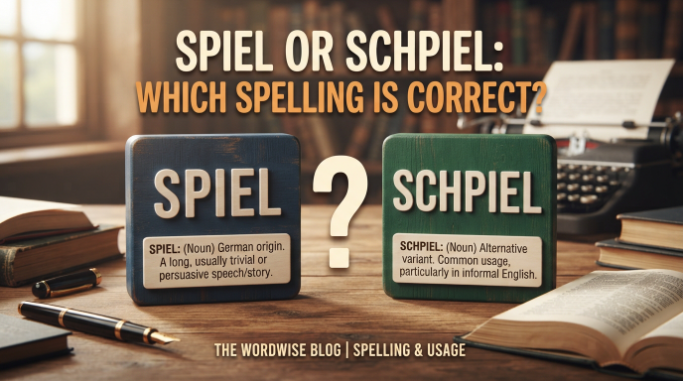
Spiel is the standard English spelling. If you mean a rehearsed, often persuasive or overly long speech, explanation, or sales pitch, write spiel.
Schpiel is a recognized variant spelling, but it is much less common. You may also encounter forms such as shpiel, shpeel, and schpeel, especially when writers are trying to represent a Yiddish-influenced pronunciation or spelling.
So, in ordinary English writing:
Correct standard choice: spiel
Less common variant: schpiel
For example:
- She gave me the whole spiel about why I should join.
- The salesman launched into his usual spiel.
- I know the spiel by heart because I’ve heard it so many times.
If you are writing for school, work, journalism, or general-purpose English, spiel is the safest spelling.

At-a-Glance Table
| Question | Answer |
|---|---|
| Standard English spelling | spiel |
| Is schpiel a word? | Yes, it can be found as a variant spelling |
| Is spiel more common? | Yes |
| What does spiel mean? | A practiced speech, pitch, explanation, or familiar line of talk |
| Part of speech | Mainly noun; also used as a verb |
| Typical pronunciation | /ʃpiːl/, roughly “shpeel” |
| Is shpeel standard? | It is a variant spelling, but spiel is the normal choice |
| Is shpiel used? | Yes, as a variant |
| Is schpeel used? | Yes, but it is uncommon |
| British vs. American English | Spiel is understood and used in both |
| Best spelling for formal/general writing | spiel |
| “The whole spiel” meaning | The complete familiar explanation, speech, pitch, or set of remarks |
What Is the Difference Between Spiel and Schpiel?
The main difference is spelling and usage frequency, not a major difference in meaning.
Spiel is the established English form. It can describe a prepared or practiced speech, especially one that someone gives repeatedly. Depending on context, it can be neutral, humorous, skeptical, or mildly dismissive.
For example:
The tour guide gave us the usual spiel about local history.
Here, spiel means a prepared or familiar explanation.
It can also refer to a sales pitch:
I listened to the salesperson’s spiel before deciding.
In this use, the word often suggests that the speaker has delivered essentially the same pitch many times.
Schpiel, meanwhile, is encountered as an alternative spelling. It represents the same basic word rather than a separate grammatical category with a different definition. In edited general English, however, spiel is considerably more conventional.
Why Does “Spiel” Sound Like “Shpeel”?
This is one reason the spelling creates confusion.
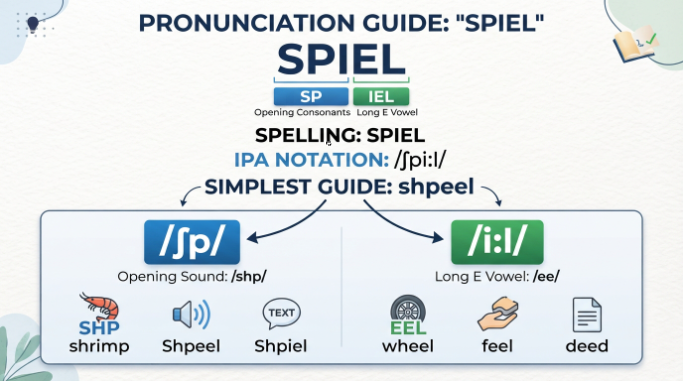
Spiel is generally pronounced approximately:
shpeel
The initial sp sound is pronounced together, while the vowel is a long ee sound.
The IPA pronunciation is commonly represented as /ʃpiːl/.
That pronunciation can encourage people to spell the word phonetically as shpeel, shpiel, or schpeel. Those forms can appear in writing, but the conventional English spelling remains spiel.
Spiel: Meaning, Grammar, and Usage
Spiel as a Noun
The most common modern English use is as a noun.
A spiel is a prepared, practiced, or familiar speech, explanation, or persuasive presentation.
Examples:
He gave me his usual spiel about saving money.
After hearing the same spiel three times, I knew what was coming next.
The guide delivered a short spiel before the tour began.
The noun can describe something quite neutral:
The presenter gave a five-minute spiel explaining how the software works.
But it frequently carries a slight suggestion that the speech is rehearsed, repetitive, exaggerated, or designed to persuade.
That implication depends on context.
Spiel as a Verb
Spiel can also function as a verb, although this use is less prominent than the noun.
It can mean to talk at length, especially in a rehearsed or persuasive manner.
Examples:
He kept spieling about the benefits of the new system.
The representative spieled for several minutes before answering my question.
The past-tense form spieled can therefore be found, although many speakers naturally prefer a construction such as gave a spiel.
For example:
She gave a spiel about the company’s new policy.
This often sounds more natural than forcing the verb into every context.
When Should You Use “Spiel”?
Use spiel when you mean a practiced speech, familiar explanation, sales pitch, persuasive talk, or extended set of remarks.
It works particularly well when someone has heard essentially the same explanation before.
Sales and Marketing
The salesperson gave us the standard spiel about the product’s benefits.
Here, spiel suggests a prepared sales presentation.
Repeated Explanations
I’ve heard this spiel before, so you don’t need to explain it again.
The speaker recognizes the explanation as familiar.
Persuasion
He launched into a long spiel about why his plan would solve everything.
The word can subtly signal skepticism toward the speaker’s claims.
Instructions or Presentations
The instructor gave a brief spiel about laboratory safety.
This is comparatively neutral. The word does not automatically mean that the speaker is dishonest or insincere.
When Might “Schpiel” Be Used?
Schpiel can appear as a variant spelling, particularly when a writer wants to emphasize a pronunciation or Yiddish-influenced form.
However, if your purpose is simply to write standard contemporary English, there is usually no advantage to choosing schpiel over spiel.
Compare:
The manager gave his usual spiel. ✓
The manager gave his usual schpiel. ✓ Possible variant, but unusual
The first sentence is the normal choice for general English prose.
This distinction matters because a spelling can be attested without being the preferred spelling for everyday edited English.
In other words, “Is schpiel a possible spelling?” and “Which spelling should I use?” are slightly different questions.
The answer to the first can be yes; the answer to the second is generally spiel.
What Does “The Whole Spiel” Mean?
The whole spiel means the complete speech, explanation, pitch, story, or familiar set of remarks someone gives.
For example:
She gave me the whole spiel about why the project was delayed.
This means she gave the speaker the complete explanation, probably including all the familiar details.
The phrase can sound mildly impatient:
I don’t need the whole spiel. Just tell me what happened.
Here, the speaker is saying that they do not want a long or familiar explanation.
It can also be neutral or humorous:
Before the trip, Dad gave us the whole spiel about keeping our passports safe.
The exact attitude comes from context rather than from the phrase itself.

Examples of “Spiel” in Different Contexts
Casual Conversation
I got the whole spiel when I asked why he was late.
Don’t give me the same spiel again.
She has a funny spiel that she uses whenever someone asks about her job.
Work and Business
The consultant gave the executives a detailed spiel about the proposed changes.
We had already heard the company’s spiel about improving customer service.
The sales team practices its opening spiel before meeting clients.
Education
The professor gave a short spiel about academic integrity before the exam.
Our instructor’s safety spiel took less than five minutes.
Travel
The guide gave us the usual spiel about staying together.
Before departure, the crew delivered a safety spiel.
Online Content
I’ve heard that productivity spiel in dozens of videos.
The advertisement starts with a familiar spiel about working smarter.
Humor or Sarcasm
Here comes the spiel about how this time everything will be different.
This sentence uses spiel to signal that the speaker has heard the same type of promise before.
“Spiel” vs. “Shpeel” vs. “Shpiel” vs. “Schpeel”
These spellings can look interchangeable, but they do not have the same status in ordinary English writing.
| Form | General status | Typical advice |
|---|---|---|
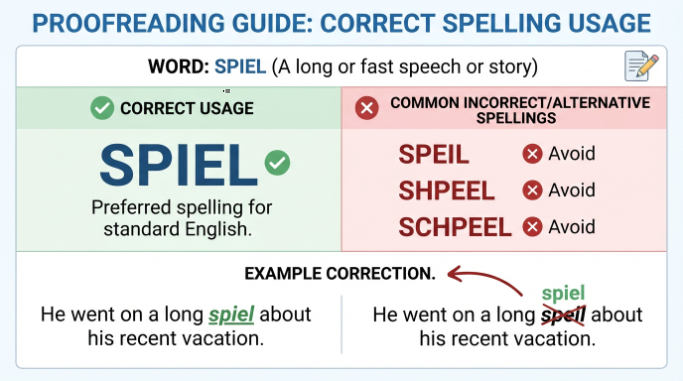
| spiel | Standard, established English spelling | Use this normally |
| schpiel | Variant spelling | Usually unnecessary in general writing |
| shpiel | Variant spelling reflecting pronunciation | May occur in informal or culturally specific usage |
| shpeel | Phonetic-looking variant | Usually avoid in edited general prose |
| schpeel | Less common variant | Usually avoid unless reproducing a specific usage |
The key point is that these variants do not normally represent five different meanings.
If you are asking how to spell shpeel, the answer in standard English is generally spiel.
If you are asking how to spell schpeel, the same practical answer applies: spiel is the conventional spelling.
“Speil” or “Spiel”?
Spiel is correct.
Speil is a common spelling error caused by rearranging the letters.
Correct:
He gave his usual spiel.
Incorrect in standard English:
He gave his usual speil.
This is a useful spelling distinction because spiel has an unusual-looking vowel sequence for English speakers.
A simple memory aid is to remember:
Spiel has “ie,” not “ei.”
That does not mean English always follows an “i before e” rule—English spelling has many exceptions—but it gives you a practical way to remember this particular word.
“Spiel” or “Speel”?
For the meaning discussed here, spiel is the standard spelling.
Speel may occur as a word in other contexts or as a variant in particular names or dialectal uses, but it is not the normal spelling of the English noun meaning a practiced speech or pitch.
So:
sales spiel ✓
sales speel ✗ for the standard form
“Spiel” or “Speal”?
Again, spiel is the standard form when you mean a speech, pitch, or familiar explanation.
Speal is not the standard spelling of this word.
The same applies to searches such as speil definition, speal or spiel, and speill: if the intended meaning is the familiar speech or pitch, the standard English form is spiel.
What Does “Shpeel” Mean?
Shpeel is generally an alternative spelling intended to represent the pronunciation of spiel.
If someone writes:
He gave me the whole shpeel.
they generally mean:
He gave me the whole spiel.
The pronunciation-based spelling is understandable because spiel is pronounced approximately “shpeel.”
However, for standard edited English, spiel remains the preferable spelling.
The same principle applies to shpiel and schpeel when they are being used to represent the same word.
Common Mistakes
Mistake 1: Writing “speil”
❌ She gave her usual speil.
✓ She gave her usual spiel.
The letters are reversed.
Mistake 2: Assuming “shpeel” is the standard spelling
❌ He gave us the whole shpeel.
✓ He gave us the whole spiel.
Shpeel reflects the sound more directly, but spiel is the conventional spelling.
Mistake 3: Treating “schpiel” as a completely different word
❌ Schpiel has a separate meaning from spiel.
The difference is primarily one of spelling and usage convention when the two forms are being used for this same sense.
Mistake 4: Assuming every spiel is dishonest
❌ A spiel always means a dishonest speech.
A spiel can be skeptical or dismissive in tone, but it can also simply mean a practiced or prepared explanation.
For example:
The instructor gave a short safety spiel.
There is nothing inherently dishonest about that statement.
Mistake 5: Using “spiel” for every kind of speech
Not every speech is a spiel.
A presidential address, academic lecture, wedding speech, or spontaneous conversation is not automatically a spiel.
The word works particularly well when the speech is prepared, familiar, repetitive, persuasive, or delivered as a set piece.
A Fast Decision Rule
When you’re unsure whether to write spiel or schpiel, use this three-step test:
1. Do you mean a practiced speech, pitch, explanation, or familiar set of remarks?
If yes, you’re probably looking for this word.
2. Are you writing standard English?
If yes, use spiel.
3. Are you deliberately reproducing an informal, phonetic, dialectal, or culturally specific spelling?
If yes, a variant such as schpiel or shpiel may be appropriate depending on the source and context.
Otherwise, choose spiel.
The 5-Second Proofreading Test
Put the word into this sentence:
He gave me the whole _____.
If you mean a familiar speech or explanation, write:
He gave me the whole spiel.
That is the standard form you should normally keep.
A Memory Trick for “Spiel”
Think:
A spiel is a speech, and both contain a strong “s” sound at the beginning.
For spelling, remember the sequence:
S + P + I + E + L
Not:
S + P + E + I + L
And not:
S + C + H + P + I + E + L
when you simply want the standard English word.
Another useful association is:
spiel → spieling → spieled
Seeing the word family together can reinforce its spelling.
Formal vs. Casual Usage
Spiel is not restricted to slang, but it often has a conversational or informal flavor.
In highly formal writing, you may prefer a more precise word depending on what you mean:
- presentation
- explanation
- statement
- speech
- pitch
- sales presentation
- argument
- description
Compare:
The representative gave a spiel about the new regulations.
with:
The representative provided an explanation of the new regulations.
The second version sounds more neutral and formal.
But spiel can be exactly the right choice when the writer wants to communicate the idea of a familiar, rehearsed, or somewhat formulaic presentation.
British and American English
Spiel is used in both British and American English.
There is no major British-versus-American spelling distinction comparable to pairs such as colour/color or centre/center.
You can therefore normally write:
spiel
regardless of whether your audience is in the United States or the United Kingdom.
Regional differences are more likely to involve tone and frequency of use than spelling.
Is “Spiel” an English Word or a German Word?
Spiel has a German origin, where the German noun Spiel means “game” or “play.” The English word developed through a different sense associated with a speech or sales pitch.
The English spiel is also connected historically with Yiddish, in which related forms were used for a speech, story, or talk. The English usage is therefore a good example of how a word can move between languages and acquire a specialized meaning in another language.
Because etymology can be complicated, it is important not to assume that the modern English meaning simply means “game” because German Spiel means “game.” The modern English sense of spiel has its own history.

How to Pronounce “Spiel”
Spiel is commonly pronounced:
/ʃpiːl/
A rough English pronunciation guide is:
shpeel
The first sound is like the sh in ship, followed by the p, then a long ee sound, and finally l.
So although the spelling begins with sp, the pronunciation begins with the sound represented by shp.
This explains why people search for spellings such as:
- shpeel
- shpiel
- schpeel
- schpiel
These forms attempt to make the pronunciation more obvious to the reader.
But pronunciation and spelling are separate issues. The fact that a word sounds like “shpeel” does not make shpeel its standard English spelling.
“Giving a Spiel” and “Give a Spiel”
Both expressions are grammatical.
Giving a spiel
He was giving a spiel about the new product.
This uses spiel as a noun after the participle giving.
Give a spiel
She gave a spiel before the meeting began.
This is the simple past.
You can also use:
He gives the same spiel every Friday.
They gave us a detailed spiel about the changes.
I don’t want to hear another spiel.
The noun construction give/gave a spiel is especially natural.
“Spiels” Meaning
Spiels is simply the plural form of the noun spiel.
For example:
I’ve heard several different sales spiels this week.
It can also be the third-person singular form of the verb:
He spiels about the product whenever someone asks.
Context tells you whether spiels is a plural noun or a verb.
Edge Cases: When a Variant May Be Deliberate
There are situations where schpiel, shpiel, or another variant may be intentionally retained.
Quoted or Historical Material
If you are reproducing someone’s original spelling, changing it could alter the source.
Character Voice
A fiction writer may use a phonetic spelling to convey a particular voice or pronunciation.
Cultural or Linguistic Context
A writer discussing Yiddish-influenced speech may deliberately use a particular transliteration.
Names and Titles
If a word appears as part of a proper name, title, publication, or other fixed expression, preserve the established spelling rather than automatically changing it to spiel.
These are exceptions to the practical rule for ordinary English prose. They do not make every variant equally standard.
FAQs
Is “schpiel” a correct spelling?
Schpiel is found as a variant spelling, but spiel is the standard and much more conventional spelling for general English writing.
How do you spell “shpeel”?
If you mean the familiar speech, pitch, or explanation, the standard English spelling is spiel.
How do you spell “schpeel”?
For the same meaning, the conventional English spelling is spiel. Schpeel is an uncommon variant.
What does “spiel” mean in English?
It usually means a practiced or familiar speech, explanation, sales pitch, or set of remarks. It can sometimes imply that the speaker is being repetitive or overly persuasive.
What does “the whole spiel” mean?
It means the complete explanation, speech, pitch, or familiar set of remarks.
Is “spiel” a noun or a verb?
It is most commonly a noun, but it can also be used as a verb meaning to talk at length, especially in a rehearsed or persuasive way.
How do you pronounce “spiel”?
It is commonly pronounced approximately “shpeel,” represented in IPA as /ʃpiːl/.
Is “shpiel” the same as “spiel”?
When used for the speech or pitch meaning, shpiel is generally a variant spelling of the same word. Spiel is the conventional spelling in standard English.
Is “speil” correct?
Not for the standard word meaning a practiced speech or pitch. Spiel is correct.
Is “speal” another spelling of spiel?
No. Speal is not the standard spelling of spiel in this sense.
Is “spiel” German?
The English word has German and Yiddish-related linguistic history, but modern English spiel has a specialized meaning referring to a speech, pitch, or familiar talk. German Spiel itself commonly means “game” or “play.”
Can I use “spiel” in formal writing?
Yes, but consider the tone. Spiel is understandable in formal English, yet words such as explanation, presentation, or statement may be more neutral when that is what you actually mean.
Is “spiel” used in British English?
Yes. Spiel is used in both British and American English, without a major spelling difference between the varieties.
Relevant Internal-Link Suggestions
For a word-choice and spelling guide site, useful internal links would include:
- Speil vs. spiel — explain why spiel is the standard spelling and address the common letter-order error.
- Shpiel vs. spiel — distinguish the variant spelling from the conventional English form.
- How to pronounce spiel — provide pronunciation, IPA, and example sentences.
- German words used in English — place spiel within the broader history of German-derived English vocabulary.
- Common English spelling mistakes — connect speil, shpeel, and similar phonetic or transposed spellings to a broader spelling guide.
Final Takeaway
If you are wondering “spiel or schpiel?”, choose spiel for standard English writing.
Spiel is the conventional spelling for a practiced speech, familiar explanation, sales pitch, or repeated set of remarks. Schpiel, along with shpiel, shpeel, and schpeel, can appear as variant spellings, but they are not normally the best choice when you simply want standard English.
The pronunciation can be remembered as “shpeel,” but the spelling to put on the page is:
SPIEL
And if you see speil, speal, speill, or a similar form when the intended meaning is this word, spiel is the form to use.