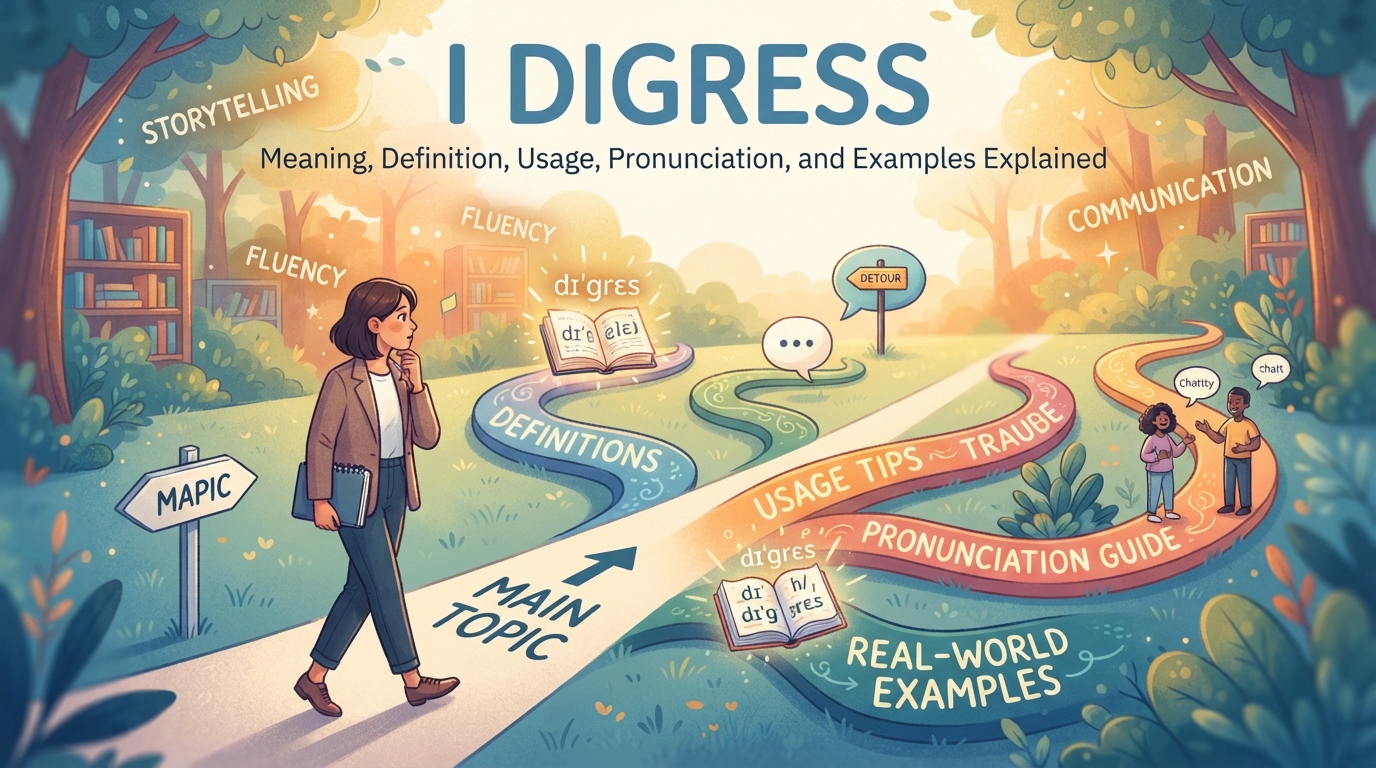
I Digress Meaning: Definition, Usage, Pronunciation, and Examples
Quick Meaning
“I digress” means “I have moved away from the main topic” or “I have started talking about something unrelated, so let me return to the original point.”
It is most commonly used after a speaker or writer has gone off-topic, especially when the side comment is noticeable but not necessarily a serious problem. In everyday English, “but I digress” is particularly common and can sound humorous or self-aware.
For example:
“I was telling you about my new job. The office coffee is terrible, by the way—but I digress. My first day was surprisingly good.”
Here, the speaker briefly moved from the topic of the new job to the coffee and then recognized the detour.
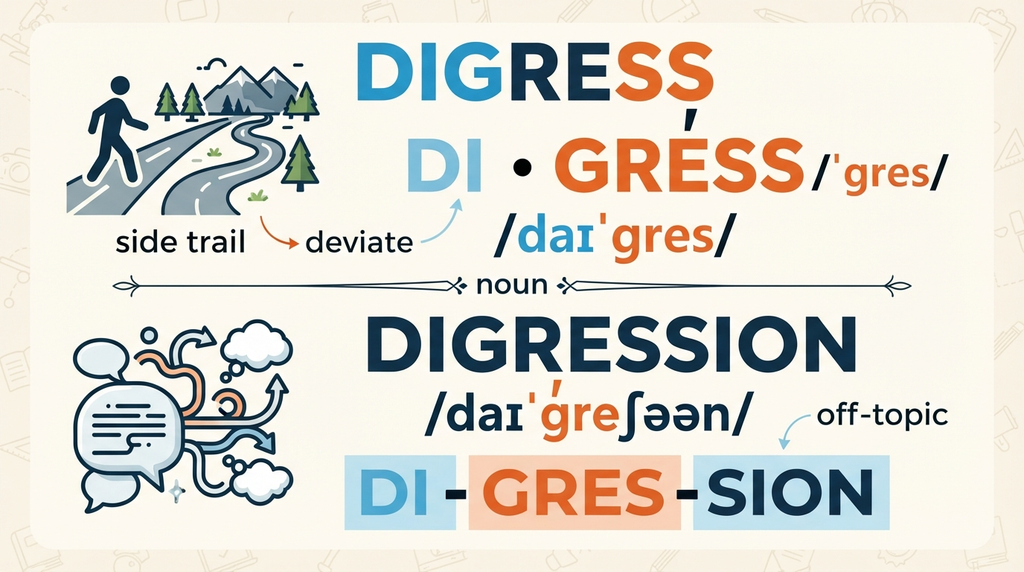
The verb digress is pronounced with the stress on the second syllable. Cambridge gives the pronunciation /daɪˈɡres/ in both British and American English.
digress
dye-GRESSAdd to flashcards
Give feedback

Definition Table
| Term or expression | Meaning | Grammar | Typical use |
|---|---|---|---|
| digress | To move away from the main subject | Verb | Formal and general writing/speech |
| I digress | I have moved away from the main point | First-person verb phrase | Self-correction after a tangent |
| but I digress | I have gone off-topic, so let me return | Fixed conversational phrase | Often humorous or self-aware |
| we digress | We have moved away from the subject | First-person plural verb phrase | Group discussion or playful commentary |
| digressing | Moving away from the main topic | Present participle | Describing an ongoing tangent |
| digression | A departure from the main subject | Noun | Formal writing and speech |
| digressive | Characterized by departures from the main topic | Adjective | Formal description of speech or writing |
The core dictionary definition is straightforward: to digress is to move away from the main subject of what you are saying or writing. Cambridge classifies the verb as formal in some of its learner and American dictionary treatments.
I Digress Meaning in Context
The expression “I digress” is not usually a literal statement about physically moving somewhere. It is a figurative use of digress: instead of following the central conversational or written “path,” you temporarily move away from it.
Suppose someone is explaining how they prepared for an exam:
“I studied every evening for three weeks. My roommate, meanwhile, watched six seasons of a TV show. I still don’t understand how he had that much free time—but I digress. The important thing is that I passed.”
The speaker’s comment about the roommate is a digression because it is not central to the original point.
What does it mean to say “I digress”?
When someone says “I digress,” they usually mean:
- “I’ve gone off-topic.”
- “I’ve wandered from my original point.”
- “I’ve started discussing something else.”
- “Let me get back to what I was saying.”
It does not necessarily mean the speaker has made a mistake. A digression can be intentional, entertaining, relevant, or completely spontaneous.
The expression can therefore carry a slightly humorous or self-aware tone. Someone may knowingly take a small conversational detour and then acknowledge it with “but I digress.”
Literal versus figurative meaning
The literal historical idea behind digress involves moving away from a path or course. In modern English, however, the word is overwhelmingly used for a figurative departure from a subject.
Compare:
Figurative:
“I was discussing the budget, but I digressed into a story about my first job.”
Physical movement:
You generally would not use digress in ordinary modern English to mean physically walking away from a road. Words such as leave, deviate, wander, or stray are normally more natural for physical movement.
The modern dictionary sense specifically centers on moving away from the main subject in speech or writing.
How to Pronounce Digress
Digress is pronounced:
/daɪˈɡres/
The stress falls on the second syllable. Cambridge lists this pronunciation for both British and American English.
The first part has the same vowel sound found in words such as my and time, while the ending rhymes closely with press.
A common pronunciation mistake is putting the strongest stress on the first syllable. In standard English, the emphasis belongs on the second syllable.
The related noun digression is pronounced /daɪˈɡreʃən/.
Usage and Grammar
Digress is a verb
Digress is an intransitive verb, meaning it normally does not take a direct object.
You can say:
“She digressed from the main topic.”
You would not normally say:
“She digressed the main topic.”
The common grammatical pattern is:
digress from + topic/subject
Examples:
“The speaker digressed from the question.”
“The article occasionally digresses from its central argument.”
“He digressed from the original subject.”
Cambridge specifically records digress from something as a common collocation.
Present, past, and continuous forms
The main forms are:
- digress — present/base form
- digresses — third-person singular
- digressed — past tense and past participle
- digressing — present participle
Examples:
“I sometimes digress when telling stories.”
“She digresses whenever the conversation turns to travel.”
“He digressed from the original question.”
“Sorry, I’m digressing.”
Cambridge confirms digressed as the past simple and past participle and digressing as the present participle.
Is “I digress” grammatically correct?
Yes. “I digress” is completely grammatical.
It is the first-person singular present form of digress. Because the expression is often used immediately after a speaker has gone off-topic, it can function almost like a conversational formula.
For example:
“I was going to explain the new software. I digress. Let’s return to the main issue.”
More naturally in casual English:
“I was going to explain the new software—but I digress.”
“But I digress”
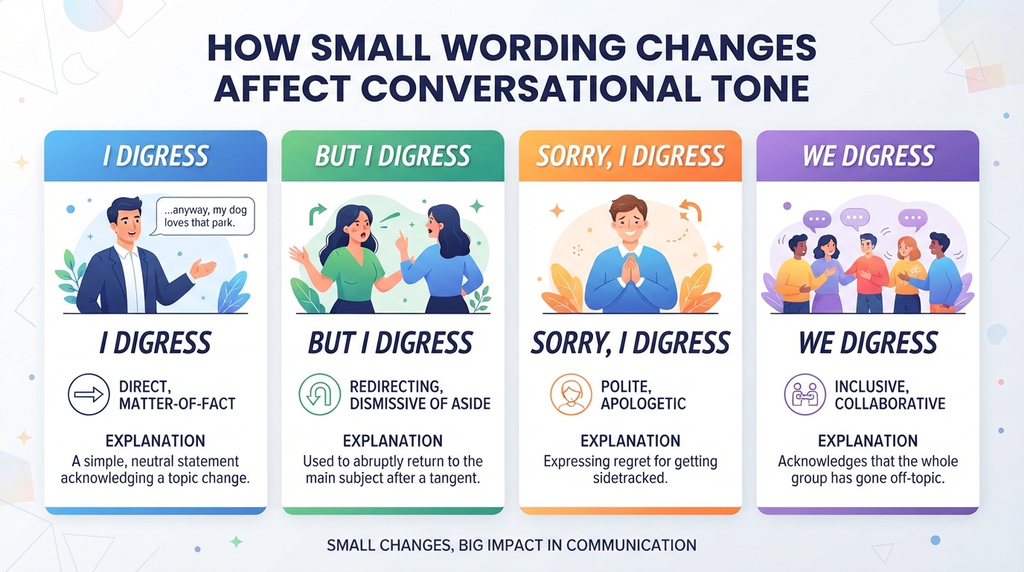
“But I digress” is probably the most recognizable version of the expression.
It generally means:
“I’ve wandered away from my original point, so let me get back to it.”
The word but creates a contrast between the detour and the return to the main subject.
For example:
“My neighbor has an impressive collection of vintage cameras—but I digress. We were talking about the house renovation.”
The phrase is especially useful when the speaker realizes that an interesting side thought has taken over the conversation.
“Sorry, I digress”
This version is slightly more apologetic:
“Sorry, I digress. You were asking about the deadline.”
It works well in professional or semi-formal speech when you want to acknowledge that you have wandered away from the question.
“We digress”
“We digress” means that the speaker and listener—or a group of speakers—have collectively moved away from the original subject.
For example:
“We started by discussing the budget, and somehow we’re now debating pizza toppings. We digress.”
It can also be playful because it makes the conversational detour sound like something everyone has participated in.
How to Use Digress in a Sentence
Here are original examples showing several natural uses.
Everyday conversation
“I was going to tell you about the meeting, but I digress.”
“Sorry, I digressed for a moment. What were you saying?”
“We digress. Let’s get back to the original question.”
Professional communication
“The report briefly digresses from the central issue to discuss historical context.”
“I don’t want to digress from the main purpose of this meeting.”
“The presenter digressed from the agenda to address a related concern.”
Academic writing
“Before examining the results, it is useful to digress briefly into the history of the method.”
Academic writing can use digress, but writers should generally avoid unnecessary digressions. A formal text can deliberately introduce background information, but a long unrelated tangent may weaken clarity.
Storytelling
“I could tell you exactly what happened next, but first I should mention that the restaurant had the strangest waiter I’ve ever seen. But I digress.”
Here, the phrase signals that the narrator knows the story has temporarily taken a different direction.
Humorous use
“I promised myself I wouldn’t buy another notebook. Then I saw the stationery shop. But I digress.”
This is a particularly natural modern use because the expression can acknowledge a humorous or relatable tangent.
“I Digress” in Modern Internet and Social-Media Language
The phrase is also common in informal online writing.
A person may write:
“The new update is actually pretty useful. The design still needs work, though. But I digress.”
In this context, “but I digress” often has a deliberately conversational quality. It can signal that the writer knows they have wandered from the original point.
Online, it may also be used ironically. Someone can deliberately make a long side comment and then say “but I digress” even though the tangent was clearly intentional.
That means the expression does not always function as a serious apology. It can be a stylistic device.
Is “I Digress” Formal or Informal?
The verb digress is more formal than ordinary alternatives such as:
- go off-topic
- get sidetracked
- go on a tangent
- wander from the point
However, “but I digress” is familiar enough to appear in ordinary conversation, humorous writing, blogs, essays, interviews, and online posts.
There is therefore an important distinction:
Digress as a verb: somewhat formal or literary.
But I digress: familiar conversational expression, often playful.
Cambridge labels the verb as formal in its American Dictionary and Learner’s Dictionary treatments.

Digress, Digression, and Digressive
These related words have different grammatical roles.
Digress
Verb
“I tend to digress when I’m excited.”
Digression
Noun
A digression is the actual departure from the main topic.
“Her story included an amusing digression about her childhood.”
Cambridge defines digression as the action of moving away from the main subject in speech or writing.
Digressive
Adjective
Something digressive tends to move away from its main subject.
“His writing style is highly digressive.”
The adjective is generally more formal and is especially useful when describing speech, writing, narrative structure, or argumentation.
“Digressing” Meaning
Digressing means moving away from the main topic, usually while speaking or writing.
For example:
“I’m digressing from the question.”
“She kept digressing during the presentation.”
“Without digressing too much, let’s consider the second issue.”
It describes an action that is happening or continuing, whereas digression names the departure itself.
Compare:
“He is digressing.” — He is currently moving away from the subject.
“That was a digression.” — The departure from the subject is being identified as a thing or event.
“Parenthetically Digress” Meaning
Parenthetically means something like “as an aside” or “by inserting a side comment.”
So if someone says they “parenthetically digress,” they mean they are briefly departing from the main subject to add an aside.
For example:
“Parenthetically, I should mention that the original plan was much more ambitious.”
The combination “parenthetically digress” is understandable, but it is not the most natural everyday phrase. More idiomatic alternatives include:
“As an aside…”
“By the way…”
“Briefly, I should mention…”
“I should digress briefly to explain…”
The important distinction is that a parenthetical remark is usually a brief aside, while a digression can be much longer.
I Digress Meaning in Psychology
There is no special standard psychological definition of “I digress.” It remains an ordinary English expression meaning that the speaker has departed from the main subject.
The verb can appear in discussions of communication, speech, attention, narrative style, or conversational behavior, but that does not create a separate psychological meaning.
For example:
“The speaker frequently digresses when discussing stressful topics.”
Here, digresses simply describes the speaker’s conversational behavior. It does not, by itself, establish a psychological condition or diagnosis.
This distinction matters because ordinary language should not automatically be treated as technical psychological terminology.
Similar Expressions
Several expressions overlap with digress, but their meanings and tones are not identical.
| Expression | Main idea | Tone |
|---|---|---|
| go off-topic | Stop discussing the main subject | Neutral |
| get sidetracked | Be diverted from the original subject or task | Casual |
| go on a tangent | Spend time discussing a related or unrelated side subject | Casual |
| wander from the point | Move away from the main argument | Literary/formal |
| stray from the subject | Depart from the topic | Neutral/formal |
| digress | Depart from the main subject | Formal/neutral |
| digression | A departure from the main subject | Formal |
| ramble | Talk at length without a clear direction | Often negative |
The difference between digress and ramble is especially useful.
A person can digress briefly and deliberately:
“I digressed for a moment to explain the background.”
To ramble usually suggests less control or structure:
“He rambled for twenty minutes without answering the question.”
So a digression is not necessarily bad writing or bad communication.

Common Mistakes
1. Writing “I disgress”
“I disgress” is a misspelling. The standard word is digress.
Incorrect:
“But I disgress.”
Correct:
“But I digress.”
2. Writing “I degress”
“I degress” is also incorrect when you mean “I have gone off-topic.”
The correct form is:
I digress.
The spelling can be confusing because digress resembles other words beginning with de- or dis-.
3. Writing “digres”
“Digres” is not the standard English spelling of the verb.
Correct:
“I digress.”
4. Treating “digress” as a noun
Incorrect:
“That was a digress.”
Correct:
“That was a digression.”
Digress is the verb; digression is the noun.
5. Using a direct object after digress
Incorrect:
“He digressed the subject.”
Better:
“He digressed from the subject.”
The pattern digress from + topic is standard.
6. Assuming every digression is irrelevant
A digression can still be related to the main topic.
For example:
“The professor digressed briefly to explain why the theory had developed.”
The side discussion may be useful even though it temporarily leaves the central subject.
7. Thinking “but I digress” means “I disagree”
The words digress and disagree have completely different meanings.
Digress = move away from the subject.
Disagree = have a different opinion.
Origin and History of Digress
The historical origin of digress is well documented.
The English verb dates from around the 1520s and comes from Latin digressus, the past participle of digredi, meaning “to go aside,” “depart,” or “deviate.” The Latin word combines dis-, meaning “apart” or “aside,” with gradi, meaning “to step” or “go.”
The related noun digression is older in English, dating to the late 14th century, from Latin digressio, meaning a going away or departure.
This history helps explain the modern figurative sense. The basic idea is one of leaving a path. In modern English, that path is usually the path of an argument, conversation, explanation, or piece of writing.
There is no need to rely on a colorful folklore explanation for the word’s origin. The Latin derivation provides a well-supported historical account.
FAQs About “I Digress”
What does “I digress” mean?
“I digress” means “I have moved away from the main topic.” It is often followed by a return to the original subject.
What does “but I digress” mean?
“But I digress” means “I have gone off-topic, so let me return to my original point.” It is frequently used humorously or self-consciously.
Is “I digress” correct English?
Yes. I digress is grammatically correct and is a standard first-person use of the verb digress.
How do you pronounce digress?
It is pronounced /daɪˈɡres/, with the stress on the second syllable.
What does “digressing” mean?
Digressing means currently moving away from the main subject of a conversation or piece of writing.
What is the noun form of digress?
The noun is digression.
“His answer included a long digression about his childhood.”
Is “disgress” a word?
Disgress is not the standard spelling of the English verb meaning “go off-topic.” If that is the intended meaning, use digress.
Is “degress” correct?
Not for this meaning. The correct spelling is digress.
What does “we digress” mean?
“We digress” means “we have moved away from the subject we were discussing.” It can be literal, formal, or playful depending on context.
Can I use “digress” in academic writing?
Yes. It can be appropriate when describing a deliberate departure from the main subject. However, unnecessary digressions can make academic writing less focused.
What is the difference between digress and go on a tangent?
Both describe leaving the main subject. Digress is more formal, while go on a tangent is more conversational. Tangent can also suggest a more extended or unexpected side discussion.
Does “I digress” mean “I disagree”?
No. Digress means to move away from the topic; disagree means to have a different opinion.
What does “I digress” mean in psychology?
It does not have a separate standard psychological meaning. In psychological or communication contexts, it normally retains its ordinary meaning: moving away from the main subject.
Summary
“I digress” means “I have moved away from the main topic.” It is a standard English expression used when someone recognizes that they have taken a conversational or written detour.
The most familiar form is “but I digress,” which often signals a playful or self-aware return to the original point. The verb normally appears with from, as in “digress from the subject.”
Remember the related forms:
- digress = verb
- digressed = past form
- digressing = ongoing action
- digression = noun
- digressive = adjective
- I digress / but I digress = acknowledgment that the speaker has gone off-topic
And if you are choosing between digress, disgress, degress, and digres, the standard spelling for this meaning is simply digress.