Vender or Vendor: Which Spelling Is Correct?
Quick Answer
Vendor is the standard English spelling for a person or business that sells goods or services.
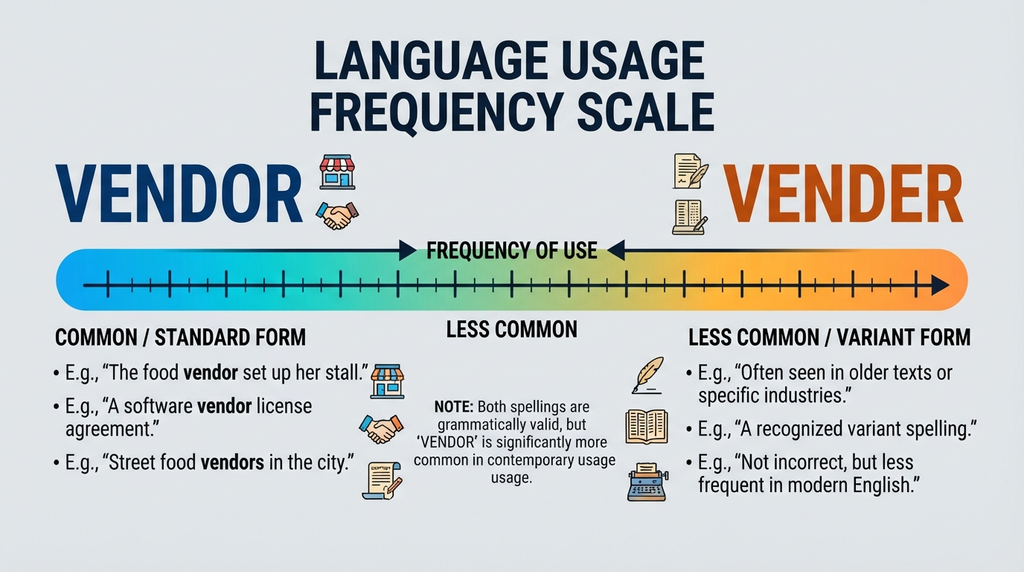
Vender is also a real English word, but it is much less common. It means essentially the same thing: a person or business that sells something. In modern standard usage, vendor is overwhelmingly the more common and generally preferred form, especially in business, technology, commerce, and formal writing.
So, if you are asking “Is it vender or vendor?”, use vendor in almost all ordinary situations.
For example:
- The vendor supplied the equipment on time. ✓
- We need to contact our software vendor. ✓
- Several vendors attended the trade show. ✓
- The street vendor sold fresh fruit. ✓
“Vender” is not simply a misspelling, but choosing it can look unusual because vendor is the established spelling most readers expect.

At-a-Glance Table
| Point | Vendor | Vender |
|---|---|---|
| Basic meaning | A person or business that sells something | A person or business that sells something |
| Part of speech | Noun | Noun |
| Standard spelling | Yes | Yes, but uncommon |
| Modern frequency | Very common | Much less common |
| Business writing | Preferred | Usually avoided |
| Technology writing | Very common | Unusual |
| Retail/commerce | Preferred | Possible but uncommon |
| British English | Used | Rare |
| American English | Used | Exists but uncommon |
| Plural | Vendors | Venders |
| Best default choice | Vendor | Usually not the first choice |
The important point is that this is not a simple correct-versus-incorrect spelling problem. Both vendor and vender have dictionary status, but they do not have equal standing in contemporary usage.
What Does “Vendor” Mean?
A vendor is a person, company, or organization that sells goods or services.
The word can refer to a small individual seller, such as someone selling food from a cart, or to a large company supplying products and services to other businesses.
Consider these examples:
- A street vendor was selling roasted corn.
- The company changed its cloud-service vendor.
- We compared prices from three equipment vendors.
- The software vendor released a security update.
The meaning is broad. A vendor can sell physical products, digital products, professional services, software, subscriptions, equipment, or other commercial offerings.
Vendor as a Noun
In ordinary contemporary English, vendor is primarily used as a noun.
It identifies the seller or supplier:
The vendor provided the replacement parts.
Here, vendor is the subject performing the action of providing the parts.
It can also appear before another noun as a modifier:
We held a vendor meeting on Tuesday.
The company is reviewing its vendor contracts.
She manages several vendor relationships.
In these constructions, vendor still relates to the seller or supplier.
Vendor in Business and Technology
The word has become especially common in business and technology.
A software vendor is a company that sells or provides software.
A hardware vendor supplies computer equipment or related physical technology.
A cloud vendor provides cloud-based infrastructure or services.
A third-party vendor is an external company or provider that supplies goods or services to an organization.
This explains why vendor is often the safest choice in professional writing.

What Does “Vender” Mean?
Vender is a legitimate English noun meaning a person who sells something.
In other words, its basic dictionary meaning overlaps with vendor.
For example:
The vender offered handmade goods at the market.
This sentence is understandable and grammatically possible. However, most contemporary readers are more accustomed to:
The vendor offered handmade goods at the market.
That difference in familiarity matters.
If you are writing a website, report, email, business document, academic paper, or professional communication, vendor is normally the more natural choice.
Is “Vender” a Misspelling?
Not necessarily.
Calling vender an outright spelling error would be too strong. The word has a genuine history in English and is recognized as a variant spelling.
The practical issue is usage frequency and convention. Because vendor is far more established in modern general and professional English, readers may assume vender is a typo even when it is technically a valid word.
That is why the safest editing advice is:
Use “vendor” unless you have a specific reason to use “vender.”
Vendor vs. Vender: Why Are There Two Spellings?
The two forms are closely related because both represent the idea of someone who sells.
English has historically contained spelling variation, particularly in words formed from older roots and borrowed forms. Over time, particular spellings become more dominant in different contexts.
For modern writers, however, you generally do not need to know the historical development to make the right choice.
The useful distinction is:
- Vendor = established, common, expected
- Vender = valid variant, but uncommon
This is similar to other cases where two forms may exist while one has become much more conventional.
The existence of vender does not mean the two forms are equally interchangeable in every practical context.
When Should You Use “Vendor”?
Use vendor when you mean a person or organization that sells goods or services.
It is particularly appropriate in the following contexts.
Business
We are negotiating a new contract with the vendor.
The purchasing team contacted several vendors.
Technology
The vendor released a patch for the application.
Our company uses a third-party software vendor.
Retail
The vendor displayed handmade products at the market.
Events and Markets
Food vendors will be available throughout the festival.
Supply and Procurement
The procurement team evaluated each vendor before signing the agreement.
In all of these examples, vendor sounds natural and conventional.
When Can “Vender” Be Used?
You can use vender when you deliberately want the less common variant or when a particular source, name, historical text, or established usage calls for it.
For example:
The dictionary lists vender as a variant of vendor.
Here, using vender is useful precisely because you are discussing the spelling itself.
Likewise, if you are quoting an older text or preserving the spelling of a historical document, changing vender to vendor could unnecessarily alter the original.
But in ordinary contemporary prose, there is rarely an advantage to choosing vender.
Venders or Vendors?
The plural follows the spelling of the singular form:
- vendor → vendors
- vender → venders
Therefore:
The market has several vendors.
is the usual modern sentence.
You may also encounter:
The market has several venders.
This is grammatically formed from vender, but it is much less common.
If you are unsure which plural to write, vendors is almost certainly the form you want.
Vendor or Vender in Different Contexts
A Person Selling Food
A street vendor was selling noodles outside the station.
This is the natural modern choice.
A Company Selling Software
We are considering a new software vendor.
Here, vendor is strongly preferred.
A Supplier to a Business
The purchasing manager reviewed each vendor before approving the contract.
Again, vendor is standard.
A Historical or Literary Text
If an original historical source spells the word vender, preserving that spelling may be appropriate.
A Dictionary or Language Article
When discussing the word itself, vender may naturally appear:
Vender is a less common variant of vendor.
This is a context in which the unusual spelling is actually relevant.

Common Mistakes
Mistake 1: Treating “Vender” as Always Wrong
Incorrect assumption:
“Vender is never a word.”
A better understanding is:
“Vender is a valid but uncommon spelling; vendor is the standard modern choice.”
This distinction is important because spelling advice should not turn a less common form into a nonexistent word.
Mistake 2: Using “Vender” in Formal Business Writing
Although vender can be understood, it can make a professional document look unusual.
For example:
We contacted five venders about the project.
Better:
We contacted five vendors about the project.
The second version follows the spelling most business readers expect.
Mistake 3: Assuming the Words Have Different Meanings
In contemporary English, vendor and vender do not normally represent two different categories of sellers.
The main difference is usage and spelling preference, not a separate modern definition.
Mistake 4: Writing “Vendors” When You Mean Buyers
A vendor is the seller or supplier.
A buyer is not normally called a vendor simply because they participate in a commercial transaction.
This becomes especially important when discussing vendor and vendee.
Vendor and Vendee
A vendor is the party that sells something.
A vendee is the party that buys something.
For example:
The vendor agreed to sell the property, and the vendee agreed to purchase it.
The terms are particularly common in legal, contractual, and real-estate contexts.
In ordinary conversation, however, people generally use simpler words such as seller and buyer.
So:
- Vendor = seller
- Vendee = buyer
These terms should not be confused with vender, which is simply a less common spelling variant of vendor.
Vendor vs. Seller
Although vendor and seller can often refer to the same person or business, they are not always identical in tone.
Seller is the simpler everyday term:
The seller shipped my order yesterday.
Vendor often sounds more commercial, organizational, or transactional:
We are evaluating potential vendors for our new system.
A vendor may also have an ongoing supplier relationship with a business, rather than simply selling one item to one customer.
The choice therefore involves context and register, not merely dictionary meaning.
Vendor, Supplier, Seller, and Vendee
These related terms are useful to distinguish:
| Term | Basic role | Typical context |
|---|---|---|
| Vendor | Person/company selling or supplying | Business, retail, technology |
| Seller | Person/company selling | General everyday English |
| Supplier | Person/company providing goods or materials | Procurement, manufacturing |
| Vendee | Person/entity buying | Legal and contractual contexts |
| Buyer | Person/entity purchasing | General and business English |
There can be overlap. A company may be both a supplier and a vendor, depending on the relationship and context.
Pronunciation
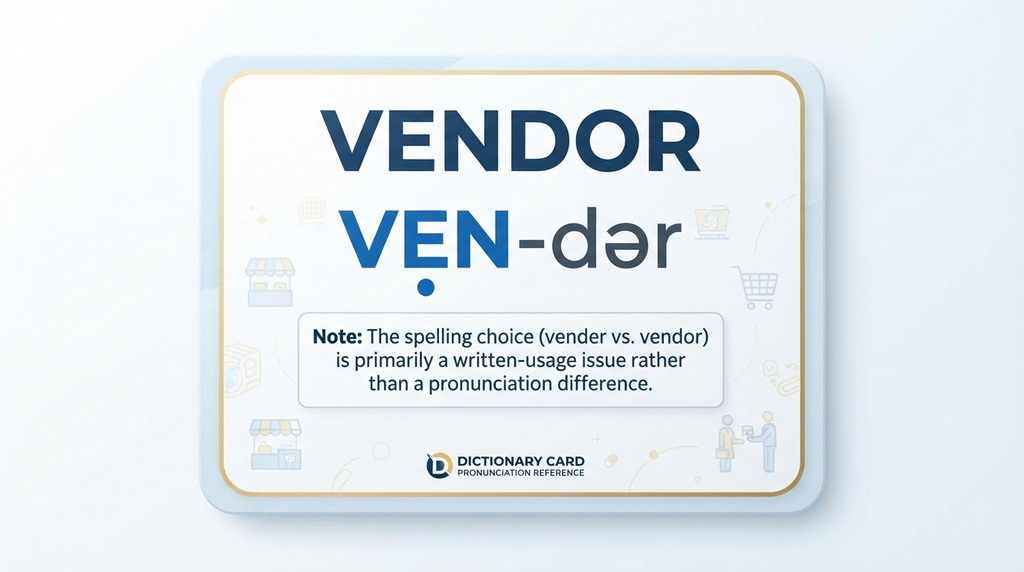
Vendor is generally pronounced approximately:
VEN-dər
The first syllable sounds like ven, followed by an unstressed second syllable similar to der.
In phonetic notation, dictionaries may represent it differently depending on the variety of English and transcription system.
Because vender is a spelling variant rather than a fundamentally different word, its pronunciation is generally not the reason to choose one spelling over the other.
The key issue is written usage.
British vs. American English
There is no major British-versus-American spelling distinction comparable to pairs such as colour/color or centre/center.
Vendor is used in both British and American English.
Vender can also be found in English-language usage, including American contexts, but it remains considerably less common than vendor.
Therefore, changing from British to American English does not normally require changing vendor to vender.
For international writing, websites, business documents, and educational material, vendor is the clearest default.
Formal vs. Casual Usage
Formal Writing
Use vendor.
The organization is reviewing its existing vendor agreements.
Each vendor must comply with the procurement requirements.
Professional but Less Formal Writing
Use vendor.
I’ll ask the vendor whether they can deliver the equipment this week.
Casual Conversation
Either vendor or seller can work, depending on the situation.
I bought it from a street vendor.
I asked the seller about the warranty.
In casual English, seller may sometimes sound more natural when referring to an individual transaction.
Very Unusual Usage
Vender may be grammatically defensible, but it can distract readers who are accustomed to vendor.
That makes vendor the practical editorial choice.
A Fast Decision Rule
When deciding between vendor and vender, ask:
“Am I talking about a person or business that sells something?”
If yes, write:
vendor
unless you have a specific reason to preserve or discuss the variant spelling vender.
A one-second rule is:
Vendor is the default. Vender is the uncommon variant.
A Practical Proofreading Test
Try replacing the word with seller.
If the sentence still makes sense, you probably mean vendor or vender.
For example:
The vendor supplied the equipment.
Replace it:
The seller supplied the equipment.
The meaning still works.
Now check the spelling. If this is normal modern writing, choose:
vendor
This test is useful because it separates the meaning question from the spelling question.
What About “Vendoring”?
The term vendoring can appear in specialized business or technical contexts, particularly when people discuss the process of working with vendors.
For example:
The company is responsible for vendoring and supplier management.
However, vendoring is much less universal and can sound like specialized corporate jargon.
Depending on the intended meaning, clearer alternatives may include:
- vendor management
- supplier management
- sourcing
- procurement
- working with vendors
- selecting suppliers
For formal writing, choose the clearer expression when possible.
What About “Vendorship”?
Vendorship is a derived noun referring to the condition or role of being a vendor, but it is not a common everyday word.
You might encounter it in specialized, legal, commercial, or organizational contexts.
For most readers, a phrase such as vendor relationship, vendor status, or role as a vendor will usually be clearer.
The fact that a derived form exists does not mean it is the best choice for ordinary prose.
What About “Vendear,” “Vendar,” “Vendeor,” and “Venoder”?
Searches for forms such as vendear, vendar, vendeor, and venoder may produce different results because search engines often interpret misspellings, multilingual queries, names, or unusual forms.
They should not automatically be treated as alternative English spellings of vendor.
For standard English, the useful spelling distinction is:
vendor — common standard form
vender — legitimate but uncommon variant
If you encounter an unfamiliar form in a particular document, dictionary, website, or another language, its meaning should be determined from that specific context rather than assumed to be an English spelling of vendor.

Common Search Questions Answered
Is it “vender” or “vendor”?
Vendor is the normal modern spelling. Vender is a legitimate but uncommon variant.
How do you spell vendor?
Spell it:
V-E-N-D-O-R
What does vendor mean?
A vendor is a person or organization that sells goods or services.
What is the meaning of vender?
Vender means a person or business that sells something. It is an uncommon variant of vendor.
Are “venders” or “vendors” correct?
Both can be formed correctly from their respective singular forms, but vendors is overwhelmingly the more usual modern plural.
Is “vender” English?
Yes. Vender is an English word, but it is much less common than vendor.
Does “vendor” mean supplier?
Often, yes. A vendor can supply products or services to another person or organization. However, supplier can be more specific when the emphasis is on providing goods or materials.
What is a vendor and vendee?
A vendor is the seller; a vendee is the buyer. These terms are particularly associated with legal and contractual language.
Is “vendoring” a word?
Vendoring is used in some specialized business contexts, but it is not as broadly established or as clear as phrases such as vendor management or supplier management.
What does “vendorship” mean?
Vendorship refers to the role or status of being a vendor, but it is uncommon and often avoidable in ordinary writing.
Final Takeaway
Vendor is the spelling you should normally use.
Vender is not simply a misspelling; it is a recognized but uncommon variant meaning essentially the same thing. The practical distinction is therefore one of modern usage and convention rather than a major difference in meaning.
For business, technology, retail, professional, academic, and general contemporary writing, choose vendor:
The company selected a new vendor for its software services.
Remember the simplest rule:
Vendor = standard, common choice.
Vender = valid, but uncommon variant.