More Smart vs. Smarter: Which Is Correct?
Quick Answer
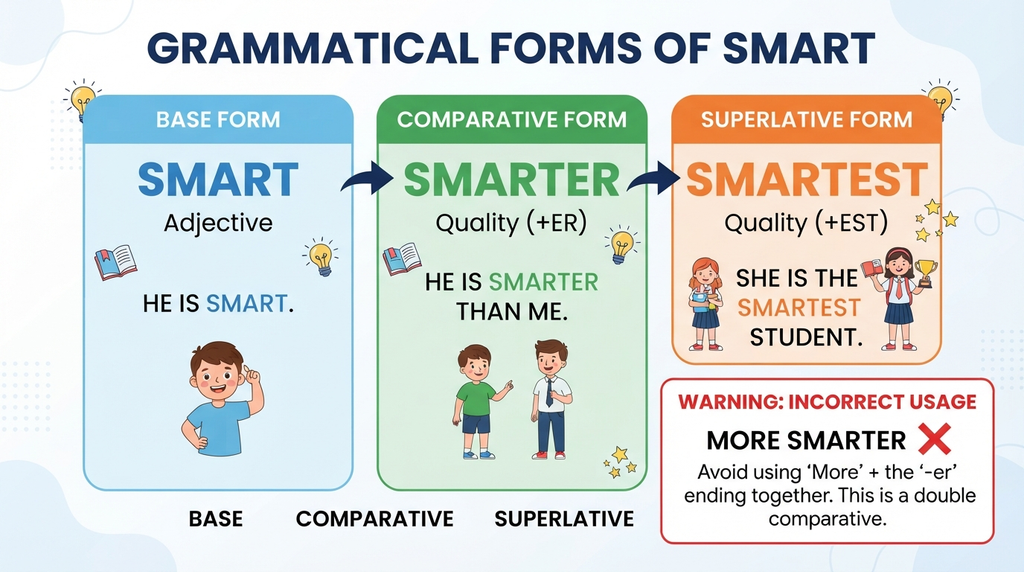
“Smarter” is the standard comparative form of “smart,” and it is usually the natural choice.
- smart = the base adjective
- smarter = comparative form, meaning “more smart” or “more intelligent” when comparing two things or people
- smartest = superlative form, used for the highest degree among three or more
So, in most situations:
She is smarter than her brother. ✅
She is more smart than her brother. ⚠️ Grammatically possible in some contexts, but unnatural in ordinary modern English.
She is more smarter than her brother. ❌ Incorrect standard English.
The same pattern applies to questions such as “is smarter a word?” and “how do you spell smarter?” Yes: smarter is a standard English word, spelled s-m-a-r-t-e-r.
At-a-Glance Table
| Form | Grammatical role | Meaning | Example |
|---|---|---|---|
| smart | Base adjective | Having intelligence, good judgment, or practical ability | “Maya is smart.” |
| smarter | Comparative adjective | More smart/intelligent than another person or thing | “Maya is smarter than Leo.” |
| smartest | Superlative adjective | The most smart/intelligent in a group | “Maya is the smartest student.” |
| more smart | Periphrastic comparative | Grammatically possible in limited contexts, but usually less natural | “He seems more smart than cautious.” |
| more smarter | Incorrect double comparative | Attempts to combine two comparative markers | “He is more smarter.” ❌ |
The basic rule
For the ordinary adjective smart, English normally forms the comparative with -er:
smart → smarter
And the superlative with -est:
smart → smarter → smartest
This is the same general pattern seen in many short adjectives:
- fast → faster → fastest
- bright → brighter → brightest
- strong → stronger → strongest
- quick → quicker → quickest
- clever → cleverer → cleverest
The important point is that smarter already means “more smart.” Adding more before it creates a double comparative.
What Does “Smarter” Mean?
Smarter is the comparative form of smart. It indicates a higher degree of whatever quality smart describes.
Depending on context, smart can refer to intelligence, practical judgment, quick thinking, stylish appearance, technological sophistication, or even physical sharpness.
For example:
“Ali is smarter than his cousin.”
Here, smarter refers to a comparative difference in intelligence or mental ability.
But the meaning can change according to the noun and context:
“We need a smarter way to organize these files.”
Here, smarter means more efficient, practical, or intelligently designed.
“This phone has smarter security features.”
Here, smarter suggests more sophisticated or adaptive technology.
“You’d be smarter to wait.”
Here, smarter means wiser or more sensible.
Thus, smarter does not have only one narrow meaning.

Is “Smarter” a Word?
Yes. Smarter is a standard English word.
It is the comparative form of the adjective smart.
You can use it when comparing two people, objects, ideas, methods, systems, or situations:
“This approach is smarter.”
“This approach is smarter than the old one.”
“Which solution is smarter?”
The word is completely standard in both American and British English.
If you are wondering how do you spell smarter, the spelling is:
s-m-a-r-t-e-r
The pronunciation is commonly represented as /ˈsmɑːrtər/ in many American pronunciations and /ˈsmɑːtə/ in many British pronunciations.
The final r is pronounced in rhotic accents such as most American English, while it is generally not pronounced after the vowel in non-rhotic accents such as many varieties of British English.
More Smart vs. Smarter
The central question is whether English should use more smart or smarter.
In ordinary comparison, smarter is the preferred form:
“This plan is smarter than the first one.”
Rather than:
“This plan is more smart than the first one.”
The reason is grammatical and stylistic. Smart is a short, one-syllable adjective that normally takes the -er comparative ending.
So the natural progression is:
smart → smarter → smartest
rather than:
smart → more smart → most smart
That does not mean more smart can never occur. English sometimes uses more + adjective for emphasis, contrast, coordination, rhythm, or a particular stylistic effect.
For example:
“The proposal is more smart than practical.”
This sentence sounds noticeably different from the simple comparison “The proposal is smarter than the alternative.” Here, more smart than practical contrasts two qualities: the proposal is characterized as smart rather than practical.
Another possible construction is:
“The new design is more smart-looking than elegant.”
The surrounding structure can make more smart sound natural because the writer is not simply forming the ordinary comparative of smart.
Therefore, the useful rule is not “more smart is always grammatically impossible.” The better rule is:
Use “smarter” for the normal comparative of “smart.” Use “more smart” only when the construction or intended contrast gives it a specific reason to appear.
Is “More Smarter” Correct?
No. “More smarter” is not correct in standard English when “more” and “smarter” are both being used as comparative markers.
Consider:
“She is smarter than me.” ✅
The suffix -er already makes smart comparative.
If you write:
“She is more smarter than me.” ❌
you are effectively marking the comparison twice.
The same problem occurs with other ordinary comparatives:
- more faster ❌
- more stronger ❌
- more quicker ❌
- more brighter ❌
- more smarter ❌
The standard forms are:
- faster
- stronger
- quicker
- brighter
- smarter
This is called a double comparative.
Why “more smarter” sounds tempting
Learners sometimes reason:
smart → smarter → more smarter
because more feels like a general signal for comparison.
But English does not normally stack the two comparative mechanisms together. Once -er has made the adjective comparative, another more is unnecessary.
Compare:
“This computer is smarter than that one.” ✅
“This computer is more intelligent than that one.” ✅
The first adjective uses -er.
The second uses more because intelligent normally forms its comparative analytically.
Smart, Smarter, and Smartest
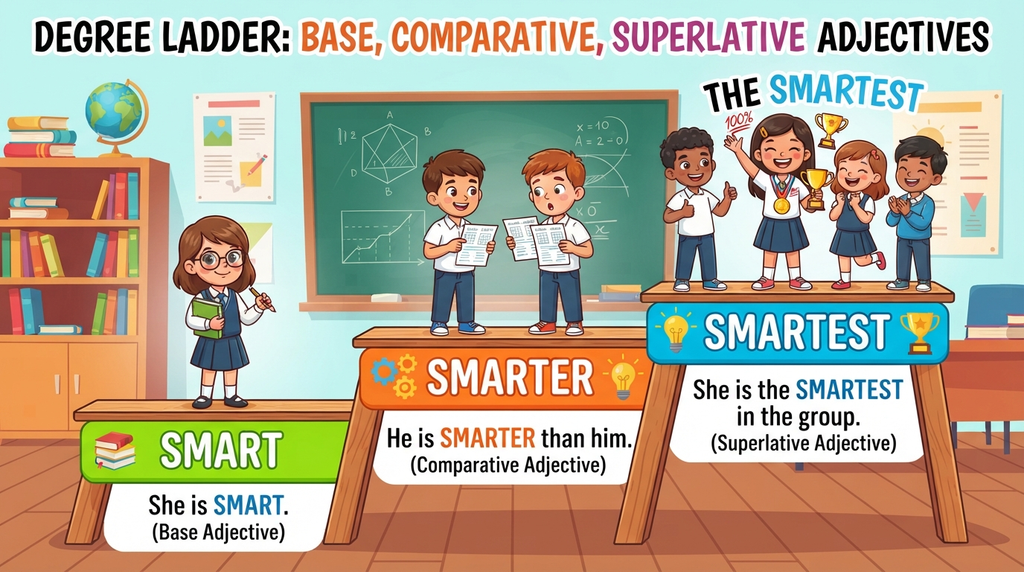
The three basic forms can be understood as degrees of comparison.
Smart
Smart is the positive or base form.
“Nadia is smart.”
This simply describes Nadia. It does not necessarily compare her with anyone else.
Smarter
Smarter is the comparative form.
“Nadia is smarter than Omar.”
The sentence establishes a comparison between Nadia and Omar.
A comparative can also appear without an explicit second person or thing when the comparison is understood:
“I need a smarter solution.”
The implied comparison is with other available solutions.
Smartest
Smartest is the superlative form.
“Nadia is the smartest student in the class.”
The superlative generally identifies the highest degree within a relevant group.
The common pattern is therefore:
smart → smarter → smartest
When to Use “Smarter”
Use smarter when you are making a normal comparison involving smart.
Comparing two people
“James is smarter than his older brother.”
“Priya is getting smarter about managing her time.”
Comparing two ideas
“The second proposal is smarter than the first.”
Comparing methods
“Automating the repetitive task is a smarter approach.”
Comparing purchases or choices
“Buying a durable model may be the smarter choice.”
Notice that smarter does not always mean intellectually superior.
In:
“Taking the train was the smarter choice.”
smarter means wiser, more practical, or more sensible.
Comparing technology
“The new software offers smarter recommendations.”
Here, smarter means more sophisticated or capable.
When Can “More Smart” Be Used?
More smart is much less common than smarter, but it is not automatically impossible in every grammatical environment.
One useful situation involves a deliberate contrast between qualities:
“The design is more smart than beautiful.”
This construction emphasizes smart as one quality on a scale or as one side of a contrast.
Another example:
“The strategy is more smart than aggressive.”
The writer is contrasting smart and aggressive rather than simply saying that one strategy is smarter than another.
Even here, however, context matters. A different sentence might naturally use smarter:
“This strategy is smarter than the previous one.”
Therefore, if you are simply asking how to compare smart, choose smarter unless there is a clear structural reason for more smart.
Examples by Context
Everyday conversation
“You were smarter to leave early.”
“I need to make a smarter decision this time.”
“She’s smarter than she looks.”
“That was a smarter way to handle the problem.”
School and education
“The smarter students are not always the ones who study the longest.”
“He found a smarter way to remember the vocabulary.”
“This explanation is smarter and easier to follow.”
A useful distinction is that smarter can describe a method of learning, not simply a person’s intelligence.
Work and business
“We need a smarter process, not just a faster one.”
“The team developed a smarter way to manage customer requests.”
“That was a smarter use of the available resources.”
Here, smarter often means more efficient, strategic, or practical.
Technology
“The latest model has smarter automation.”
“A smarter search system can adapt to user behavior.”
“The device makes smarter decisions based on the available data.”
In technology writing, smarter is often promotional or descriptive language. It does not necessarily mean that the system possesses human-like intelligence.
Relationships and advice
“You’d be smarter to ask before assuming.”
“We should make a smarter choice about how we communicate.”
In these examples, smarter is close to wiser or more sensible.
Appearance
The adjective smart can also mean well-dressed or neat, especially in British English:
“He looked smart in his new suit.”
A comparative can therefore describe appearance:
“She looked smarter in the navy jacket.”
Here, smarter does not mean more intelligent. It means better dressed or neater in appearance.
This is an important contextual edge case.

Smart vs. Intelligent
One of the related questions is “What’s the difference between smart and intelligent?”
The words overlap substantially, but they are not interchangeable in every context.
Intelligent usually refers specifically to mental ability, reasoning, learning, or understanding.
Smart is broader and more flexible. Depending on context, it can mean intelligent, sensible, practical, stylish, neat, or technologically sophisticated.
Compare:
“She is intelligent.”
This focuses directly on her intellectual ability.
“She is smart.”
This can also mean intelligent, but it can carry a broader implication of good judgment or practical awareness.
Compare:
“He’s intelligent but inexperienced.”
with:
“He’s smart enough to know when to stop.”
The second sentence can emphasize judgment rather than raw intellectual ability.
Intelligent has its own comparative
Because intelligent is a longer adjective, its standard comparative is normally:
more intelligent
“She is more intelligent than her colleague.”
Not:
“She is intelligenter than her colleague.” ❌
This gives us a useful comparison:
| Base adjective | Comparative | Superlative |
|---|---|---|
| smart | smarter | smartest |
| intelligent | more intelligent | most intelligent |
| clever | cleverer / more clever | cleverest / most clever |
| wise | wiser | wisest |
The exact choice with adjectives such as clever can vary by dialect and style, but smarter is the normal comparative of smart.
British vs. American English
There is no major British-American disagreement over the basic forms:
smart → smarter → smartest
Both American and British English use smarter.
The more noticeable difference concerns the meaning of smart.
In American English, smart very commonly means intelligent:
“She’s a smart student.”
In British English, smart can also commonly mean neat, well-dressed, or polished:
“He looks very smart in that jacket.”
American English uses this meaning too, but it is particularly familiar in British usage.
The comparative smarter can consequently refer to either intelligence or appearance depending on context:
“He is smarter than his classmates.”
= more intelligent.
“He looks smarter in that suit.”
= neater or better dressed.
Context determines the intended meaning.
How Do You Pronounce “Smarter”?
Smarter is generally pronounced approximately:
SMART-er
In IPA, a common American pronunciation is /ˈsmɑːrtər/.
In many British non-rhotic accents, it is approximately /ˈsmɑːtə/.
The first syllable receives the main stress:
SMART-er
The word has two syllables.
A simple pronunciation breakdown is:
- smart — the stressed first syllable
- -er — the unstressed comparative ending

Common Mistakes
Mistake 1: “More smarter”
“This method is more smarter.” ❌
Correct:
“This method is smarter.” ✅
Why? The -er ending already marks the comparative.
Mistake 2: “More smart” for every comparison
“This laptop is more smart than mine.” ⚠️
Usually better:
“This laptop is smarter than mine.” ✅
Why? Smart is a short adjective that normally takes -er.
Mistake 3: “Smartest than”
“She is smartest than her sister.” ❌
Correct:
“She is smarter than her sister.” ✅
Or:
“She is the smartest person in the group.” ✅
Why? Than normally accompanies a comparative, while the superlative uses the in many standard constructions.
Mistake 4: “More smartest”
“He is the more smartest student.” ❌
Correct:
“He is the smartest student.” ✅
Again, the comparative marker is being duplicated or mixed with the superlative.
Mistake 5: Assuming “smarter” always means more intelligent
“The second option is smarter.”
This may mean more practical, more efficient, or more sensible, not necessarily more intelligent.
Always examine the noun and context.
Mistake 6: Confusing “smarter” with “more intelligent”
Both can be correct, but they can carry slightly different shades of meaning.
“The researcher is highly intelligent.”
focuses on intellectual ability.
“The researcher is smart about choosing experiments.”
focuses more on practical judgment.
A Fast Decision Rule
When deciding between more smart and smarter, ask:
Am I simply comparing something using the adjective “smart”?
If yes, use:
smarter
Examples:
“Which option is smarter?”
“This approach is smarter than the old one.”
“He became smarter with experience.”
If more smart appears naturally because you are deliberately contrasting smart with another quality, the construction may be acceptable:
“The plan is more smart than practical.”
But this is a specialized structure, not the normal comparative pattern.
The three-second test
Replace smart with another ordinary short adjective such as fast.
Would you normally say:
“This car is more fast than that one.”
No. You would say:
“This car is faster than that one.”
The same basic comparative pattern applies to smart:
“This car is smarter than that one.”
A Practical Proofreading Test
When proofreading a sentence containing more smarter, simply remove more.
“The new approach is more smarter.”
becomes:
“The new approach is smarter.”
The second version is correct.
When proofreading more smart, ask whether you are making an ordinary comparison.
“This is more smart than the old method.”
For ordinary comparison, revise it to:
“This is smarter than the old method.”
If more smart is part of a deliberate contrast, examine the whole sentence before changing it automatically.
Formal vs. Casual Usage
Smarter is suitable across virtually all registers.
It can appear in:
- everyday speech
- academic writing
- professional communication
- journalism
- technical writing
- advertising
- formal presentations
For example:
“The researchers developed a smarter method for detecting errors.”
There is nothing inherently informal about smarter.
However, the word can become vague in technical or formal writing if the writer does not specify what “smarter” means.
Compare:
“The company created a smarter system.”
with:
“The company created a system that reduces processing time and automatically detects duplicate records.”
The second sentence is more precise because it explains how the system is smarter.
In formal writing, use smarter when the comparison is clear; otherwise, describe the specific improvement.
Is “More Smart” Ever Better Style?
Occasionally, yes.
Consider:
“The proposal is more smart than practical.”
Here, replacing more smart with smarter would produce:
“The proposal is smarter than practical.”
That changes the grammatical relationship and sounds awkward.
The original construction is treating smart and practical as contrasting qualities.
So the issue is not that more smart is universally forbidden. The issue is that it is not the ordinary comparative form of smart.
This distinction is important because English grammar has many cases where a construction that is uncommon in isolation becomes natural within a particular sentence.
What Is the Comparative Degree of “Smart”?
The comparative degree of smart is smarter.
The three degrees are:
| Degree | Form | Example |
|---|---|---|
| Positive | smart | “He is smart.” |
| Comparative | smarter | “He is smarter than Tom.” |
| Superlative | smartest | “He is the smartest student.” |
So if a grammar exercise asks for the comparative degree of smart, the answer is:
smarter
The superlative degree is:
smartest
“Smart and Smart”: Why Context Matters
The phrase smart and smart does not represent a standard grammatical comparison by itself.
But related questions can arise because smart has multiple meanings.
For example:
“She’s smart in mathematics.”
can refer to intellectual ability.
Meanwhile:
“She’s smartly dressed.”
refers to appearance.
And:
“That’s a smart solution.”
can mean clever, efficient, or well judged.
Consequently, the meaning of smart, smarter, and smartest must be determined from context.
“S.M.A.R.T.E.R.” and Other Meanings
If you see S.M.A.R.T.E.R. written with periods, it may be an acronym rather than the ordinary adjective smarter.
For example, organizations or educational systems can create acronyms using the letters in a word. The meaning then depends entirely on the particular framework.
That should not be confused with ordinary English:
“She is smarter than me.”
Here, smarter is simply the comparative adjective derived from smart.
If a particular organization uses S.M.A.R.T.E.R. as a named acronym, its capitalization and meaning should be preserved according to that organization’s terminology.
Can “Smarter” Be Used Without “Than”?
Yes.
A comparative adjective does not always need an explicit than phrase.
“We need a smarter solution.”
The comparison is implied: a smarter solution than the current or available alternatives.
“Think smarter, not harder.”
Here, smarter is part of a contrast.
“He became smarter with experience.”
The comparison is understood over time.
So the absence of than does not make smarter incorrect.
“Smarter Than Me” vs. “Smarter Than I”
Both forms have a long history of usage, but they arise from different grammatical analyses.
In ordinary modern conversation:
“She is smarter than me.”
is extremely common and natural.
A more formal construction may use:
“She is smarter than I am.”
This version removes the ambiguity and is often preferable in formal edited prose.
The bare:
“She is smarter than I.”
is grammatically defensible under a traditional analysis in which than is treated as a conjunction with an implied am, but it can sound formal or stiff to many modern readers.
For most contexts, smarter than me in conversation and smarter than I am in formal writing are practical choices.
FAQs
Is smarter a word?
Yes. Smarter is the standard comparative form of smart.
Is “more smarter” correct grammar?
No, not when more and -er are both being used to form the comparative. Use smarter instead.
Is “more smart” grammatically correct?
It can occur in specific constructions, especially contrasts such as “more smart than practical,” but smarter is the normal comparative form.
Which is correct: smarter or more smart?
For an ordinary comparison, smarter is the standard and natural choice.
What is the comparative degree of smart?
The comparative degree is smarter.
What is the superlative of smart?
The standard superlative is smartest.
How do you spell smarter?
Smarter: S-M-A-R-T-E-R.
How do you pronounce smarter?
It is generally pronounced SMART-er, with the stress on the first syllable. The treatment of the final r varies between accents.
What is the difference between smart and intelligent?
Intelligent generally focuses on mental ability, reasoning, or learning. Smart has a wider range of meanings and can refer to intelligence, practical judgment, appearance, or sophistication depending on context.
Can I say “smarter” about an object?
Yes.
“This is a smarter design.”
Here, smarter may mean more efficient, practical, sophisticated, or intelligently designed.
Can “smart” mean well-dressed?
Yes. In particular, this meaning is common in British English.
“He looks smart in that suit.”
Here, smart means neat or well-dressed, not intelligent.
Is “smartest” correct?
Yes. Smartest is the standard superlative form of smart.
Is “more smartest” correct?
No. More smartest incorrectly combines a comparative marker with a superlative form.
Can I say “smarter and smarter”?
Yes.
“The software is getting smarter and smarter.”
This is a standard construction meaning that something is becoming increasingly smart, capable, or sophisticated.
Final Takeaway
The standard comparison is simple:
smart → smarter → smartest
For ordinary comparisons, choose smarter:
“This is a smarter solution.”
Avoid more smarter because it creates a double comparative:
“This is more smarter.” ❌
More smart is possible in certain carefully structured contrasts, but it is not normally the form you want when simply comparing two things.
The most useful rule to remember is:
If you mean “more smart,” the normal comparative word is “smarter.”