Afterward vs Afterwards: What’s the Difference?
Quick Answer
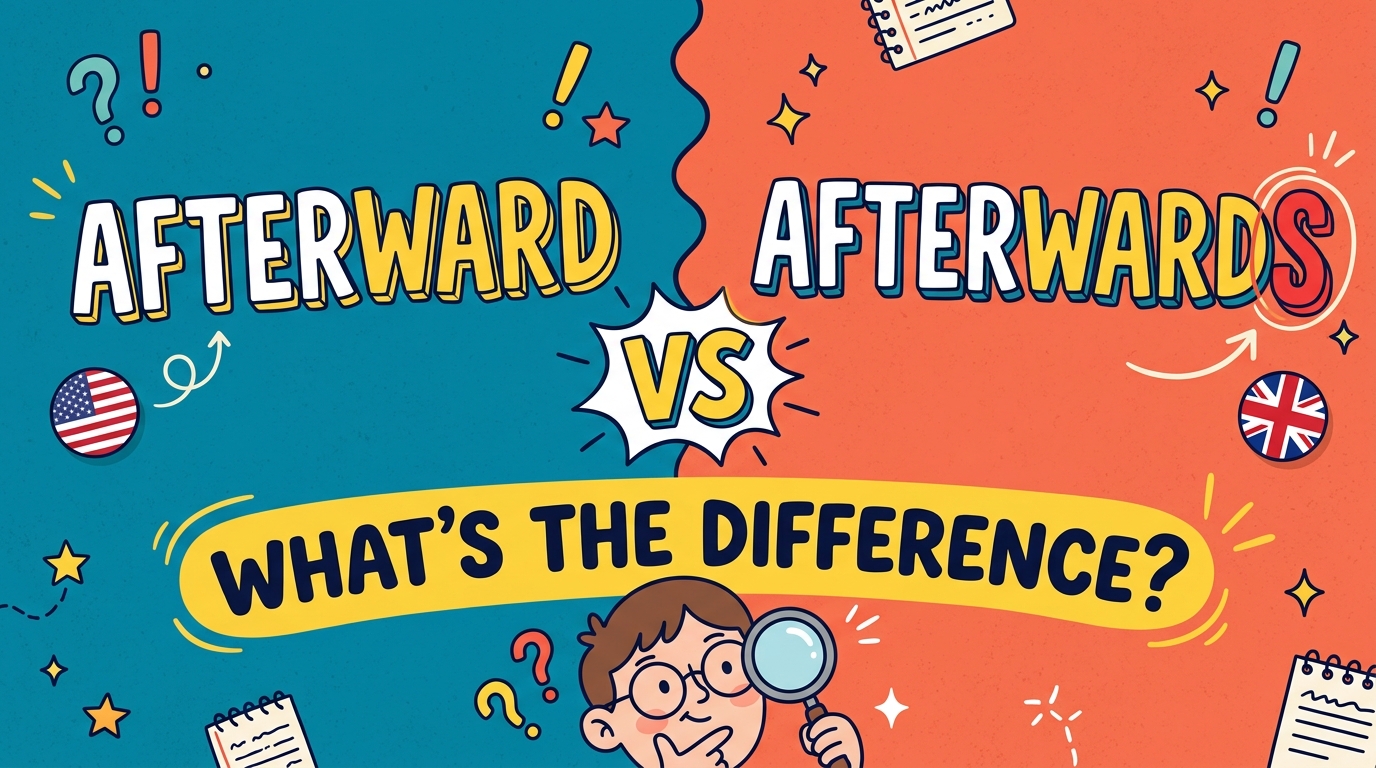
Afterward and afterwards mean the same thing: “at a later time” or “after something has happened.” Both are correct adverbs, and in most sentences, you can use either one without changing the meaning.
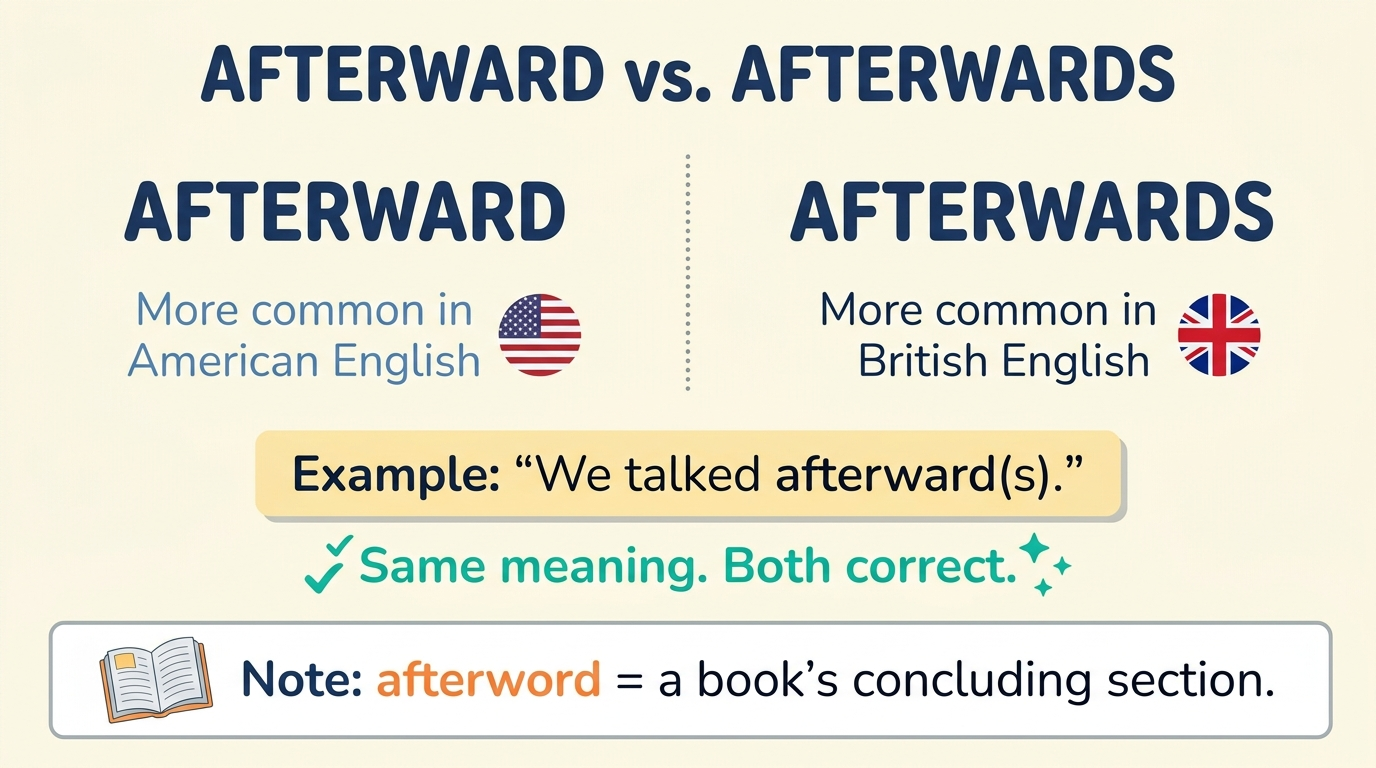
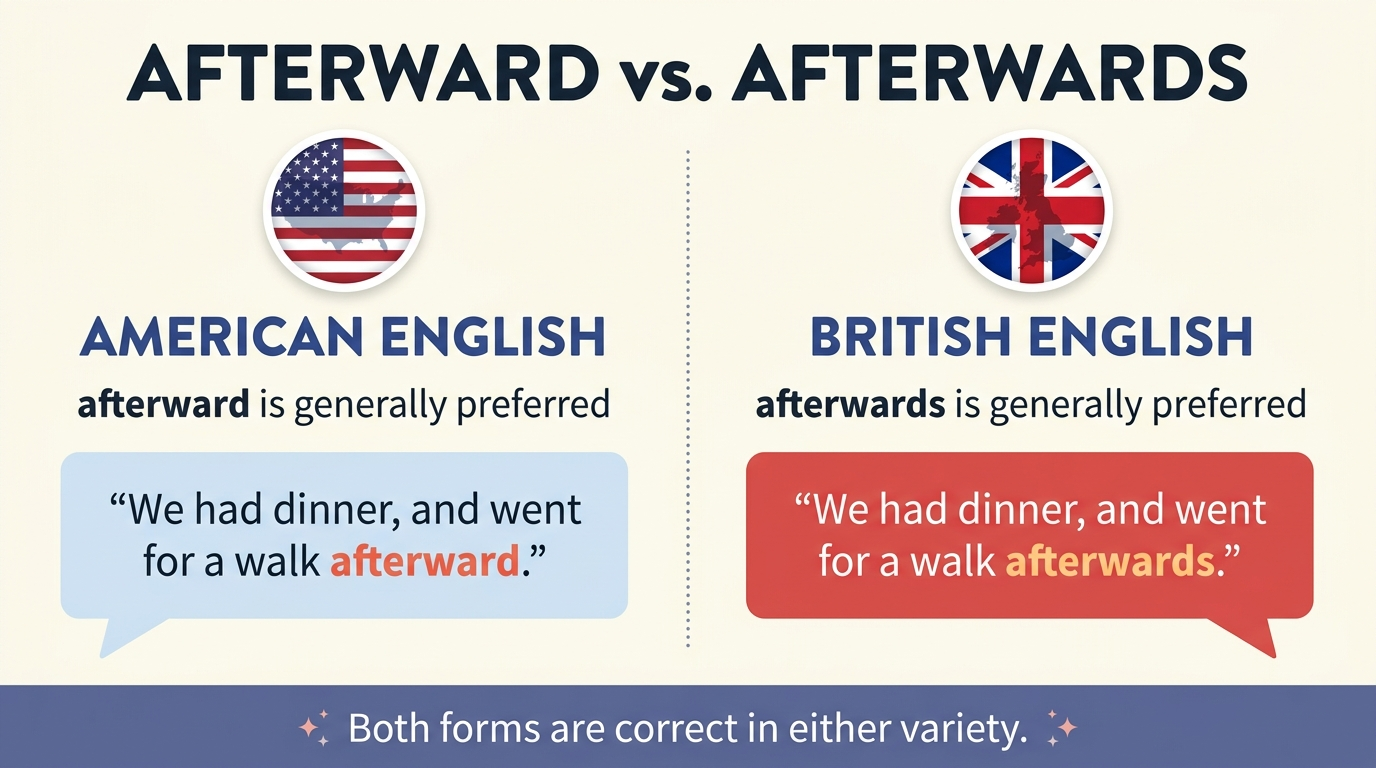
The main difference is regional preference. Afterward is more common in American English, while afterwards is more common in British English and other varieties of English. Neither spelling is inherently more correct, and both work in everyday writing as well as formal contexts.
Examples:
- American English: We went out for dinner afterward.
- British English: We went out for dinner afterwards.
Both sentences are grammatically correct. The choice is primarily a matter of regional usage and writing consistency, not grammar.
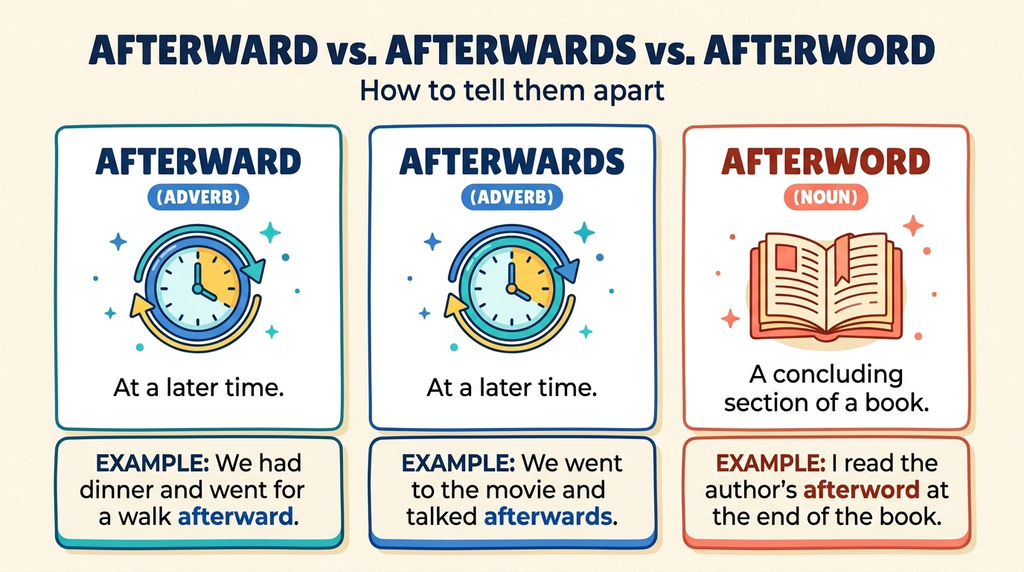
One important distinction: afterward and afterwards are different from afterword, which is a concluding section in a book, and afterwords, the plural of that word.
At-a-Glance Table
| Feature | Afterward | Afterwards |
|---|---|---|
| Meaning | At a later time; subsequently | At a later time; subsequently |
| Part of speech | Adverb | Adverb |
| Grammar | Correct | Correct |
| American English | More common | Correct, but less common |
| British English | Correct | More common |
| Formal writing | Acceptable | Acceptable |
| Casual conversation | Natural | Natural |
| Example | I’ll call you afterward. | I’ll call you afterwards. |
| Difference in meaning | None in ordinary use | None in ordinary use |
The practical takeaway is straightforward: choose the form that fits your preferred variety of English. If you are writing for an American audience, afterward is a sensible default. If your audience primarily uses British English, afterwards is a natural choice.
What Is the Difference Between Afterward and Afterwards?
1. Meaning: Both refer to a later time
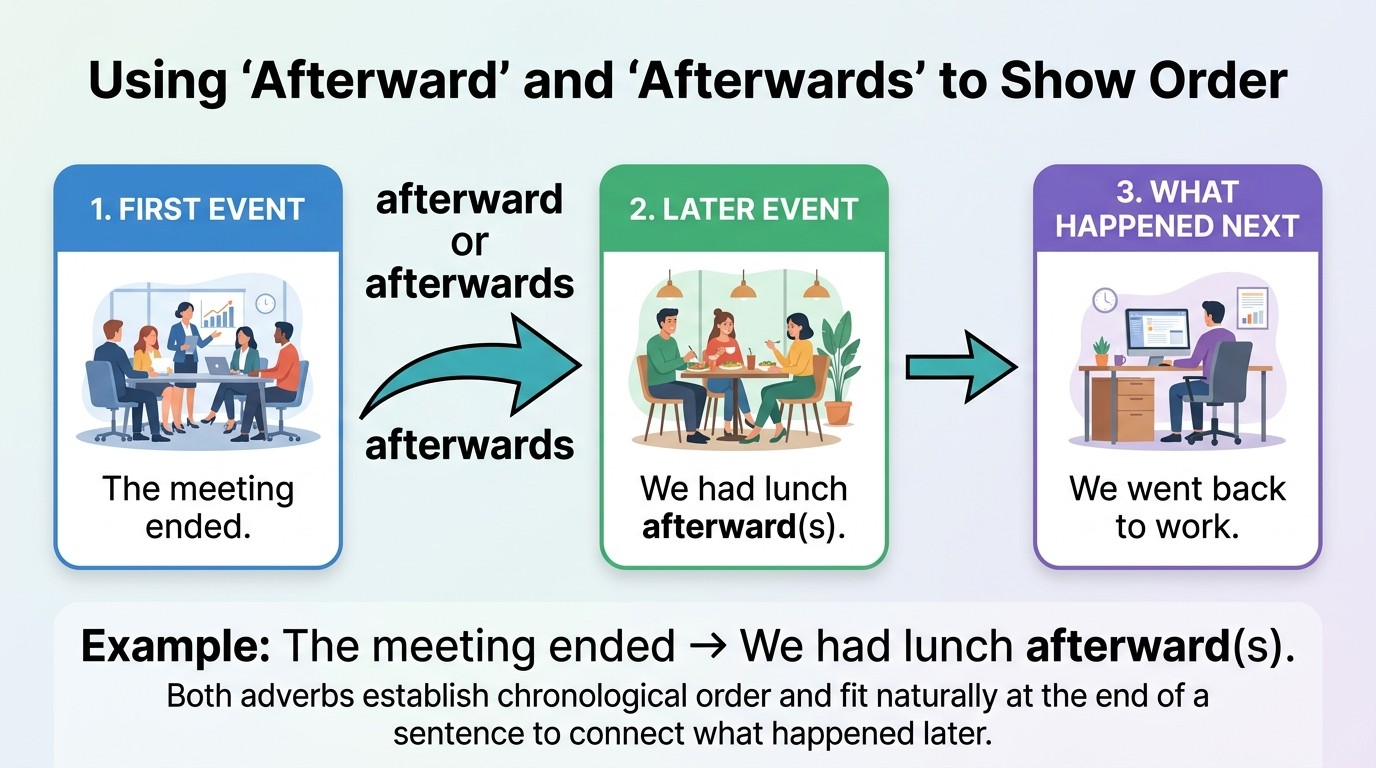
Both words describe an action or event that happens after another event. They often appear at the end of a sentence, but they can also appear at the beginning or in the middle when the sentence structure allows it.
Consider these examples:
- We finished the meeting and went for coffee afterward.
- We finished the meeting and went for coffee afterwards.
The meaning is identical: the coffee came after the meeting.
Here are two more examples:
- She felt nervous before the interview but relaxed afterward.
- She felt nervous before the interview but relaxed afterwards.
In each case, the adverb places the second situation later in time. It does not indicate exactly how much time passed. The later event might occur seconds, hours, days, or even years after the first event, depending on the context.
For instance, “He apologized afterward” could describe an apology delivered immediately after an argument or one delivered several days later. The sentence itself does not specify the interval.
2. Part of speech: Both are adverbs
An adverb can modify a verb, an adjective, another adverb, or an entire clause. In this case, afterward and afterwards most often indicate when an action takes place.
Examples:
- We discussed the issue afterward.
- They celebrated afterwards.
- Afterwards, everyone returned to work.
In the first two examples, the adverb indicates when the discussion or celebration occurred. In the third, it establishes the time sequence for the following statement.
Neither word is a verb, noun, or adjective in these examples. Both function as adverbs of time.
Compare them with after, which can serve several grammatical roles:
- Preposition: We went home after the show.
- Conjunction: We went home after the show ended.
- Adverb: We arrived soon after.
Afterward and afterwards are adverbs, so they do not normally take a noun or clause directly after them in the same way that the preposition or conjunction after does.
For example:
- Correct: We went home afterward.
- Correct: We went home after the show.
- Incorrect: We went home afterward the show.
The final example incorrectly uses afterward where the preposition after is needed.
3. Spelling: Why does one form end in -s?
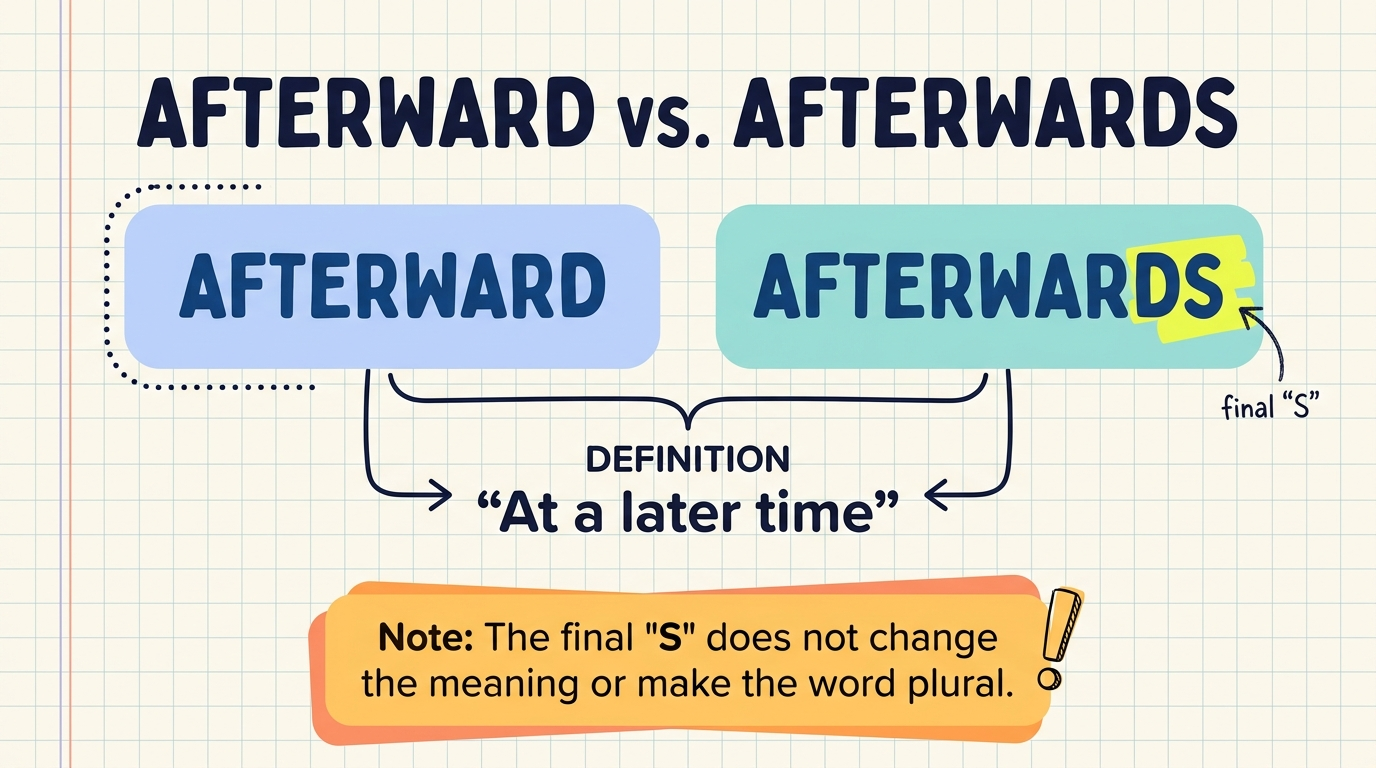
The only spelling difference is the final s. That additional letter does not create a plural form, change the tense, or alter the meaning.
Both afterward and afterwards are established English spellings. The ending in afterwards is part of the word itself; it does not mean that the word refers to multiple later events.
Compare these sentences:
- I’ll explain the decision afterward.
- I’ll explain the decision afterwards.
Both communicate the same intention.
This is an example of a spelling variation in English in which two forms coexist without a meaningful grammatical distinction. Regional usage helps explain which form a writer might prefer, but neither spelling should automatically be marked wrong.
When to Use Afterward
Choose afterward when it fits the English variety you are writing in, particularly American English. It is common in journalism, academic prose, professional communication, personal messages, and everyday conversation.
In everyday conversation
Afterward sounds natural when describing what happens next.
Examples:
- Let’s finish the shopping and grab lunch afterward.
- I need to speak with my manager afterward.
- We can watch a movie afterward if we have time.
- She called me afterward to explain what happened.
- I’ll send you the photographs afterward.
These sentences describe a later action without specifying its exact time. The context makes the sequence clear.
In academic and professional writing
Afterward works well when describing the order of events, procedures, discussions, or observations.
Examples:
- The participants completed the questionnaire and were interviewed afterward.
- The equipment was inspected afterward to confirm that it was functioning properly.
- The team reviewed the findings and revised the proposal afterward.
- The researcher collected the samples and analyzed them afterward.
- The committee discussed the recommendation and issued its decision afterward.
There is no grammatical reason to avoid afterward in formal writing. Its suitability depends on the sentence and the publication’s style preferences, not on an informal or unprofessional meaning.
In American English
American writers generally favor afterward over afterwards. For example, an American newspaper, university publication, or business document might naturally use sentences such as:
- The ceremony ended, and the guests went to dinner afterward.
- We spoke briefly afterward about the next steps.
- The company released a statement afterward.
However, American English speakers also use afterwards. It remains a valid choice, so it should not be treated as a spelling error merely because the writer is American.
When to Use Afterwards
Choose afterwards when it matches your preferred English variety, especially British English. The word is common in British writing and is also used in other English-speaking regions.
In everyday conversation
Afterwards is perfectly natural in informal British English and many other varieties.
Examples:
- We went to the park and got some ice cream afterwards.
- I’ll see you afterwards.
- She came over for tea, and we went for a walk afterwards.
- We can talk about the details afterwards.
- He felt much better afterwards.
The word does not sound inherently more formal, polite, or sophisticated than afterward. The difference is largely regional.
In formal and published writing
Afterwards is equally acceptable in reports, essays, articles, and professional correspondence.
Examples:
- The witnesses were interviewed separately afterwards.
- The documents were reviewed and archived afterwards.
- The panel met privately afterwards to discuss the outcome.
- The students completed the exercise and submitted their answers afterwards.
- The organization published a summary of the findings afterwards.
A British editor might prefer afterwards throughout a document to maintain a consistent house style. An American editor might make the opposite choice.
In British English
Afterwards is generally the more familiar form in British English.
Examples:
- We visited the exhibition and had dinner afterwards.
- I’ll explain everything afterwards.
- The meeting finished early, so we went for coffee afterwards.
Nevertheless, afterward is also correct in British English. Regional preference is a tendency, not an absolute grammatical rule.
Afterward vs Afterwards: Examples by Context
The best way to understand these words is to see how they work in different situations. In every pair below, the two versions express the same meaning.
1. Everyday activities
| Afterward | Afterwards |
|---|---|
| We went shopping afterward. | We went shopping afterwards. |
| I’ll clean the kitchen afterward. | I’ll clean the kitchen afterwards. |
| They took a walk afterward. | They took a walk afterwards. |
| We can talk afterward. | We can talk afterwards. |
| She took a nap afterward. | She took a nap afterwards. |
All five pairs are grammatically correct. The adverb identifies an action that follows the event already mentioned.
2. Work and business
| Afterward | Afterwards |
|---|---|
| We discussed the proposal afterward. | We discussed the proposal afterwards. |
| The manager spoke to the team afterward. | The manager spoke to the team afterwards. |
| I’ll send the revised document afterward. | I’ll send the revised document afterwards. |
| The company issued a statement afterward. | The company issued a statement afterwards. |
| We reviewed the results afterward. | We reviewed the results afterwards. |
In a business document, consistency matters more than choosing one spelling over the other. If a company follows American English conventions, afterward may be preferable. A British English publication may favor afterwards.
3. School and education
| Afterward | Afterwards |
|---|---|
| We discussed the lesson afterward. | We discussed the lesson afterwards. |
| The teacher answered our questions afterward. | The teacher answered our questions afterwards. |
| I studied for an hour afterward. | I studied for an hour afterwards. |
| The students took a short break afterward. | The students took a short break afterwards. |
The words work equally well when describing classroom activities, study sessions, and events that follow a lesson.
4. Relationships and personal conversations
| Afterward | Afterwards |
|---|---|
| We talked about our disagreement afterward. | We talked about our disagreement afterwards. |
| She texted me afterward. | She texted me afterwards. |
| They apologized afterward. | They apologized afterwards. |
| We understood each other better afterward. | We understood each other better afterwards. |
In personal communication, either form sounds natural. The choice does not change the emotional tone or imply anything different about the relationship.
5. Travel and events
| Afterward | Afterwards |
|---|---|
| We visited the museum and ate afterward. | We visited the museum and ate afterwards. |
| The concert ended, and we went home afterward. | The concert ended, and we went home afterwards. |
| They explored the city afterward. | They explored the city afterwards. |
| We took photographs afterward. | We took photographs afterwards. |
These examples demonstrate how the adverb connects two events in a sequence. The exact time between them comes from context rather than from the spelling.
6. Health, procedures, and instructions
| Afterward | Afterwards |
|---|---|
| Rest afterward if you feel tired. | Rest afterwards if you feel tired. |
| The area was examined afterward. | The area was examined afterwards. |
| We recorded the measurements afterward. | We recorded the measurements afterwards. |
| The equipment was cleaned afterward. | The equipment was cleaned afterwards. |
In instructions or technical writing, both forms can be used. However, if timing is important, a more specific expression such as immediately after the procedure or two hours later may be clearer.
7. Storytelling and narrative writing
Both words help readers follow the order of events.
Examples:
- He closed the door and stood quietly afterward.
- She remembered the conversation long afterward.
- Afterwards, the village returned to its usual routine.
- They never spoke about the incident afterward.
- The truth became clear only afterward.
Notice that afterward and afterwards can appear at the beginning or end of a sentence. Their placement depends on emphasis and sentence rhythm, not on a difference in meaning.
Afterword vs Afterward: Understanding the Important Difference
One of the most common sources of confusion is the word afterword. Unlike afterward and afterwards, afterword is a noun with a different meaning.
An afterword is a section at the end of a book or other written work. It usually provides additional commentary, reflections, background information, or an explanation related to the main text.
Examples:
- The author included an afterword explaining how the book was written.
- I read the afterword after finishing the final chapter.
- The new edition contains a detailed afterword by the editor.
The difference is not simply a matter of American versus British spelling. Afterword refers to a written section, while afterward and afterwards refer to a later time.
Afterward vs afterword
Compare the following sentences:
- Correct: We discussed the book afterward.
- Correct: The book’s afterword discusses the author’s research.
- Incorrect: We discussed the book afterword.
- Incorrect: The book’s afterward explains the author’s research.
The first sentence needs an adverb because it describes when the discussion took place. The second needs a noun because it identifies a section of the book.
Afterwords vs afterwards
Afterwords is the plural of afterword. It refers to multiple concluding sections or, in some contexts, multiple instances of that noun.
Afterwards is an adverb meaning later.
Compare:
- The two books contain separate afterwords.
- We discussed both books afterwards.
In the first sentence, afterwords names parts of books. In the second, afterwards tells the reader when the discussion occurred.
Afterword or afterward: Which one is correct?
Both words are correct, but they are not interchangeable.
Use afterword when referring to a concluding section of a book. Use afterward when referring to something happening later. Use afterwards for the same temporal meaning when that spelling suits your preferred regional style.
After vs Afterwards: Are They the Same?
After and afterwards are related, but they do not always serve the same grammatical purpose.
After can be a preposition, a conjunction, or an adverb. Afterwards is an adverb that refers to a later time.
Use after before a noun or noun phrase
Examples:
- We went home after the meeting.
- She called after lunch.
- They left after the concert.
In each sentence, after introduces a noun phrase that identifies the earlier event.
Use after before a clause
Examples:
- We went home after the meeting ended.
- She called after she finished work.
- They left after the concert was over.
Here, after introduces a clause containing a subject and a verb.
Use afterward or afterwards to mean later
Examples:
- We went home afterward.
- She called afterwards.
- They left shortly afterward.
In these examples, the adverb stands on its own without introducing a noun phrase or clause.
Compare these constructions:
| Sentence | Why it works |
|---|---|
| We ate after the show. | After introduces a noun phrase. |
| We ate after the show ended. | After introduces a clause. |
| We ate afterward. | Afterward is an adverb indicating a later time. |
| We ate afterwards. | Afterwards serves the same function. |
A frequent mistake is writing afterwards the show when the intended meaning is “after the show.” Use after before the noun phrase, or use afterward or afterwards without placing the noun phrase directly after the adverb.
Common Mistakes and Corrected Examples
Understanding the difference between the two spellings is only part of the task. You also need to distinguish them from related words and use them in the right grammatical structure.
Mistake 1: Treating afterwards as incorrect American English
Incorrect claim: “Afterwards is wrong in American English.”
Correction: Afterwards is a valid English adverb in American English, although afterward is generally more common.
Example:
- Acceptable: I’ll call you afterwards.
- Also acceptable: I’ll call you afterward.
For American-focused writing, afterward is a reasonable editorial preference, not a mandatory grammatical rule.
Mistake 2: Assuming afterward is incorrect British English
Incorrect claim: “British writers must always use afterwards.”
Correction: British English commonly favors afterwards, but afterward is also correct.
Example:
- Acceptable: We went for lunch afterward.
- Also acceptable: We went for lunch afterwards.
The preference is regional rather than absolute.
Mistake 3: Confusing afterwards with afterwords
Incorrect: I will explain the instructions afterwords.
Correct: I will explain the instructions afterwards.
Why? The sentence refers to an explanation delivered later, so it requires the adverb afterwards. Afterwords would suggest multiple concluding sections of written works, which makes no sense in this context.
Mistake 4: Using afterword as an adverb
Incorrect: We talked about the problem afterword.
Correct: We talked about the problem afterward.
Why? The sentence needs a word that indicates when the conversation happened. Afterword is a noun, not the required adverb.
Mistake 5: Adding a noun directly after afterward
Incorrect: We went home afterward the ceremony.
Correct: We went home after the ceremony.
Also correct: We went home afterward.
Why? After introduces the noun phrase the ceremony. Afterward is used independently as an adverb.
Mistake 6: Switching spellings unnecessarily
Suppose a report begins with “The participants completed the survey afterward” and later says “The results were discussed afterwards.”
Neither sentence is wrong, but switching forms without a reason can make the document feel less carefully edited.
A better approach is to choose a preferred form and apply it consistently unless a quotation, publication requirement, or other specific reason calls for a change.
Mistake 7: Assuming afterward means immediately after
Incorrect assumption: “If something happens afterward, it must happen straight away.”
Correction: Neither afterward nor afterwards specifies an exact interval.
For example, “She contacted me afterward” could mean she contacted you minutes, days, or weeks later. If timing matters, specify it:
- She contacted me immediately afterward.
- She contacted me two days afterward.
- She contacted me several weeks afterward.
The added words provide the precision that the adverb alone does not.
A Simple Memory Trick and Proofreading Test
You do not need to memorize a long grammar rule to choose between afterward and afterwards. A short decision process is enough.
The quick decision rule
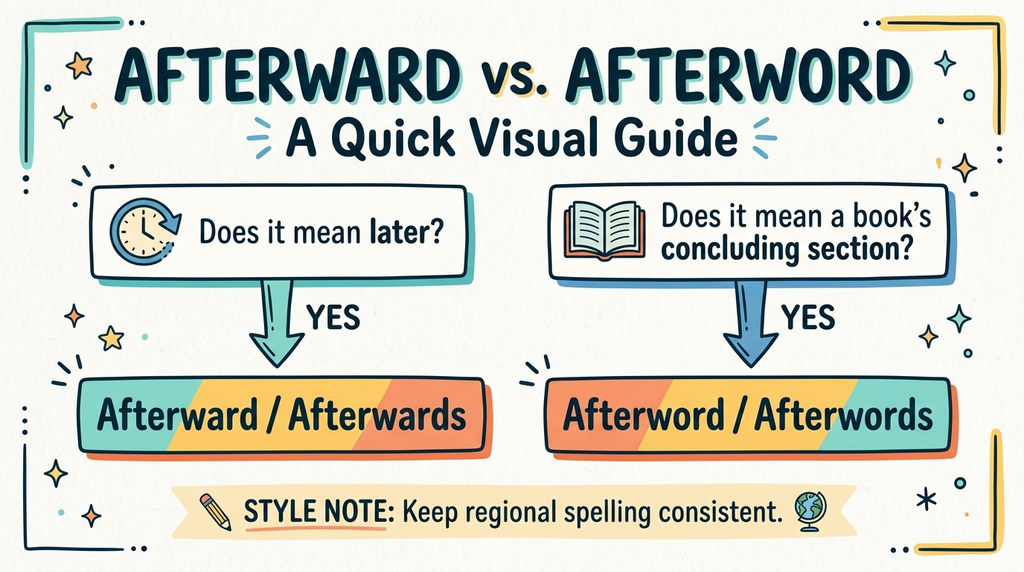
Do you mean “at a later time”?
Use afterward or afterwards. Both are correct.
Do you mean a section at the end of a book?
Use afterword for one section and afterwords for more than one.
Are you choosing a regional style?
Prefer afterward for American English and afterwards for British English, while recognizing that both are acceptable in either variety.
The substitution test
Replace the word with later or at a later time. If the sentence retains its intended meaning, afterward or afterwards is probably the right choice.
For example:
- Original: We discussed the proposal afterward.
- Substitution: We discussed the proposal later.
- Result: The meaning remains essentially the same.
Now try the same test with afterword:
- Original: The book’s afterword explains the author’s research.
- Substitution: The book’s later explains the author’s research.
- Result: The sentence no longer works.
This indicates that afterword is functioning as a noun rather than an adverb.
The substitution test is a useful proofreading aid, but it is not a complete grammar test for every context. Words can have slightly different nuances, and sentence structure still matters.
Test your understanding
1. We went for coffee ___ the meeting.afterwardafterwardsEither afterward or afterwards
2. The final chapter is followed by an author’s ___.afterwardafterwardsafterword
3. We left ___ the presentation ended.afterafterwards theafterword
Try again
Formal vs Casual Usage and Regional Notes
Is afterward more formal than afterwards?
No. Neither word is inherently more formal than the other. Both are suitable for professional documents, academic writing, news articles, and everyday messages.
For example, the following sentences are equally appropriate in a formal report:
- The data were reviewed afterward.
- The data were reviewed afterwards.
An editor may choose one form because of the publication’s regional conventions. That decision should not be mistaken for a difference in formality or grammatical correctness.
Is afterwards more British?
Generally, yes, in the sense that afterwards is more commonly preferred in British English. Afterward is more strongly associated with American usage.
However, this is a matter of frequency and convention rather than an exclusive national rule. British speakers may use afterward, and American speakers may use afterwards.
Other English varieties may show their own preferences, so writers addressing an international audience should prioritize clarity and consistency rather than assume that only one form is acceptable.
What about academic, legal, and technical writing?
Both forms can be used in formal writing. The most important considerations are consistency, precision, and compliance with the relevant style guide.
In academic prose, for example, afterward can describe a later stage in a study. Afterwards can do exactly the same job.
In legal or technical documents, the bigger concern may be ambiguity about timing. If a deadline, sequence, or waiting period has legal or practical consequences, a phrase such as within 24 hours after completion is often more precise than either adverb.
How are afterward and afterwards pronounced?
The words have essentially the same pronunciation apart from the additional final /z/ sound in afterwards.
- Afterward: commonly pronounced /ˈæf.tɚ.wɚd/ in American English.
- Afterwards: commonly pronounced /ˈɑːf.tə.wədz/ in British English, with regional variation.
The first syllable and the pronunciation of the vowel in after vary across English accents. The final s in afterwards is generally pronounced like the /z/ sound in days, not like the /s/ sound in cats.
There is no important pronunciation difference that changes the meaning. The primary distinction remains the regional preference for spelling.
Frequently Asked Questions
1. Is it afterward or afterwards?
Both are correct. They have the same meaning and grammatical function. Afterward is more common in American English, while afterwards is more common in British English.
2. What is the difference between afterward and afterwards?
There is no meaningful difference in ordinary usage. Both mean “at a later time” or “subsequently.” The main distinction is regional preference and editorial style.
3. Is afterward one word?
Yes. Afterward is written as one word. Afterwards is also one word. Neither form requires a hyphen or space.
4. Is afterwards grammatically correct?
Yes. Afterwards is a standard English adverb used to describe something happening later. It is particularly common in British English but is also correct in American English.
5. Is afterward correct in British English?
Yes. Although British English often favors afterwards, afterward is grammatically correct and understandable in British writing.
6. Is afterwords or afterwards correct?
Both spellings exist, but they have different meanings. Afterwards means “later,” while afterwords is the plural of afterword, a noun referring to concluding sections of written works.
For example, “We spoke afterwards” describes when a conversation happened. “The books contain afterwords” refers to sections at the ends of books.
7. What is the difference between afterward and afterword?
Afterward is an adverb meaning “at a later time.” Afterword is a noun meaning a concluding section of a book or similar written work.
Examples:
- We discussed the topic afterward.
- The author included an afterword.
8. Can I use afterward at the beginning of a sentence?
Yes. An adverbial afterward can appear at the beginning of a sentence to establish a time sequence.
Example: “Afterward, we returned to the office.”
Afterwards works in the same position: “Afterwards, we returned to the office.”
A comma is commonly used after either word when it introduces the sentence in this way.
9. Should I use afterward or afterwards in an essay?
Either is correct. Follow your teacher’s instructions or your institution’s style guide if one is provided. Otherwise, choose the form that matches your preferred variety of English and use it consistently.
10. Can afterward and afterwards be used interchangeably?
Yes, in ordinary sentences where both words mean “later.” They are interchangeable without a change in meaning in examples such as “We spoke afterward” and “We spoke afterwards.”
They are not interchangeable with afterword, which has a different grammatical role and meaning.
11. Does afterward mean immediately afterward?
Not by itself. Afterward simply indicates that something happens later. Use immediately afterward, shortly afterward, or a specific time expression when the interval needs to be clear.
12. What is the difference between after and afterwards?
After can introduce a noun phrase or a clause, as in “after lunch” and “after lunch ended.” Afterwards is an adverb that refers to a later time, as in “We ate afterwards.”
Afterward has the same adverbial function as afterwards.
13. Is afterward old-fashioned?
No. Afterward remains a normal, current word in English, especially in American English. Afterwards is also current and widely used. Neither form is inherently archaic.
14. Which spelling should I use for an international audience?
Either spelling will be understood by most English readers. If your website, publication, or organization follows a particular regional variety, use its preferred form. If there is no established convention, choose one and remain consistent.
Final Takeaway
The choice between afterward vs afterwards is simpler than it first appears. Both are correct adverbs meaning “at a later time,” and neither is inherently more formal or grammatically superior.
Use afterward as your default if you are following American English conventions, or afterwards if you are following British English conventions. Most importantly, distinguish both forms from afterword and afterwords, which refer to concluding sections of written works rather than a point in time.
Remember the essential rule: afterward and afterwards mean later; afterword means a concluding section of a book. Once you understand that distinction, you can choose the right form confidently in everyday messages, essays, professional writing, and published content.