Choose vs Chose: What’s the Difference?
Quick Answer
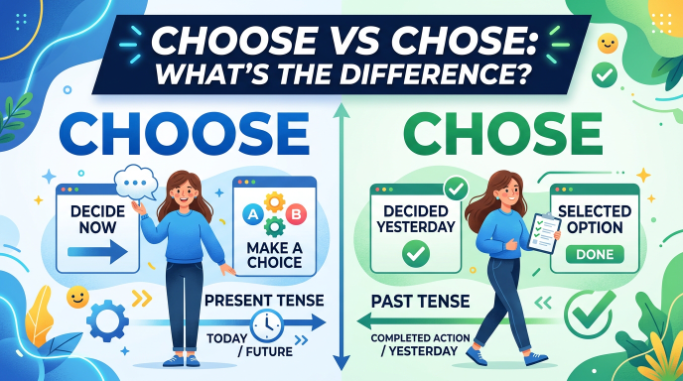
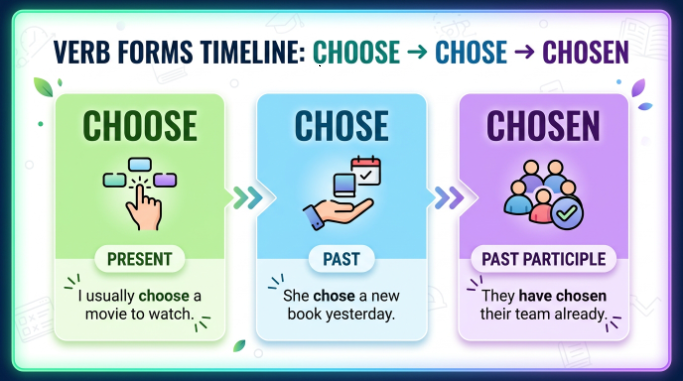
Choose and chose are different forms of the same verb.
- Choose is the present-tense form: I choose the blue shirt.
- Chose is the simple past tense: Yesterday, I chose the blue shirt.
- Chosen is the past participle: I have chosen the blue shirt.
The basic pattern is:
choose → chose → chosen
So, if the action is happening now or regularly, use choose. If the action happened and ended in the past, use chose.
| Form | Grammar role | Example |
|---|---|---|
| choose | Base form / present tense | I choose carefully. |
| chose | Simple past tense | I chose carefully yesterday. |
| chosen | Past participle | I have chosen carefully. |
Choose vs Chose at a Glance
The confusion between choose vs chose is mainly a matter of verb tense and spelling.
| Question | Choose | Chose |
|---|---|---|
| What does it mean? | To select or decide | Selected or decided in the past |
| What tense is it? | Present / base form | Simple past |
| Can it follow “to”? | Yes: to choose | No: to chose |
| Can it describe yesterday? | Usually no | Yes |
| Example | I choose my words carefully. | I chose my words carefully. |
| Pronunciation | “chooz” | “chohz” |
The key difference is time:
Choose = present or future-related choice
Chose = a completed choice in the past
For example:
- I choose this option. → The decision is current or habitual.
- I chose this option. → The decision happened earlier.
The Detailed Difference Between Choose and Chose
The verb choose means to select one person, thing, option, or course of action from available possibilities.
You might choose:
- a restaurant
- a career
- a colour
- a candidate
- a route
- whether to participate
For example:
You can choose whichever seat you prefer.
Here, choose is the correct form because the selection is happening now or may happen in the future.
Now compare:
She chose the window seat.
The choice has already happened, so chose is required.
This distinction is similar to other irregular English verbs:
| Present | Past | Past participle |
|---|---|---|
| speak | spoke | spoken |
| break | broke | broken |
| drive | drove | driven |
| choose | chose | chosen |
The important point is that choose does not form its past tense by adding -ed.
You do not say:
❌ I choosed the cheaper option.
You say:
✅ I chose the cheaper option.
And for the past participle:
✅ I have chosen the cheaper option.

When to Use Choose
Use choose when you need the base form or present-tense form of the verb.
1. For present actions
I choose quality over convenience.
The speaker is describing a current preference or decision.
We choose different priorities.
The subject we takes the form choose.
2. After “to”
Use to choose, never to chose.
✅ It is difficult to choose between the two offers.
❌ It is difficult to chose between the two offers.
The word to here is followed by the base form of the verb.
3. After modal verbs
Words such as can, could, should, would, may, might, and must are followed by the base form.
You can choose either option.
She should choose carefully.
We might choose another location.
Not:
❌ You can chose either option.
4. For habitual actions
I usually choose tea in the morning.
They always choose the safest route.
These describe repeated or general behaviour, so choose is correct.
5. For future decisions in certain structures
English sometimes uses the present form when discussing a future choice.
Choose whichever option works best for you.
When you choose a plan, read the details carefully.
The action may happen in the future, but the grammar still requires choose.
When to Use Chose
Use chose for the simple past tense of choose.
1. For a completed decision
I chose the first option.
The selection happened in the past.
2. With past-time expressions
Words such as yesterday, last week, earlier, in 2024, and when I was younger often signal that chose may be needed.
Yesterday, I chose to stay home.
She chose a different university last year.
We chose this location months ago.
3. In past narratives
After comparing several options, Marcus chose the quieter neighbourhood.
The story is describing completed events, so chose is the correct simple past form.
A useful rule is:
If you could naturally add “yesterday” to the sentence, chose may be the form you need.
For example:
Yesterday, I chose the red one. ✅
But:
Yesterday, I choose the red one. ❌
Choose, Chose, and Chosen: The Full Difference
Many people searching for choose vs chosen, chose vs chosen, or choose chose chosen are dealing with three forms of the same verb.
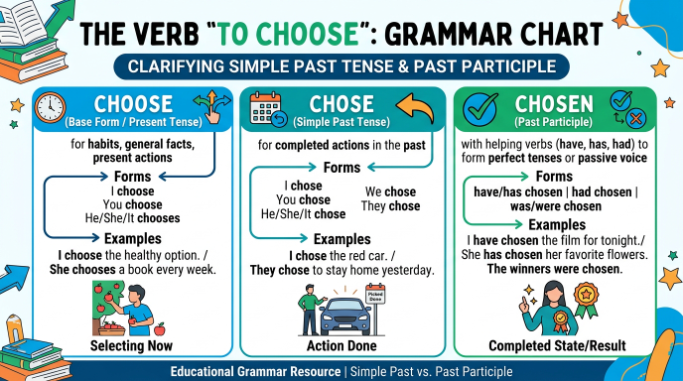
Choose
Choose is the base form and present-tense form.
I choose carefully.
They choose their own projects.
Chose
Chose is the simple past tense.
I chose carefully yesterday.
They chose their own projects last year.
Chosen
Chosen is the past participle.
It is commonly used with have, has, or had, or sometimes as an adjective.
I have chosen my answer.
She has chosen a new career.
They had chosen before the meeting began.
He was the chosen candidate.
A quick comparison:
I choose. → present
I chose. → past
I have chosen. → completed action connected to a perfect tense
One of the most common mistakes is using chose after have or has.
❌ I have chose the winner.
✅ I have chosen the winner.
Why? Because have requires a past participle, and the past participle is chosen, not chose.
Examples of Choose and Chose in Different Contexts
Everyday decisions
I choose what to wear based on the weather.
This morning, I chose a jacket because it was cold.
Work
Managers choose candidates based on several factors.
The company chose a new director last month.
Education
Students can choose from several subjects.
Maya chose biology because she enjoys science.
Relationships
You should choose people who treat you with respect.
He chose to remain friends.
Food and shopping
I usually choose the simplest meal.
At the restaurant, we chose the vegetarian option.
Writing and communication
Writers often choose words carefully.
She chose her words carefully before responding.
Difficult decisions
Sometimes you must choose between two good opportunities.
After weeks of discussion, they chose to postpone the project.
These examples show that the meaning remains broadly the same—making a selection or decision—while the verb form changes according to grammar and time.
“I Choose” or “I Chose”?
This is one of the most common forms of the choose or chose question.
Use “I choose” for the present
I choose to focus on what I can control.
This can describe a current decision, a general principle, or a deliberate present choice.
Use “I chose” for the past
I chose to focus on what I could control.
The decision happened earlier.
Compare:
Every day, I choose optimism.
This describes a repeated or ongoing attitude.
Yesterday, I chose optimism over frustration.
This describes one completed decision in the past.
Common Mistakes With Choose and Chose
Mistake 1: Using chose for the present
❌ I chose this option because it is better.
If you are explaining a decision you are making right now, the tense may need to be present:
✅ I choose this option because it is better.
However, context matters. If the decision has already been made, this is perfectly correct:
✅ I chose this option because it was better.
The surrounding context determines the intended tense.
Mistake 2: Writing “choosed”
❌ She choosed the blue dress.
✅ She chose the blue dress.
Choose is an irregular verb. Its simple past tense is chose, not choosed.
Mistake 3: Using chose after “have”
❌ We have chose a location.
✅ We have chosen a location.
Remember:
have/has/had + chosen
Mistake 4: Writing “to chose”
❌ I want to chose.
✅ I want to choose.
After the infinitive marker to, use the base form.
Mistake 5: Confusing “chosing” and “choosing”
❌ I am chosing a new laptop.
✅ I am choosing a new laptop.
The correct spelling is choosing.
The final e in choose is retained before -ing.
Mistake 6: Confusing “chooses” and “choses”
Chooses is the third-person singular form of the verb:
She chooses carefully.
Choses, however, is not the normal English verb form of choose. If you mean the verb, the correct word is almost certainly chooses.
How Do You Spell Choose or Chose Correctly?
Both words are correctly spelled English words, but they serve different grammatical purposes.
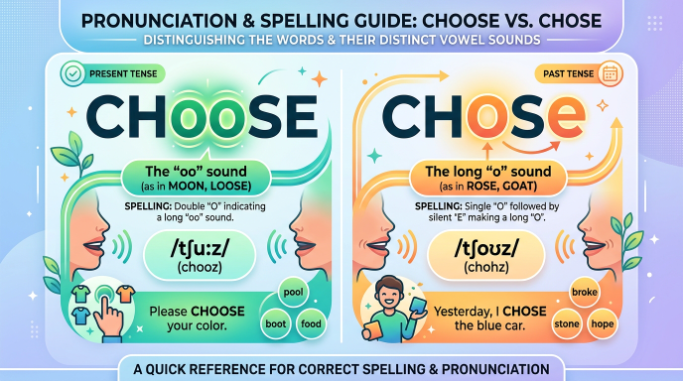
- C-H-O-O-S-E = choose
- C-H-O-S-E = chose
The extra o matters.
Choose
Pronounced approximately like “chooz.”
Chose
Pronounced approximately like “chohz.”
Although the spellings are similar, the vowel sounds differ.
A useful spelling observation is:
choose has the “oo” spelling and the present/base form
chose has one “o” after ch and is the past form
This is a spelling aid, not a complete grammar rule, but it can help when proofreading.
A Fast Decision Rule for Choose vs Chose
Use this quick checklist.
Step 1: Is the action happening now or generally?
If yes, use choose.
I choose carefully.
Step 2: Did the action happen and finish in the past?
If yes, use chose.
I chose carefully yesterday.
Step 3: Is the verb after have, has, or had?
If yes, you probably need chosen.
I have chosen carefully.
Step 4: Is the verb after “to” or a modal?
Use choose.
to choose
can choose
should choose
might choose
This simple pattern solves most choose vs chose problems.
A Practical Proofreading Test
When proofreading, replace the sentence with a time clue.
Ask yourself:
Can I add “every day” naturally?
Every day, I choose my priorities.
If yes, choose may be correct.
Can I add “yesterday” naturally?
Yesterday, I chose my priorities.
If yes, chose may be correct.
Is there a form of “have”?
I have chosen my priorities.
If yes, check whether you need chosen rather than chose.
This test is especially useful because many mistakes happen when writers know the words look similar but do not stop to identify the sentence’s tense.
Is Choose Formal or Casual?
Choose and chose are neutral standard English words.
They work in:
- everyday conversation
- academic writing
- business communication
- journalism
- formal documents
- creative writing
There is no meaningful formal-versus-casual distinction between the two forms. The choice depends on grammar, not register.
For example:
Casual:
I chose the cheaper one.
Formal:
The committee chose the proposal after careful consideration.
Both use chose because both describe past actions.
Likewise:
Casual:
You can choose whatever you want.
Formal:
Applicants may choose from the following options.
Both use choose because the grammar requires the base form.
British English vs American English
There is no important British-versus-American difference in the standard forms:
- choose
- chose
- chosen
- choosing
- chooses
Both British English and American English use the same core conjugation:
choose → chose → chosen
This is different from some verbs whose forms or spellings vary across English varieties, but choose does not present a major standard UK–US difference.
Pronunciation may vary slightly by accent, as many English words do, but the grammatical distinction remains the same.
Memory Trick for Choose vs Chose
Try this:
Choose has two o’s because the choice is still open.
Chose has one o because the choice is over.
This is only a memory device, not a linguistic rule, but it can help you remember the spelling difference.
Another useful pattern is to memorize the complete sequence:
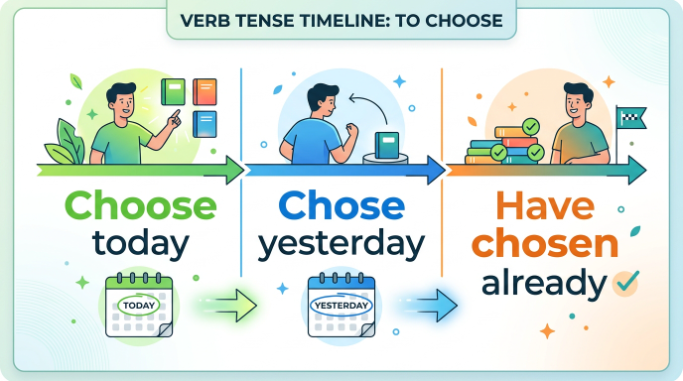
Choose today. Chose yesterday. Have chosen already.
For example:
Today, I choose.
Yesterday, I chose.
I have chosen.
Once you remember all three forms together, the difference becomes much easier to recognize.
Edge Cases and Contextual Differences
The basic distinction is straightforward, but English context can sometimes make the correct form less obvious.
“Choose” can refer to the future
The present form does not always mean the action is happening at this exact moment.
When you choose a university next year, consider the location carefully.
The choice will happen in the future, but choose is used because English commonly uses present forms in certain time clauses.
“Choose” can express a general principle
We choose how we respond to challenges.
This does not necessarily describe one decision happening right now. It expresses a general idea.
“Chose” describes one completed past choice
We chose how to respond after discussing the situation.
The decision happened at a specific completed point in the past.
“Chosen” can function adjectivally
She is the chosen representative.
Here, chosen describes the representative rather than functioning as the main finite verb.
Compare:
They chose her.
She was the chosen representative.
Understanding these differences helps prevent the common mistake of treating chose and chosen as interchangeable.
Frequently Asked Questions
Is chose the past tense of choose?
Yes. Chose is the simple past tense of choose.
I choose carefully.
Yesterday, I chose carefully.
What is the past tense of choose?
The simple past tense of choose is chose.
The past participle is chosen.
Choose → chose → chosen
Is choose past tense?
No. Choose is generally the base form or present-tense form.
The simple past tense is chose.
Is chose a verb?
Yes. Chose is a verb: specifically, the simple past tense of choose.
She chose a different path.
Is it “I chose” or “I choose”?
Both can be correct.
Use I choose for the present, habitual actions, or general statements:
I choose honesty.
Use I chose for a completed past decision:
I chose honesty over convenience yesterday.
Is it “chose or chosen”?
It depends on the grammar.
Use chose for the simple past:
They chose a winner.
Use chosen as the past participle:
They have chosen a winner.
Is “choosed” correct?
No, not in standard English.
❌ I choosed.
✅ I chose.
The past participle is chosen:
I have chosen.
How do you spell choosing?
The correct spelling is choosing.
❌ chosing
✅ choosing
Example:
Choosing the right option can take time.
What does “I chose this because” mean?
I chose this because… means that the speaker made the selection in the past and is about to explain the reason.
For example:
I chose this because it offered more flexibility.
The word chose shows that the decision has already been made.
Can I say “I have chose”?
No.
Use:
I have chosen.
Not:
I have chose.
The verb have requires the past participle chosen.
Final Takeaway
The difference between choose vs chose is primarily about verb tense:
- Choose = present or base form
- Chose = simple past
- Chosen = past participle
The easiest pattern to remember is:
I choose now. I chose yesterday. I have chosen already.
If you are unsure, identify when the choice happened and check whether the sentence contains to, can, should, have, has, or had. Those clues usually reveal the correct form immediately.