Smooth vs. Smoothe: Which Spelling Is Correct?
Quick Answer
Smooth is the correct standard spelling. Smoothe is a common misspelling of the verb smooth and is not accepted as a standard spelling in modern English.
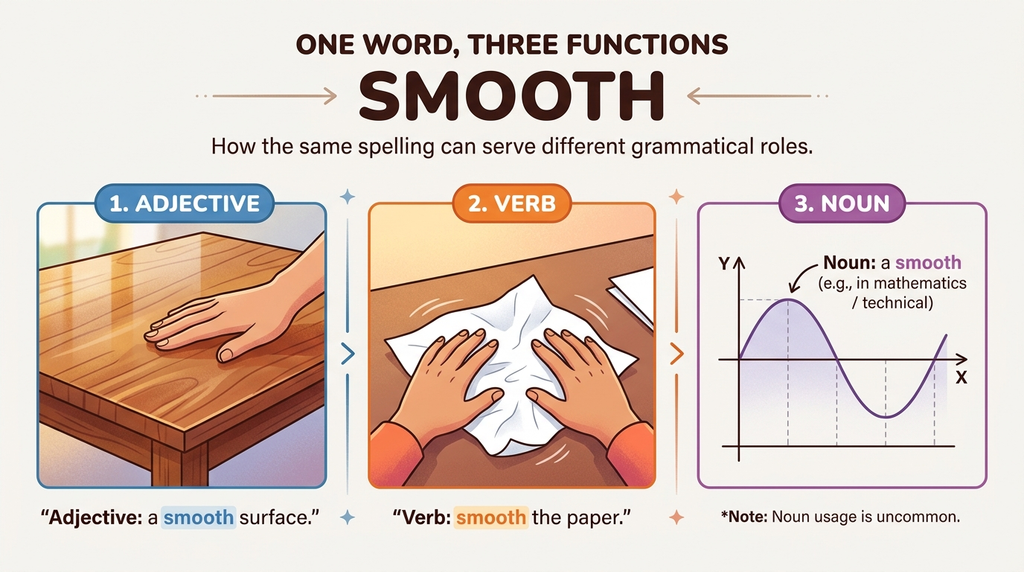
Use smooth as an adjective to describe something even, level, soft to the touch, or free from interruptions. Use it as a verb when you mean to make something even, remove roughness, or improve the flow of something.
- Correct: She used a brush to smooth her hair.
- Incorrect in standard English: She used a brush to smoothe her hair.
- Correct: The surface feels smooth.
- Incorrect in standard English: The surface feels smoothe.
The confusion arises because many English verbs add -e or -en in certain forms, but smooth does not need an extra e to function as a verb.
Smooth vs. Smoothe: At-a-Glance Table
| Feature | Smooth | Smoothe |
|---|---|---|
| Standard spelling | Yes | No |
| Meaning | Even, level, gentle, or free from roughness; also to make something smooth | Usually intended to mean smooth |
| Part of speech | Adjective, verb, and noun in certain contexts | Not a standard English word |
| Correct example | The road is smooth. | The road is smoothe. |
| Correct verb use | Smooth the paper. | Smoothe the paper. |
| Standard past tense | Smoothed | Smoothed is the intended form, not smoothed derived from smoothe |
| Standard -ing form | Smoothing | Smootheing is incorrect |
| Standard comparative | Smoother | Smoothe(r) is incorrect |
| British vs. American English | Standard in both | Not a standard regional alternative |
| Best choice in writing | Always use smooth when this meaning is intended | Avoid in formal and standard informal writing |
The key distinction is spelling, not meaning. In ordinary modern English, smooth and smoothe are not two accepted spellings with different definitions.
1. What Does Smooth Mean?
Smooth has several related meanings. Its precise meaning depends on whether it describes a quality, an action, or a particular kind of movement or experience.
Smooth as an adjective
As an adjective, smooth describes something without noticeable bumps, roughness, or irregularities. It can also describe something that happens easily or sounds pleasant and uninterrupted.
Examples:
- The glass surface is smooth and cool.
- This cream leaves my hands feeling smooth.
- We enjoyed a smooth journey with very little traffic.
- Her presentation had a smooth, natural flow.
- The singer has a smooth voice.
- The negotiations proceeded smoothly.
In these examples, smooth describes a physical quality, a process, or an experience.
Smooth as a verb
As a verb, smooth means to make something even, flatten wrinkles, remove irregularities, or make a process less difficult.
Examples:
- Smooth the dough before placing it in the oven.
- He smoothed the creases from his shirt.
- She smoothed the blanket over the bed.
- The manager tried to smooth relations between the two teams.
- The editor smoothed a few awkward sentences in the report.
Notice that the spelling stays smooth in its base form. The final h is part of the word, but no additional e is required.
Smooth as a noun
Smooth can also appear as a noun in specialized or informal expressions, although this use is much less common than its adjective and verb forms.
For example, in some technical contexts, the smooth may refer to a smooth part or component of a surface or mathematical structure. Most everyday writers will rarely need this usage.
2. What Does Smoothe Mean?
Smoothe is generally a misspelling of smooth. Writers may use it because they assume the verb needs an extra final e, perhaps by analogy with words such as breathe or bathe.
However, the standard spelling does not change when smooth functions as a verb.
Compare these sentences:
| Nonstandard spelling | Standard spelling |
|---|---|
| Please smoothe the edges. | Please smooth the edges. |
| She smoothe’d the fabric. | She smoothed the fabric. |
| He is smootheing the surface. | He is smoothing the surface. |
| The table looks smoothe. | The table looks smooth. |
The second row illustrates another issue: adding an apostrophe does not make an incorrect spelling correct. The standard past tense is smoothed, with no apostrophe.
Is smoothe ever correct?
You might encounter smoothe in usernames, brand names, creative spellings, or informal online content. A particular business or artist may deliberately use it as a name.
That does not make it the standard English spelling. In essays, professional emails, educational material, and edited articles, use smooth.
3. Smooth vs. Smoothe: Grammar and Word Forms
Understanding the word’s grammatical forms makes the distinction easier to remember.
| Grammatical form | Correct spelling | Example |
|---|---|---|
| Base form | Smooth | Smooth the surface carefully. |
| Third-person singular | Smooths | She smooths the icing with a spatula. |
| Past tense | Smoothed | He smoothed the paper flat. |
| Past participle | Smoothed | The surface has been smoothed. |
| Present participle | Smoothing | They are smoothing the concrete. |
| Comparative adjective | Smoother | This fabric is smoother than the other one. |
| Superlative adjective | Smoothest | This is the smoothest finish available. |
| Adverb | Smoothly | The machine operates smoothly. |
| Related verb | Smoothen | The treatment may smoothen the surface. |
The central rule is straightforward: adding a grammatical ending does not require inserting an e before the ending.
Why is it smoothed rather than smoothe’d?
The verb is smooth, so its regular past-tense form is smoothed. English usually forms the past tense of regular verbs by adding -ed.
The final h remains, and the additional letters form the ending:
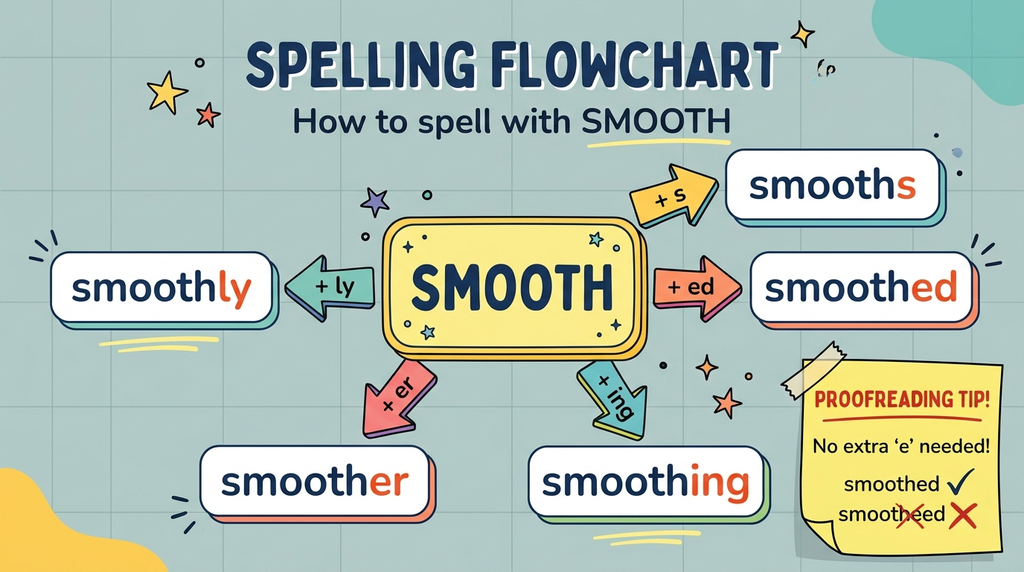
- smooth + ed = smoothed
- smooth + ing = smoothing
- smooth + s = smooths
By contrast, smoothe is not the standard base spelling from which these forms should be constructed.
How do you spell smoothes?
Both smooths and smoothes occur in English, but they do not have the same grammatical status or frequency.
- Smooths: The standard third-person singular form of the verb smooth. Example: “The lotion smooths dry-looking skin.”
- Smoothes: A less common variant verb form recorded in some dictionaries and usage contexts. It is generally unnecessary in modern writing, where smooths is the clearer and more conventional choice.
For most readers and writers, choose smooths.

4. When to Use Smooth
Use smooth whenever you want to describe an even surface, a gentle texture, an uninterrupted process, or an action that removes roughness.
To describe a physical surface
Use smooth when a surface feels even or has few noticeable irregularities.
Examples:
- The stone has a smooth finish.
- Sanding made the wooden panel smooth.
- The silk felt smooth against her skin.
- The river stones became smooth over time.
- Check that the edges are smooth before assembling the furniture.
To describe movement or progress
The word can also describe movement without sudden changes or a process that works without unnecessary difficulty.
Examples:
- The train made a smooth stop.
- The software update went smoothly.
- We want a smooth transition between the two stages.
- Their teamwork helped ensure a smooth launch.
- The conversation moved smoothly from one topic to another.
When describing how an action happens, the adverb smoothly is often more appropriate than the adjective smooth.
Compare:
- Correct: The engine runs smoothly.
- Correct: The engine has a smooth sound.
- Incorrect for the intended adverbial meaning: The engine runs smooth.
The last sentence may occur in informal speech or particular dialects, but smoothly is the standard choice in formal writing.
To describe sound, speech, or style
Smooth can describe speech that flows naturally, music with a gentle quality, or writing that reads easily.
Examples:
- The speaker delivered a smooth, confident introduction.
- Her voice sounded smooth and warm.
- The revised paragraph has a smoother rhythm.
- The pianist created a smooth transition between sections.
- The new version reads more smoothly than the original.
To describe social interactions
In figurative use, smooth can mean easy, tactful, or free from friction.
Examples:
- A clear agenda helped make the meeting smooth.
- The mediator worked to smooth tensions between the groups.
- She smoothed over a misunderstanding before it grew.
- Good planning makes the handover smoother.
The expression smooth over is especially useful when discussing disagreements, awkward situations, or difficulties that someone tries to resolve or minimize.
5. Examples of Smooth in Different Contexts
The following examples show how the spelling works in everyday, academic, professional, and creative contexts.
Everyday conversation
- This stone feels smooth.
- Can you smooth the bedsheet?
- The ride was surprisingly smooth.
- My hair feels smoother after conditioning.
- Please smooth out the wrinkles in the tablecloth.
School and academic writing
- The experiment produced a smooth curve.
- The researcher smoothed the data to reduce short-term fluctuations.
- A smooth transition connects the two paragraphs.
- The model assumes a smooth function over the interval.
- The revised argument flows more smoothly.
In technical writing, smooth can have a precise mathematical meaning. A smooth function, for example, has derivatives of all orders in the relevant mathematical definition. It should not be treated as merely a synonym for attractive or even-looking.
Business and workplace writing
- The team planned a smooth onboarding process.
- The new checklist should make the handover smoother.
- The facilitator helped smooth communication between departments.
- We hope the migration proceeds smoothly.
- The revised procedure reduces interruptions and creates a smoother workflow.
Beauty, fashion, and personal care
- The moisturizer leaves a smooth finish.
- She smoothed her hair before the photograph.
- This fabric has a smooth texture.
- The makeup blended smoothly across the skin.
- The tailor checked that the seams felt smooth.
These examples describe texture, appearance, or an action. They do not require the spelling smoothe.
Technology and product design
- The phone has smooth, rounded edges.
- The application offers a smoother navigation experience.
- The engineer smoothed the rough points in the interface.
- The animation moves smoothly between screens.
- The update should make the transition smoother.
6. Smooth vs. Smoothen: Is Smoothen a Word?
Yes. Smoothen is a real English verb, meaning to make something smooth or smoother. It is less common than smooth used as a verb, and in many sentences, smooth is the more natural choice.
Compare:
- The carpenter smoothed the wooden surface.
- The carpenter smoothened the wooden surface.
Both forms can be understood, but the first is more concise and conventional.
Smooth vs. smoothen
| Feature | Smooth | Smoothen |
|---|---|---|
| Part of speech | Adjective and verb | Verb |
| Core meaning | Even or make even | Make smooth or smoother |
| Frequency | Very common | Less common |
| Natural example | She smoothed the paper. | The process smoothens the surface. |
| Best everyday choice | Usually preferred | Useful when it fits the sentence or technical context |
Is smoothen a word in British and American English?
Smoothen is an English verb used in more than one English variety. Its acceptability does not depend on adding an e to smooth. The form is built with the ending -en.
Its related forms include:
- Smoothen: They smoothen the rough edges.
- Smoothens: This treatment smoothens the material.
- Smoothened: The surface was smoothened during finishing.
- Smoothening: The smoothening process takes several minutes.
These forms are grammatical, although the smooth family is often more idiomatic in ordinary writing.
Is smoothening a word?
Yes. Smoothening is the -ing form of smoothen and can function as a gerund or participle.
Examples:
- Smoothening the rough edges takes patience.
- The technician is smoothening the surface.
- The smoothening process improved the finish.
However, smoothing is usually the simpler alternative.
- More common: Smoothing the rough edges takes patience.
- Also possible: Smoothening the rough edges takes patience.
Do not confuse smoothening with smootheing. The latter is not the standard spelling.
7. Smooths vs. Smoothes: Which Form Should You Choose?
This is a separate question from smooth vs. smoothe because smooths and smoothes are competing verb forms rather than an accepted spelling and a simple misspelling.
Smooths
Smooths is the standard, widely preferred third-person singular form of smooth.
Examples:
- This tool smooths rough edges.
- The cream smooths the appearance of the skin.
- She smooths the fabric before cutting it.
- The filter smooths small variations in the graph.
Smoothes
Smoothes appears as a less common variant in some usage references. Although it may be encountered in published material, most writers should prefer smooths for clarity and consistency.
Examples where smooths is preferable:
- Preferred: The machine smooths the surface.
- Less common: The machine smoothes the surface.
- Preferred: This technique smooths the transition.
- Less common: This technique smoothes the transition.
How do you spell smoothes?
If you mean the ordinary third-person singular verb form, write smooths.
If you have encountered smoothes in a text, consider the context and the dictionary or style guide governing that text. Do not automatically treat every occurrence as a typo, but do not choose the less common form merely because it appears to match a pattern such as washes or brushes.
The distinction is one of conventional usage and preference, not a difference in the intended meaning.
8. Smooth vs. Soft: What Is the Difference?
Smooth and soft are related adjectives, but they describe different qualities. Something can be both smooth and soft, but the words are not interchangeable in every situation.
- Smooth primarily describes surface texture, evenness, or uninterrupted movement.
- Soft primarily describes a lack of hardness, a yielding texture, gentleness, or low intensity.
| Example | Meaning |
|---|---|
| A smooth stone | The stone has an even, non-rough surface. |
| A soft stone | The stone is relatively easy to compress, scratch, or deform. |
| Smooth fabric | The fabric has an even texture. |
| Soft fabric | The fabric feels gentle or yielding to the touch. |
| Smooth music | The sound flows gently or evenly. |
| Soft music | The music is quiet or gentle in volume or tone. |
| Smooth skin | The skin feels even rather than rough. |
| Soft skin | The skin feels yielding or gentle to the touch. |
Can something be smooth but not soft?
Yes. A glass tabletop can be smooth but hard. A polished metal surface can also be smooth without being soft.
Can something be soft but not smooth?
Yes. A fluffy towel can be soft but have a textured, uneven surface. A wool blanket can feel soft while its fibers create a noticeable texture.
What about smooth and soft together?
Both words can accurately describe an object when it has both qualities.
For example:
- The pillowcase feels smooth and soft.
- The lotion leaves my hands feeling soft and smooth.
- The fabric is soft to the touch but has a slightly rough surface.
Choose the adjective that describes the quality you actually mean.

9. More Smooth or Smoother: Which Is Correct?
When comparing two things, smoother is usually the preferred comparative form of smooth.
Examples:
- This surface is smoother than the old one.
- The second draft has a smoother opening.
- The new road makes for a smoother journey.
- Her revised explanation is smoother and easier to follow.
The form more smooth is also possible, particularly when emphasizing the adjective or creating a particular rhythm or contrast. However, smoother is the more natural default in ordinary prose.
Compare:
- Natural: This material is smoother than the other one.
- Possible, but less usual: This material is more smooth than the other one.
In some contexts, more smooth may be chosen for emphasis, contrast, or stylistic reasons. It is not universally ungrammatical.
Use smoothest when comparing three or more items or identifying the highest degree within a group:
- Of the three surfaces, this one is the smoothest.
- That was the smoothest transition in the presentation.
10. Smooth or Smoove: Are They the Same?
No. Smooth is the standard English spelling. Smoove is an informal, stylized spelling that may appear in slang, usernames, entertainment, music, or branding.
People may use smoove to create a playful or distinctive voice, but it is not the normal spelling for edited English.
Examples:
- Standard: He made a smooth move.
- Informal stylization: He made a smoove move.
- Standard: The performance was smooth.
- Stylized: The performance was smoove.
Use smooth in school assignments, formal writing, workplace documents, and general explanatory content. Use smoove only when you intentionally want a nonstandard or expressive style.
11. Common Mistakes and Corrected Examples
The following errors are easy to avoid once you distinguish the base spelling from its grammatical forms.
| Incorrect or less suitable | Better choice | Why |
|---|---|---|
| Please smoothe the surface. | Please smooth the surface. | Smooth is the standard spelling. |
| She is smootheing the dough. | She is smoothing the dough. | Add -ing directly to smooth. |
| He smoothe’d the paper. | He smoothed the paper. | Regular past tense uses -ed. |
| This is the smootheest finish. | This is the smoothest finish. | The superlative is smoothest. |
| The machine runs smooth. | The machine runs smoothly. | Use the adverb to describe how the machine runs in standard formal prose. |
| This surface is more smoother. | This surface is smoother. | Avoid using two comparative markers together. |
| The blanket is smooth when I mean it is yielding. | The blanket is soft. | Choose the adjective that matches the intended quality. |
| The tool smoothes the wood. | The tool smooths the wood. | Smooths is the conventional preferred form. |
| The treatment is smootheing the skin. | The treatment is smoothing the skin. | The standard spelling has no extra e. |
| The process is smootheing the surface. | The process is smoothening the surface. | If using smoothen, retain its standard spelling and ending. |
Why do these mistakes happen?
Several patterns in English can make smoothe look plausible:
- Spelling analogy: Writers may compare smooth with words that end in a silent e, such as breathe.
- Pronunciation: In most accents, the final th sound does not change simply because someone adds an imagined e.
- Verb confusion: Some writers assume every verb needs a spelling change before taking an ending.
- Visual familiarity: Seeing nonstandard spellings online can make them appear legitimate.
The best solution is to remember the base word and form the ending directly from it.
12. A Fast Decision Rule and Memory Test
Use this checklist whenever you are unsure whether to write smooth or smoothe.
- Am I describing an even surface, gentle movement, or uninterrupted progress? Use smooth.
- Am I describing the action of making something even? Use smooth as a verb.
- Do I need the past tense? Write smoothed.
- Do I need the -ing form? Write smoothing.
- Do I need the third-person singular? Usually write smooths.
- Am I making a comparison? Usually write smoother.
- Am I referring to a nonstandard brand name or deliberate creative spelling? Keep smoothe only if it is genuinely the intended name or style.
The substitution test
Try replacing the disputed word with flatten, polish, or make even.
If the sentence means that someone is making something smoother, smooth will usually work as the verb.
For example:
- Original: Please smoothe the paper.
- Substitute: Please flatten the paper.
- Corrected: Please smooth the paper.
The substitution confirms that the sentence needs the verb smooth, not a different word.
Quick proofreading quiz
Choose the correct option in each sentence.
Select an answer for each sentence, then check your results.
1. Please ___ the icing before serving.smoothesmooth
2. The new road provides a ___ ride.smoothesmoother
3. She is ___ the fabric with her hand.smootheningsmootheing
4. This tool ___ rough edges.smoothssmoothe’s
5. The engine runs ___.smoothsmoothly
Check answersReset
13. Formal vs. Casual Usage and Regional Differences
Formal English
In academic writing, professional documents, and edited publications, use smooth and its standard forms consistently.
Examples:
- The revised procedure creates a smoother workflow.
- The surface was smoothed before painting.
- The application operates smoothly under normal conditions.
- The editor smoothed the transition between paragraphs.
Avoid smoothe unless it is a proper name or a deliberate quotation of nonstandard spelling.
Casual English
Informal conversation may include nonstandard grammar or playful spellings, but that does not make every variant a standard written form.
People may type smoothe because it looks plausible or because they have seen it online. Readers will generally understand the intended meaning, but the spelling is still nonstandard.
British vs. American English
There is no general British-versus-American spelling distinction between smooth and smoothe. Both British and American English use smooth.
Examples in both varieties include:
- smooth surface
- smooths the edges
- smoothed the fabric
- smoothing the paper
- smoother finish
- smoothest route
Differences in pronunciation may occur among accents, but they do not establish smoothe as an accepted regional spelling.
Pronunciation
Smooth is commonly pronounced /smuːð/ in standard English pronunciation guides. It rhymes approximately with soothe and ends with the voiced “th” sound heard in this.
Smoothe, when encountered, is generally intended to be pronounced like smooth. The additional written e does not signal a separate standard pronunciation.
The word smoth is also not the standard spelling for this meaning. If someone writes smoth, they usually intend smooth but have omitted a letter.

14. Frequently Asked Questions
Is it smooth or smoothe?
It is smooth in standard English. Smoothe is generally a misspelling, not a separate word with a different meaning.
How do you spell smooth?
Spell it s-m-o-o-t-h. There is no final e.
What is the difference between smooth and smoothe?
There is no standard difference in meaning. Smooth is the correct spelling, while smoothe is nonstandard when used to express the same meaning.
Is smoothe a word?
It is not a standard spelling of the ordinary English word smooth. It may appear as a proper name, brand, username, or intentional creative spelling.
What is the smoothe definition?
When people search for a smoothe definition, they usually want the meaning of smooth. The standard word describes something even, level, gentle, or uninterrupted, or means to make something smooth.
What does smoothe mean in a sentence?
If you see “Please smoothe the surface,” the intended meaning is “Please smooth the surface.” The standard spelling is smooth.
Is smoothen a word?
Yes. Smoothen is a verb meaning to make something smooth or smoother. However, smooth used as a verb is generally more common and concise.
Is smoothening a word?
Yes. Smoothening is the -ing form of smoothen. In everyday writing, smoothing is usually the more natural alternative.
Should I use smooths or smoothes?
Use smooths as the normal third-person singular form: “This tool smooths the surface.” Smoothes is a less common variant, so smooths is the preferred choice in most contexts.
How do you spell smoothes?
If you mean the verb form used in “This product ___ the surface,” the standard, preferred spelling is smooths. The less common form smoothes also appears in some usage references.
Is it more smooth or smoother?
Smoother is usually the most natural comparative form. More smooth can be used for emphasis or stylistic reasons, but it is less common.
What is the difference between smooth and soft?
Smooth describes evenness or surface texture, while soft describes a lack of hardness or a yielding feel. A material can be smooth and hard, soft and textured, or both smooth and soft.
Is smooth a verb or an adjective?
It can be both. In “The surface is smooth,” it is an adjective. In “Smooth the surface,” it is a verb.
What does smoth mean?
Smoth is not the standard spelling for the word discussed here. If you mean an even surface or the action of making something even, write smooth.
Is smoove the same as smooth?
Not in standard spelling. Smoove is a stylized or informal variant sometimes used for creative effect. Use smooth in ordinary edited English.
15. Final Takeaway
The distinction between smooth and smoothe is simple: smooth is the correct standard spelling; smoothe is not a standard alternative.
Remember the main word forms:
- Smooth: The surface is smooth.
- Smooths: The tool smooths the surface.
- Smoothed: She smoothed the fabric.
- Smoothing: He is smoothing the paper.
- Smoother: This finish is smoother.
- Smoothly: The machine runs smoothly.
- Smoothen: A valid but less common verb meaning to make smooth.
- Smoothening: A valid form of smoothen, although smoothing is usually preferred.
When proofreading, start with smooth and add only the grammatical ending the sentence requires. You will avoid the common smoothe spelling error while choosing forms that sound natural in standard English.