Window Seal or Sill: What’s the Difference?
Quick Answer
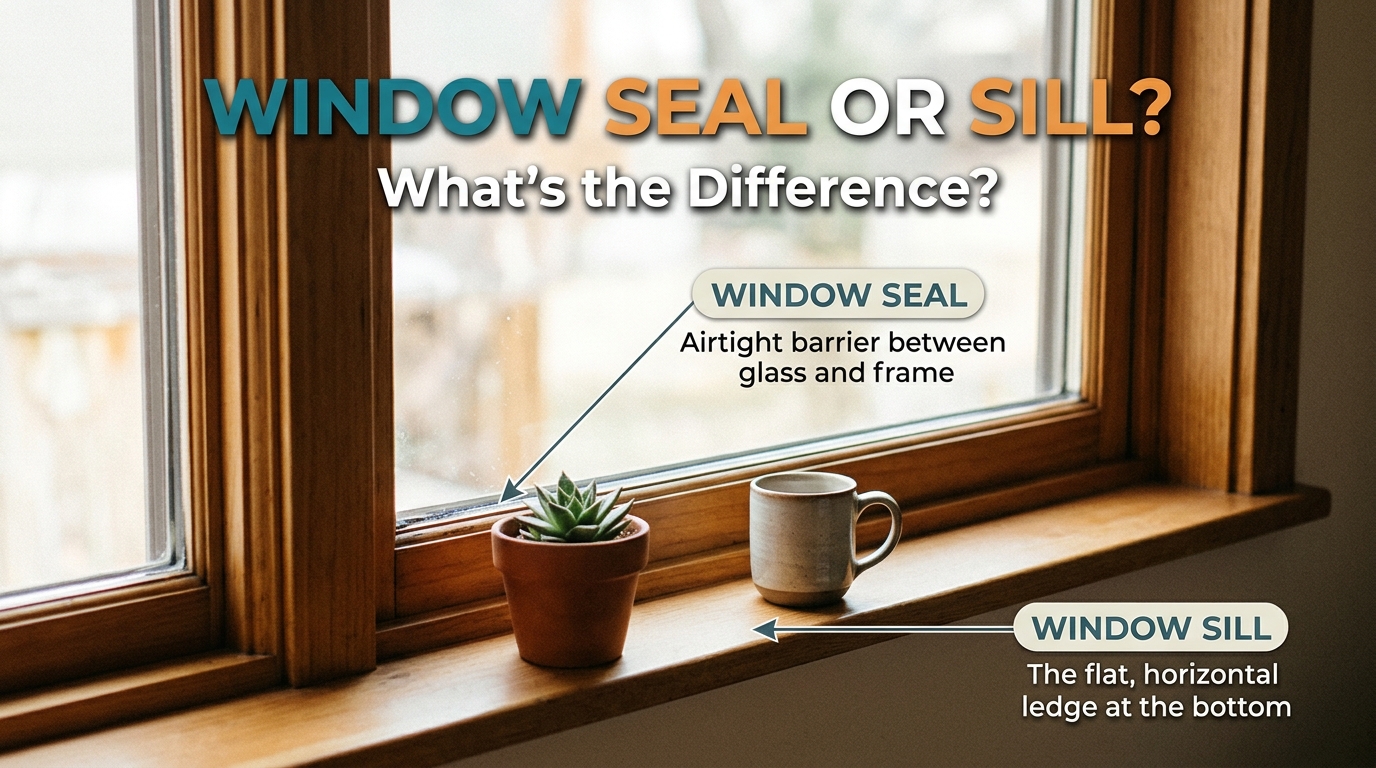
The correct word is usually window sill or windowsill when you mean the horizontal ledge at the bottom of a window. A window seal is different: it refers to a sealing material or component that helps prevent air, water, or moisture from passing through gaps around a window.
Both seal and sill are correctly spelled English words, but they describe different things. Choose the word that matches what you mean.
- Window sill / windowsill: The ledge at the bottom of a window, often used for plants or decorations.
- Window seal: A component or material that helps close gaps and keep out drafts, rain, or moisture.
- Window cill: A British spelling variant of window sill, particularly common in construction and building terminology.
At-a-Glance Table
| Feature | Window sill / windowsill | Window seal |
|---|---|---|
| Meaning | The ledge at the bottom of a window | Material or a component that closes a gap |
| Part of speech | Noun | Noun |
| Main purpose | Supports objects and helps manage water at the window base | Helps prevent air or water leakage |
| Example | She placed a flowerpot on the windowsill. | The damaged window seal let rainwater in. |
| Spelling | Window sill or windowsill | Window seal |
| American English | Both spellings of sill are used | Common technical and everyday term |
| British English | Sill, windowsill, and cill are used | Common, especially for weatherproofing components |
| Pronunciation | SILL | SEEL |
| Common mistake | Writing window seal when referring to a ledge | Writing window sill when referring to a sealing component |
The easiest distinction is this: a sill is a ledge; a seal prevents leakage.
What Is the Difference Between a Window Sill and a Window Seal?
Although sill and seal sound somewhat similar, they refer to different parts or functions of a window. Understanding what each word describes is the most reliable way to choose the correct spelling.
What Does Window Sill Mean?
A window sill is the horizontal surface at the bottom of a window opening. Depending on the window design, it may extend into the room, project outside the building, or have both interior and exterior sections.
A sill may be made from wood, stone, concrete, metal, vinyl, or another building material. Indoors, it often serves as a ledge for plants, ornaments, or other small objects. In building construction, the sill can also help direct water away from the wall and form part of the window installation.
Examples:
- The cat sat on the wide window sill.
- Dust had collected along the bedroom windowsill.
- The contractor replaced the cracked stone window sill.
- Rainwater was pooling on the exterior sill.
- She measured the window sill before ordering a custom wooden board.
In each sentence, sill identifies a physical ledge or structural surface. It does not mean the rubber strip or material used to seal gaps around the window.
What Does Window Seal Mean?
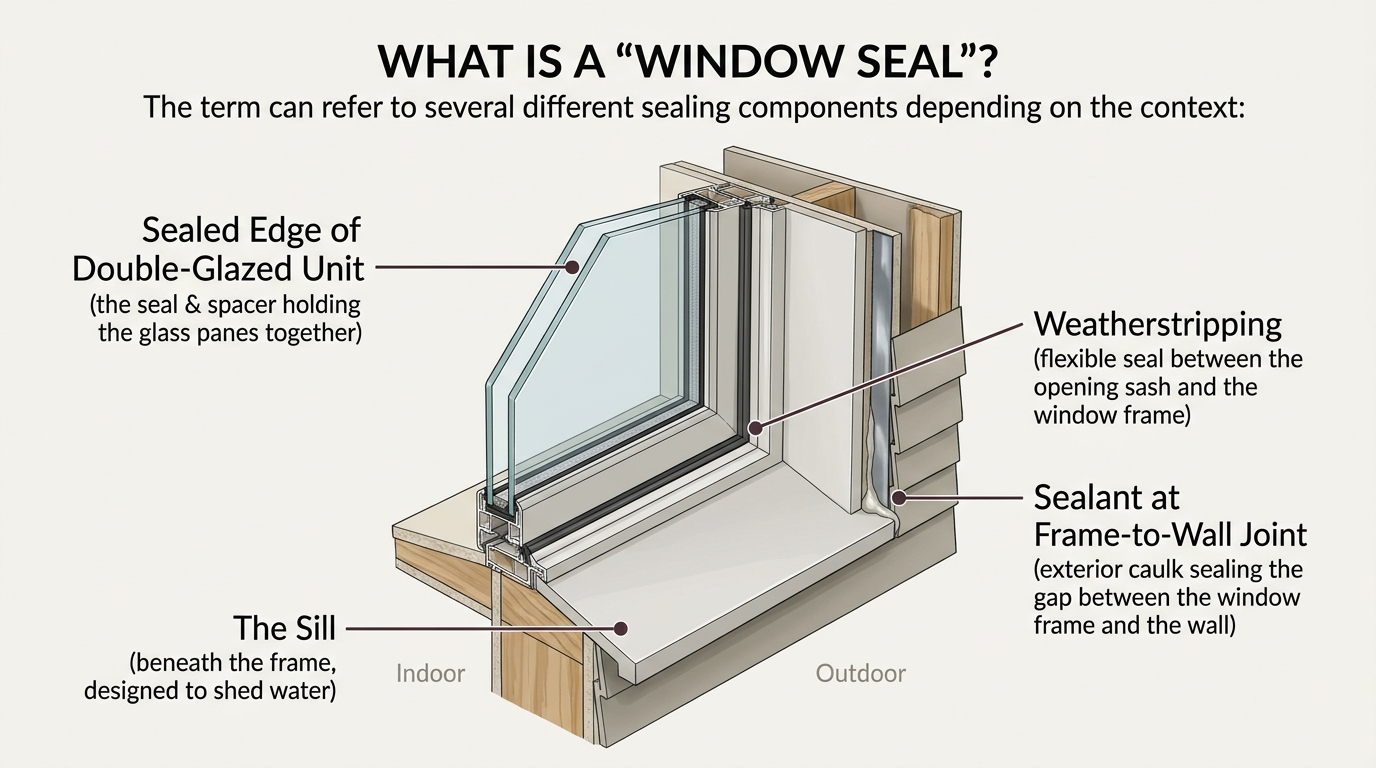
A window seal is a component, material, or sealing arrangement that helps close gaps around a window or between parts of the window assembly. Depending on the context, it may refer to weatherstripping, a rubber gasket, sealant, or another element designed to reduce air or water leakage.
The precise component matters. For example, the seal around an opening window may be a flexible gasket, while the joint between the window frame and the surrounding wall may be sealed with caulk or another sealant. In double-glazed windows, the seal around the glass unit has a different function: it helps maintain the sealed space between the panes.
Examples:
- The window seal needs replacing because cold air is entering the room.
- A damaged seal allowed water to seep around the frame.
- The installer applied sealant along the joint between the frame and the wall.
- The double-glazed unit has failed because its edge seal is no longer intact.
- We checked the window seals before the winter weather arrived.
Here, seal refers to a barrier or sealing component, not a ledge.
Window Sill or Windowsill: Is It One Word or Two?
Both window sill and windowsill are correct spellings for the ledge at the bottom of a window.
- Window sill: The traditional two-word form, widely used in American and British English.
- Windowsill: A standard one-word compound spelling, also widely accepted in both varieties of English.
Examples:
- The book was resting on the window sill.
- The book was resting on the windowsill.
- Potted herbs lined the kitchen window sill.
- Potted herbs lined the kitchen windowsill.
All four sentences are correct. The meaning does not change when you combine the two words.
Which Spelling Should You Use?
For ordinary writing, either form is appropriate. If you are writing a building specification, following a house style, or editing a website, choose one form and use it consistently.
For example, a home-improvement article might use window sill in its headings and body text. Another publication might prefer windowsill as a single compound word. Neither choice is inherently incorrect.
The important distinction is between sill and seal, not between the one-word and two-word spellings of windowsill.
When to Use Window Sill, Window Seal, or Window Cill
Use the following guidance to choose the correct term for your sentence.
1. Use Window Sill for a Ledge
Choose window sill or windowsill when you are talking about the horizontal surface beneath a window.
Examples:
- The wooden window sill needs a fresh coat of paint.
- I left my glasses on the windowsill.
- The builder installed a sloping exterior window sill to help drain rainwater.
- A narrow sill runs along the bottom of the office window.
- The paint on the old window sill has started to peel.
Why it works: Each example refers to a physical surface, either decorative or structural.
2. Use Window Seal for Weatherproofing
Choose window seal when you mean a component or material that helps keep air, rain, or moisture from passing through a gap.
Examples:
- The window seal has deteriorated over time.
- Replace the damaged seal to reduce drafts.
- The inspector found a leak around the window frame.
- A flexible gasket helps seal the opening window.
- The installer checked the perimeter seal after fitting the new window.
Why it works: The subject is the barrier or the function of closing a gap, rather than a ledge.
3. Use Window Cill When Appropriate in British English
Cill is an alternative spelling of sill used particularly in British building and construction contexts. You may see it in specifications, product descriptions, and trade terminology.
Examples:
- The contractor measured the stone window cill.
- The replacement timber cill must match the original dimensions.
- The building specification calls for a concrete cill.
In general writing, window sill and windowsill are widely understood in the UK as well. You do not need to change sill to cill unless you are following a specific regional or industry convention.
4. Use Sealant When You Mean the Product
Sometimes neither window sill nor window seal is the most precise expression.
If you mean the substance applied to a joint, window sealant or sealant around the window frame may be clearer.
Compare these sentences:
- The window seal is damaged. — The sealing component or barrier is damaged.
- The window sealant is cracked. — The sealing substance has cracked.
- The window sill is damaged. — The ledge itself is damaged.
These terms are related, but they are not interchangeable in every technical context.
Examples of Window Sill vs. Window Seal in Different Contexts
The context often makes the correct word obvious. Compare the examples below to see how the meaning changes.
| Context | Correct example | Why |
|---|---|---|
| Home decoration | I put a vase on the window sill. | A vase sits on a ledge. |
| Gardening | The windowsill gets plenty of sunlight. | The word identifies the ledge where plants sit. |
| Building repair | The exterior sill is cracked. | The physical sill needs repair. |
| Draft prevention | The window seal is letting cold air in. | The sealing component is failing. |
| Rain leakage | Water is entering through a damaged window seal. | The barrier is no longer preventing leakage. |
| Window installation | The installer sealed the gap around the frame. | Sealed describes the action of closing the gap. |
| Double glazing | The insulated glass unit has a failed edge seal. | The seal maintains the integrity of the glass unit. |
| Construction specifications | The stone window cill must be replaced. | Cill is a regional spelling of sill. |
Everyday Conversation Examples
In casual speech, people usually choose the term based on the object they are discussing.
- “Move that cup off the windowsill before it falls.”
- “There’s a draft coming through the window seal.”
- “Can you wipe the dust off the window sill?”
- “We need someone to check the seals around the bedroom windows.”
- “The exterior cill is cracked, so we should have it inspected.”
Notice that the plural seals refers to multiple sealing components, while sills refers to multiple ledges.
Home Improvement and Construction Examples
Technical contexts require a little more precision because a window has several separate components.
- The interior sill has a decorative finish.
- The exterior sill directs water away from the wall.
- The weather seal around the opening sash has become brittle.
- The sealant between the window frame and masonry needs attention.
- The glazing unit’s edge seal has failed, causing condensation between the panes.
A window may have a perfectly sound sill but a damaged seal. Conversely, a sill can be cracked while the weather seals remain intact. The two components perform different roles, so identifying the actual problem matters.

How Do You Spell Window Sill?
The standard spelling is window sill or windowsill.
Spell the two-word version as follows:
- Window: W-I-N-D-O-W
- Sill: S-I-L-L
The word sill has two Ls at the end. It does not contain an E.
If you are asking how to spell the ledge beneath a window, write:
- The window sill is painted white.
- The windowsill is painted white.
Both are correct.
How Do You Spell Window Seal?
The spelling is window seal:
- Window: W-I-N-D-O-W
- Seal: S-E-A-L
The word seal contains the vowel combination ea and ends in L.
Use it when referring to the sealing component or barrier, as in “The window seal needs replacing.”
Window Sill Pronunciation vs. Window Seal Pronunciation
The two terms sound different, even though they can be confused in fast conversation.
| Word | Pronunciation | Rhymes with |
|---|---|---|
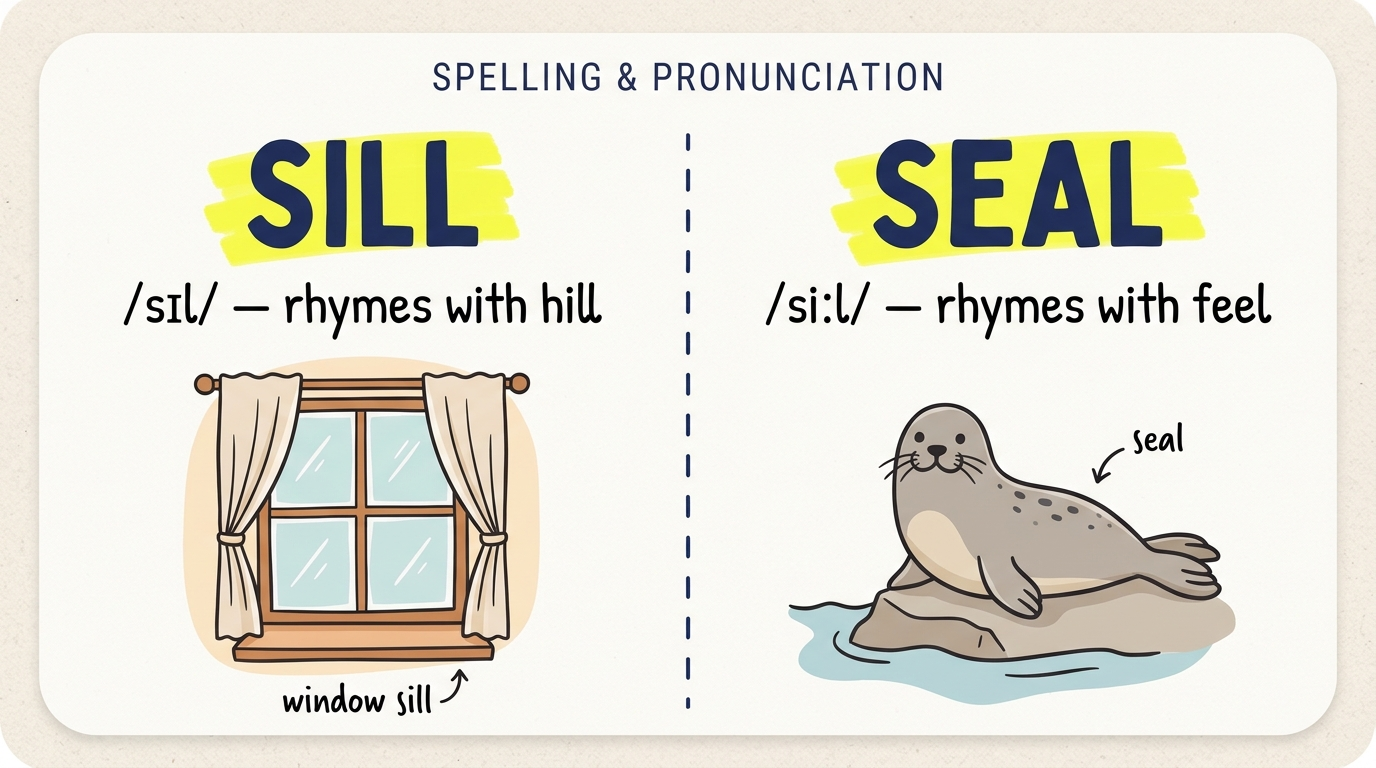
| Sill | /sɪl/ | Fill, hill, bill |
| Seal | /siːl/ | Feel, heel, meal |
| Window | /ˈwɪn.doʊ/ in typical American English | Begins with the sound in win |
| Cill | Usually /sɪl/ | Sill, fill, hill |
Sill has a short vowel sound, like the vowel in sit. Seal has a longer vowel sound, like the vowel in see.
In ordinary pronunciation, window sill and windowsill sound the same because the spelling difference does not change the pronunciation.
Common Mistakes: Window Seal or Sill?
Confusing these words can change the meaning of a sentence. The following examples show common errors and how to correct them.
| Incorrect or potentially misleading | Better wording | Explanation |
|---|---|---|
| I put the plant on the window seal. | I put the plant on the window sill. | A plant sits on a ledge, not a weather seal. |
| The window sill is letting cold air in. | The window seal is letting cold air in. | The sealing component is the likely source of the draft. |
| The window ceal is broken. | The window seal is broken. | Seal is spelled S-E-A-L. |
| The window sil needs painting. | The window sill needs painting. | Sill ends in two Ls. |
| I cleaned the window seal where the dust collects. | I cleaned the window sill where the dust collects. | A ledge is the usual surface where dust collects. |
| The windowsil is covered in dirt. | The windowsill is covered in dirt. | The compound word has two Ls at the end of sill. |
| The contractor replaced the window sill to stop a draft. | The contractor replaced the window seal to stop a draft. | A damaged seal may cause a draft, although other defects are also possible. |
| The builder installed a new window seal made of stone. | The builder installed a new stone window sill. | Stone usually describes the ledge in this context, not the weather seal. |
Some sentences are not necessarily impossible; they are simply inaccurate for the intended meaning. For example, a sill can contribute to water management, so replacing a damaged exterior sill may help resolve a water problem. However, it is still important to identify whether the actual defect involves the sill, the sealant, the weather seal, or another part of the window assembly.
Mistakes Involving Window Sill and Window Cill
Another common source of uncertainty is the spelling cill.
| Form | Usage |
|---|---|
| Window sill | Standard and widely accepted |
| Windowsill | Standard one-word compound |
| Window cill | Regional or construction-related variant, especially in British usage |
| Windowsill or window sill | Both acceptable; follow your chosen style |
| Window seal | Correct when referring to a sealing component |
| Window ceal | Incorrect spelling for the intended meaning |
Do not automatically treat cill as a misspelling. It is an established variant of sill, particularly in British construction terminology. However, if you are writing for an international audience, window sill is a safe and familiar choice.
A Quick Decision Rule: Sill or Seal?
When you are unsure whether to write window seal or sill, use this simple checklist.
Choose the correct word
What are you trying to describe?A horizontal ledge beneath a windowA component that keeps out drafts or waterA substance applied to close a gapA ledge described in a British construction specification
Use window sill or windowsill
Example: “The keys are on the windowsill.”
The Practical Proofreading Test
Try replacing the word in your sentence with a short definition.
- If you can replace it with “the ledge beneath the window,” use sill.
- If you can replace it with “the component that closes a gap,” use seal.
- If you can replace it with “the substance used to close a joint,” use sealant.
For example:
“The cat jumped onto the window ___.”
The phrase “the ledge beneath the window” fits naturally, so the correct spelling is sill.
“The cold air is coming through the window ___.”
The phrase “the component that closes a gap” fits the intended meaning, so seal is the appropriate choice.
This test works because it checks the meaning of the sentence rather than relying on how similar the words sound.

Formal vs. Casual Usage and Regional Differences
The distinction between sill and seal is primarily about meaning, not formality. Both words are appropriate in everyday conversation, professional writing, and technical documentation when used correctly.
American English
In American English, window sill and windowsill are both common. Window sill is particularly familiar in general writing, while windowsill is also an accepted spelling.
Window seal is used for sealing components or arrangements that protect against drafts and moisture. In technical writing, more specific terms such as weatherstripping, gasket, glazing seal, and sealant may be preferable when they identify the exact component.
British English
British English also uses window sill and windowsill. The variant window cill is encountered in construction and building terminology, particularly in product descriptions and specifications.
The spelling cill does not mean a different component from sill. Regional preferences and industry conventions can determine which spelling appears in a document.
British writers may also distinguish between a weather seal, window gasket, and sealant according to the component being described. The most precise term depends on the construction detail.
Formal Writing and Technical Documents
For a professional report, repair estimate, building specification, or maintenance guide, choose the most precise term available.
Compare:
- Casual: “The window seal looks worn.”
- More specific: “The rubber weather seal around the opening sash is deteriorated.”
- Casual: “The window sill is cracked.”
- More specific: “The exterior stone sill has a crack along its front edge.”
- Casual: “The seal around the window needs fixing.”
- More specific: “The sealant at the frame-to-wall joint requires inspection.”
Technical precision is particularly useful when several different components could be responsible for a problem. A sill, a weather seal, a glazing seal, and a sealant joint are not interchangeable parts.
Frequently Asked Questions
1. Is it window sill or seal?
Use window sill for the ledge beneath a window and window seal for a component that helps prevent air or water from passing through gaps. Both are correct terms, but they mean different things.
2. How do you spell window sill?
Spell it window sill: W-I-N-D-O-W, followed by S-I-L-L. You can also write it as the single word windowsill.
3. How do you spell windowsill: one word or two?
Both windowsill and window sill are accepted spellings. Choose either form and use it consistently throughout your writing.
4. Is windowsill one word?
Yes. Windowsill is a standard compound noun. The two-word spelling, window sill, is also correct.
5. What is a window seal?
A window seal is a component or sealing arrangement designed to close gaps and help prevent air or water leakage. Depending on the context, it may refer to weatherstripping, a gasket, a glazing seal, or a sealed joint.
6. What is the difference between a window sill and a window seal?
A window sill is a physical ledge at the bottom of a window. A window seal is a barrier or component that helps prevent leakage. A sill can support objects, while a seal performs a weatherproofing or sealing function.
7. How do you pronounce window sill?
Sill is pronounced /sɪl/, rhyming with hill, fill, and bill. The full phrase is pronounced with the same short vowel sound.
8. How do you pronounce window seal?
Seal is pronounced /siːl/, rhyming with feel, heel, and meal. Its vowel sound is different from the short vowel in sill.
9. Is window cill or window sill correct?
Both are used. Window sill is widely accepted in American and British English, while window cill is an established variant particularly associated with British construction terminology.
10. Should I write window cills or window sills?
Both cills and sills are valid plural forms. Use window sills for a broadly familiar spelling, or window cills when following a regional convention or a construction specification.
11. Is window seal ever correct for the ledge beneath a window?
Generally, no. If you mean the horizontal ledge, use window sill or windowsill. Use window seal when you mean the sealing component or barrier.
12. Is window sealant the same as a window seal?
Not exactly. Sealant usually refers to the substance applied to close a joint or gap. Seal is broader and can refer to a sealing component, barrier, or the condition of being sealed.
13. Can a window sill prevent water from entering a house?
Yes, the sill can contribute to water management, especially when its shape and installation direct water away from the wall. However, the sill alone does not guarantee a watertight window; flashing, drainage, sealant, and other installation details can also matter.
14. Which spelling is best for an SEO article: windowsill or window sill?
Both are correct. Choose the form that reads naturally for your audience and use it consistently. You can explain the alternative spelling once where useful, without repeatedly inserting both versions into every paragraph.
Final Takeaway
The choice between window seal or sill depends on what you are describing:
- Window sill / windowsill: The ledge beneath a window.
- Window seal: A component or barrier that helps prevent air or water leakage.
- Window sealant: A substance used to seal a joint or gap.
- Window cill: An accepted alternative spelling of window sill, especially in British construction contexts.
Remember the simplest rule: a sill is a ledge; a seal keeps a gap closed. If you are referring to a ledge where a plant or ornament sits, write window sill or windowsill. If you are referring to weatherproofing, write window seal or use a more precise technical term where appropriate.