Whether It Be vs Whether It Is: Meaning, Grammar, and Examples
Quick Answer
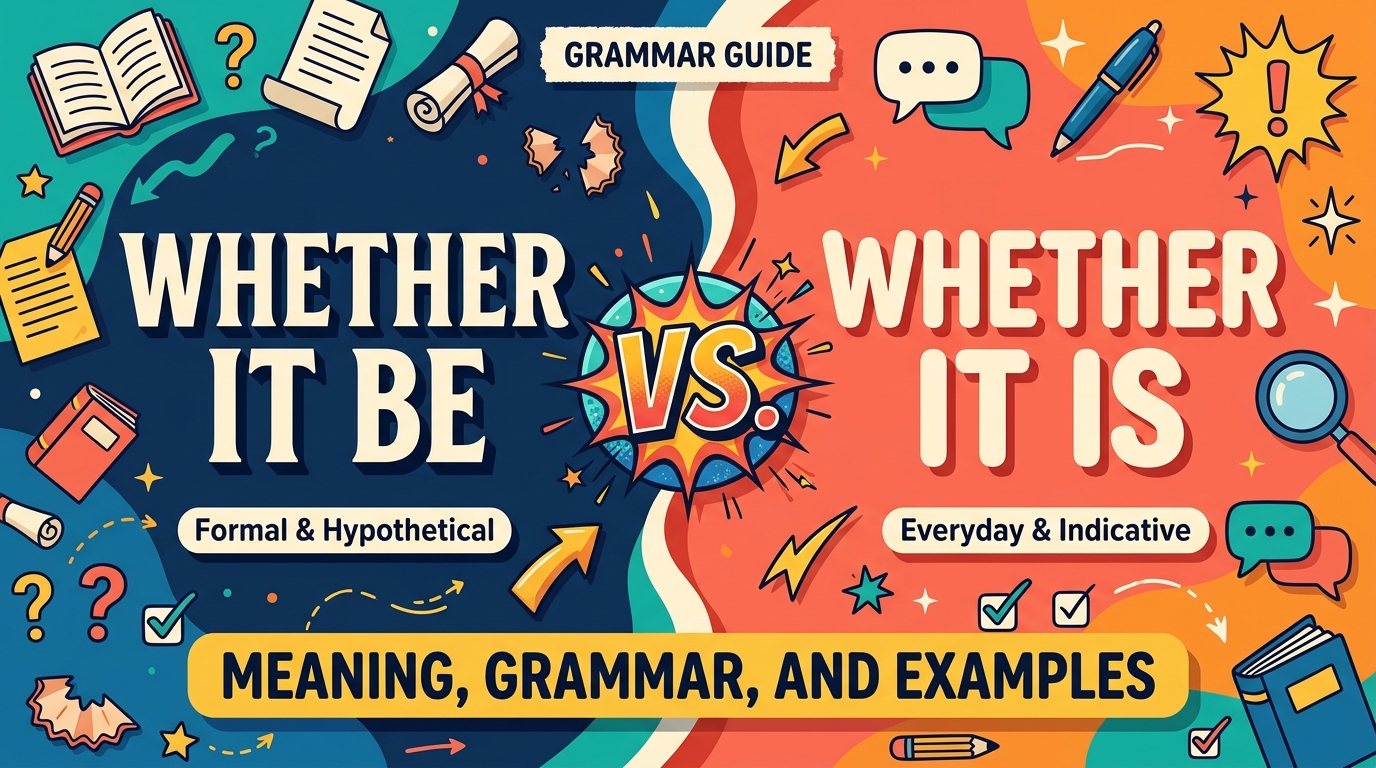
“Whether it is” is the standard choice for ordinary modern English, while “whether it be” is a more formal, literary, or traditional subjunctive construction. Both can be grammatically correct, but they are not always interchangeable.
Use whether it is when stating or considering whether something is true, describing a situation, or presenting alternatives in everyday writing.
Use whether it be when using a traditional subjunctive construction, especially in formal expressions such as “whether it be this or that.” In many such sentences, the phrase conveys the idea of considering any possibility, regardless of which one applies.
Compare these examples:
- Everyday English: I don’t know whether it is the right decision.
- Formal or literary English: Whether it be right or wrong, the decision must be made.
- Alternative phrasing: Whether it is right or wrong, the decision must be made.
The last two examples can both be correct. The version with be sounds more formal or rhetorical, while the version with is sounds more natural in contemporary conversation.

At-a-Glance Table
| Feature | Whether it is | Whether it be |
|---|---|---|
| Basic meaning | Whether something is true or applies | Whether something is true or applies |
| Grammar | Present-tense indicative verb | Present subjunctive verb |
| Everyday usage | Very common | Uncommon |
| Formal writing | Standard and natural | Possible in specific constructions |
| Literary style | Neutral | Often more elevated or rhetorical |
| Conversation | Usually preferred | Can sound old-fashioned or theatrical |
| Example | I wonder whether it is necessary. | Whether it be necessary or not, we must act. |
| Best use | Ordinary statements and questions | Deliberate subjunctive or stylistic emphasis |
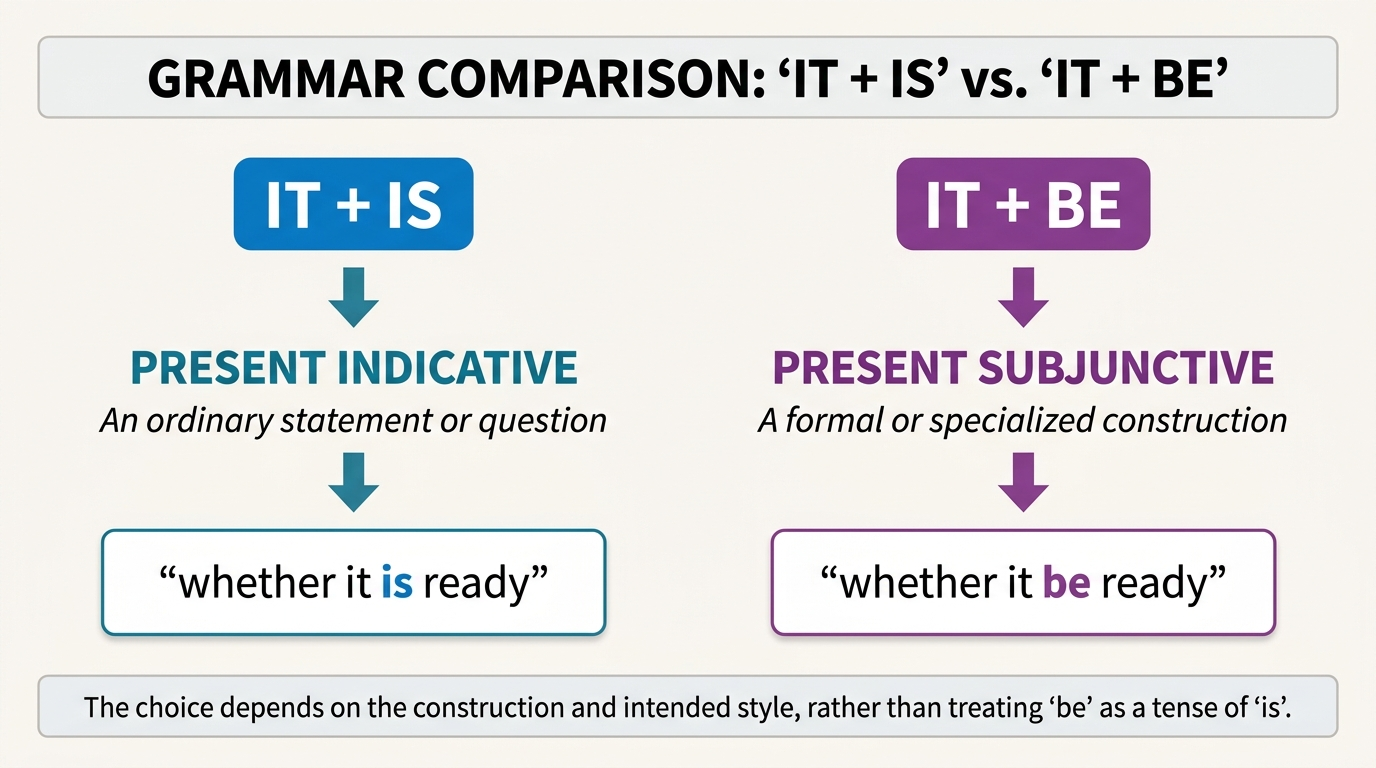
The important distinction is grammatical mood, not simply present versus past tense. Is is the ordinary present-tense form of be used with it. Be is the base form used in several grammatical constructions, including the present subjunctive.
Detailed Difference Between “Whether It Be” and “Whether It Is”
What Does “Whether It Is” Mean?
The expression whether it is introduces an indirect question or a situation involving uncertainty, alternatives, or a condition under consideration.
The word whether introduces the issue being considered. The pronoun it refers to a thing, situation, action, or idea. The verb is connects the subject to a description, identity, state, or condition.
Examples:
- I cannot tell whether it is genuine.
- She asked whether it is safe to proceed.
- We need to determine whether it is worth the effort.
- Nobody knows whether it is the correct address.
- He wondered whether it is possible to finish today.
In each example, is is the ordinary present-tense indicative form. The speaker is considering a question without necessarily assuming the answer.
The construction also works with alternatives:
- I don’t know whether it is Monday or Tuesday.
- We must decide whether it is practical or unrealistic.
- Tell me whether it is available or sold out.
- They are checking whether it is a technical problem or a user error.
In modern English, this is the default construction for most everyday communication, professional writing, academic discussion, and explanatory content.
What Does “Whether It Be” Mean?
Whether it be uses the present subjunctive form of be. The subjunctive is a grammatical mood associated with certain hypothetical, formal, or non-assertive constructions.
The phrase can introduce alternatives, possibilities, or circumstances that do not depend on which option turns out to be true.
Examples:
- Whether it be a minor error or a serious fault, report it immediately.
- Whether it be true or false, the allegation deserves careful examination.
- Whether it be day or night, the lighthouse remains visible.
- Whether it be a simple task or a difficult one, preparation matters.
These sentences use be rather than is because the writer has chosen a subjunctive construction. The choice may lend the sentence a formal, traditional, literary, or rhetorical tone.
However, the subjunctive is not required merely because a sentence contains whether. In contemporary English, the indicative form is generally more natural:
- Whether it is a minor error or a serious fault, report it immediately.
- Whether it is true or false, the allegation deserves careful examination.
Both sets are grammatical. The be versions deliberately adopt a different grammatical construction and style.
Is “Be” a Tense or a Mood?
The distinction is easier to understand when you separate tense from mood.
- Tense locates a situation in time, such as present or past.
- Mood indicates how a verb is grammatically presented, such as an ordinary statement or a subjunctive construction.
In whether it is, the verb is is present indicative.
In whether it be, the verb be is present subjunctive in the relevant traditional construction. It is not simply an older spelling of is, nor does it automatically make the sentence hypothetical.
The word be also appears in other constructions, such as “I insist that he be present.” That sentence uses the mandative subjunctive, a separate but related use of the subjunctive form.
When to Use “Whether It Is”
Choose whether it is for most situations in which you are discussing a fact, asking an indirect question, or evaluating a possible state of affairs.
1. Use It in Everyday Conversation
In ordinary speech, whether it is sounds natural and direct.
Examples:
- I don’t know whether it is open today.
- Can you check whether it is working?
- She asked whether it is too late to apply.
- We need to find out whether it is still available.
- I’m not sure whether it is the same model.
These sentences express uncertainty without requiring a special literary or formal tone.
2. Use It in Professional and Academic Writing
Professional communication generally benefits from clarity rather than unnecessary formality. The indicative construction is appropriate when discussing evidence, decisions, processes, or results.
Examples:
- The committee will determine whether it is appropriate to proceed.
- Researchers examined whether it is possible to reproduce the results.
- The report explains whether it is necessary to revise the policy.
- The manager asked whether it is feasible to meet the deadline.
- The analysis considers whether it is an effective solution.
There is no grammatical need to replace is with be simply to make writing sound sophisticated.
3. Use It When Asking an Indirect Question
An indirect question reports or embeds a question within a larger sentence.
Examples:
- I wonder whether it is true.
- Do you know whether it is available?
- Please confirm whether it is the latest version.
- She wanted to know whether it is suitable for beginners.
- They have not decided whether it is worth pursuing.
Notice that the embedded clause uses normal statement word order: “whether it is true,” not “whether is it true.”
The direct question would be “Is it true?” When that question becomes indirect, the order changes to “whether it is true.”
4. Use It for Clear Alternatives
The indicative works naturally when presenting two possibilities.
Examples:
- We must decide whether it is urgent or routine.
- Tell me whether it is a problem with the software or the network.
- I cannot determine whether it is blue or green under this lighting.
- The investigation will establish whether it is negligence or an honest mistake.
Here, whether introduces alternatives, while is remains the standard indicative verb.
5. Use It in Contemporary Explanatory Content
Guides, reports, emails, instructions, and educational articles usually sound clearer with whether it is.
For example:
“Before submitting the form, check whether it is complete and whether the required documents are attached.”
This is straightforward and professional. Replacing is with be would not improve its accuracy or clarity.
When to Use “Whether It Be”
Use whether it be when a subjunctive construction is appropriate and you deliberately want its formal, traditional, literary, or rhetorical effect.
1. Use It in Formal or Rhetorical Statements
The expression can emphasize that a conclusion or instruction applies regardless of the possibility being considered.
Examples:
- Whether it be a success or a failure, the experience will teach us something.
- Whether it be a reasonable concern or an unfounded fear, it should be addressed respectfully.
- Whether it be a temporary setback or a lasting change, the team must respond thoughtfully.
These examples have an elevated tone. They may suit speeches, literary essays, ceremonial language, or writing that intentionally uses traditional grammatical forms.
In everyday prose, the versions with is would usually be more natural.
2. Use It in Traditional Fixed Expressions
Some familiar constructions preserve the subjunctive form because it has become part of an established rhetorical pattern.
For example:
- Be that as it may, we must continue.
- Whether that be the case or not, further evidence is needed.
- Whatever the reason may be, the decision stands.
These expressions should not be treated as interchangeable templates with identical grammar. “Be that as it may” is a conventional concessive expression with an inverted word order. “Whether that be the case” is a subjunctive construction. “Whatever the reason may be” uses a different clause pattern.
The important point is that formal English contains several legitimate uses of be that are not ordinary indicative statements.
3. Use It When the Intended Meaning Is “Whatever the Possibility”
Consider this sentence:
“Whether it be a question of time, money, or experience, careful planning helps.”
The sentence groups several possible explanations together. The subjunctive construction gives the statement a formal, almost proverbial quality.
A more contemporary version is:
“Whether it is a question of time, money, or experience, careful planning helps.”
The meaning is essentially the same. The choice is stylistic and grammatical rather than a difference in the underlying facts.
4. Use It When a Literary Voice Calls for It
Writers may choose whether it be in fiction, historical dialogue, poetry, speeches, or essays that intentionally use elevated diction.
Example:
“Whether it be the memory of an old promise or the fear of a new beginning, something kept him from leaving.”
This construction can contribute to the narrative voice. It is not necessary for ordinary narration, however, and should not be inserted into modern dialogue unless the character’s voice supports it.

Examples of “Whether It Be” vs “Whether It Is” by Context
The best way to understand the difference is to compare the constructions in realistic situations.
Everyday Conversation
| Situation | Natural example | Explanation |
|---|---|---|
| Checking a fact | I don’t know whether it is true. | Standard indirect question |
| Asking about availability | Find out whether it is open. | Ordinary indicative |
| Expressing uncertainty | I’m unsure whether it is necessary. | Neutral and conversational |
| Making a broad statement | Whether it be true or false, we should verify it. | Formal subjunctive |
| Giving a practical instruction | Whether it is easy or difficult, finish it carefully. | Natural contemporary phrasing |
In conversation, whether it is will normally be the better choice. Using whether it be is not automatically incorrect, but it may sound deliberately formal or unusual.
Academic and Professional Writing
| Context | Example | Best explanation |
|---|---|---|
| Research | The study examines whether it is effective. | Direct and conventional |
| Policy | We must determine whether it is lawful. | Standard professional English |
| Evaluation | The reviewer questioned whether it is reliable. | Ordinary indicative |
| Formal argument | Whether it be a valid objection or not, it merits consideration. | Deliberately elevated style |
| Contemporary alternative | Whether it is a valid objection or not, it merits consideration. | Clear and neutral |
In academic writing, grammatical precision matters more than choosing a construction that merely sounds formal. The subjunctive is appropriate when the sentence and intended register support it, not because academic writing requires it.
Literature and Speeches
Literary and rhetorical writing can make greater use of less common grammatical patterns.
Examples:
- “Whether it be courage or desperation, she could not explain her decision.”
- “Whether it is courage or desperation, the consequences remain.”
- “Whether it be a gift or a burden, the truth must eventually emerge.”
- “Whether it is a gift or a burden, the truth must eventually emerge.”
The first and third examples use the subjunctive for rhetorical effect. The second and fourth use the more neutral indicative. None of these choices, by itself, establishes whether the claim is true.
Formal Documents and Instructions
For instructions, contracts, and official communication, use the form that best expresses the intended grammatical relationship.
Examples:
- Please confirm whether it is necessary to provide identification.
- The department will determine whether it is appropriate to extend the deadline.
- Whether it be required or optional, the information must be recorded accurately.
The last sentence is possible as a formal construction, but the more natural contemporary version is “Whether it is required or optional, the information must be recorded accurately.”
If the document has legal or regulatory significance, clarity and consistency should take priority over rhetorical style.
“Whether It Be This or That”
The phrase whether it be this or that is a recognizable way to present alternatives. It suggests that the result or general point holds regardless of which possibility applies.
Examples:
- Whether it be this method or that one, accuracy is essential.
- Whether it be this explanation or another, the evidence must support it.
- Whether it be this year or next, the project requires preparation.
In ordinary contemporary English, these can be rewritten as:
- Whether it is this method or that one, accuracy is essential.
- Whether it is this explanation or another, the evidence must support it.
- Whether it is this year or next, the project requires preparation.
The indicative version is generally more conversational. The subjunctive version sounds more formal or literary.
“Whether That Be” vs “Whether That Is”
Both expressions are possible, but their suitability depends on the surrounding clause.
Whether that is is the ordinary indicative form:
- We need to establish whether that is the correct interpretation.
- I don’t know whether that is what she intended.
- The question is whether that is enough evidence.
Whether that be uses the subjunctive:
- Whether that be the correct interpretation or not, the evidence must be reviewed.
- Whether that be the explanation, further investigation is necessary.
In many modern contexts, whether that is is the simpler choice. The subjunctive is most defensible when it fits a formal construction or an intentionally elevated style.
“Whether It Was” vs “Whether It Is”
This is a separate distinction: present versus past tense.
Use whether it is when considering a current state or a proposition framed in the present.
- I don’t know whether it is accurate.
- She asked whether it is still available.
Use whether it was when referring to a past state or a past situation.
- I didn’t know whether it was accurate.
- She asked whether it was available yesterday.
- The investigation examined whether it was a deliberate mistake.
However, past tense is not always required merely because the main verb is in the past. English often allows either tense depending on whether the embedded situation is still current.
Compare:
- She asked whether it was open. — The question concerns the past or follows a past-time perspective.
- She asked whether it is open. — The question concerns a current state that may still be relevant.
Both can be correct. The intended time reference determines the choice.

Common Mistakes and Their Corrections
Mistake 1: Assuming “Whether It Be” Is Always Wrong
Incorrect claim: “Whether it be” is never grammatical in modern English.
Correction: The expression is grammatically possible in appropriate subjunctive constructions, although it is uncommon in everyday conversation.
Example:
- Formal: Whether it be true or false, the claim must be investigated.
- Neutral: Whether it is true or false, the claim must be investigated.
Both versions are acceptable. Their register differs.
Mistake 2: Assuming “Whether It Is” Is Less Formal or Less Correct
Incorrect claim: Formal writing requires whether it be.
Correction: Whether it is is standard in formal English. It is often the clearest option for reports, research, official messages, and academic writing.
Example:
- Natural professional writing: The panel will decide whether it is necessary.
- More rhetorical: Whether it be necessary or not, the process must continue.
The second sentence adopts a more marked construction. It is not inherently more accurate.
Mistake 3: Confusing “Whether” with “Wether”
Whether introduces a choice, uncertainty, or an indirect question.
Wether is a different word meaning a castrated male sheep.
Examples:
- Correct: I cannot tell whether it is genuine.
- Incorrect: I cannot tell wether it is genuine.
- Correct use of wether: The farmer moved the wether into another enclosure.
The spelling error “wether it is” is common because the two words sound alike in many varieties of English. In this context, the correct spelling is always whether.
Mistake 4: Writing “Whether Its” When You Mean “Whether It Is”
The word its is a possessive determiner, while it’s is a contraction of it is or it has.
Compare:
- Whether it is ready, we cannot say. — Correct.
- Whether it’s ready, we cannot say. — Also correct; it’s means it is.
- Whether its ready, we cannot say. — Incorrect if the intended meaning is it is ready.
A useful test is to expand the contraction. If it is makes sense, it’s may be correct. If possession is intended, use its: “The machine is ready, but its display is broken.”
Mistake 5: Using “Whether Be It” in the Wrong Word Order
The ordinary phrase is whether it be, not whether be it.
- Correct: Whether it be necessary or not, we must prepare.
- Incorrect for the intended ordinary construction: Whether be it necessary or not, we must prepare.
There are other constructions with different word orders, including “be it ever so humble,” but they do not justify moving be before it in every sentence.
Mistake 6: Treating “Whether Being” as a Substitute
Whether being is not a direct replacement for either whether it is or whether it be.
Compare:
- Correct: We must decide whether it is appropriate.
- Correct: Whether it be appropriate or not, the decision is final.
- Different construction: Whether being present is necessary remains unclear.
In the last example, being present is a gerund-participial phrase functioning as the subject of the clause. Its grammar differs from the finite clause whether it is present.
Mistake 7: Confusing “Whether It Is Correct or Not” with a Direct Question
An indirect question does not normally use direct-question word order.
- Direct question: Is it correct or not?
- Indirect question: I don’t know whether it is correct or not.
- Alternative: I don’t know whether it is correct.
The phrase or not is optional when the meaning is already clear. It can add emphasis, especially when the speaker wants to stress that both possibilities are being considered.
Mistake 8: Using the Subjunctive Merely to Sound Intelligent
A rare construction does not automatically improve a sentence.
Awkward for ordinary conversation: “I am uncertain whether it be the appropriate time to depart.”
More natural: “I’m not sure whether it is the right time to leave.”
The second sentence is clear and idiomatic. Choose the subjunctive when it fits the sentence and intended tone, not merely because it sounds elevated.

Memory Trick and Practical Proofreading Test
You can choose between whether it be and whether it is by asking three quick questions.
The Three-Step Decision Rule
Step 1: Are you discussing an ordinary fact or asking an indirect question?
Use whether it is.
Examples:
- I wonder whether it is true.
- Check whether it is safe.
- They asked whether it is necessary.
Step 2: Are you deliberately using a subjunctive construction for formal, literary, or rhetorical effect?
If so, whether it be may be appropriate.
Examples:
- Whether it be true or false, the evidence must be examined.
- Whether it be a blessing or a challenge, the experience matters.
Step 3: Are you actually talking about the past?
If the situation is past, consider whether it was instead.
Examples:
- I wondered whether it was true yesterday.
- She asked whether it was necessary at that time.
Do not choose be simply because the sentence is formal or because its main verb is in the past. Decide what the sentence means first.
The Substitution Test
Try replacing the phrase with a more direct version.
- “I don’t know whether it is true.” → “Is it true?” The embedded question is clear.
- “Whether it be true or false, we must investigate.” → “Regardless of whether it is true or false, we must investigate.” The broad, concessive meaning is clear.
The second test helps you recognize the meaning of the entire construction. It does not mean that be must always be replaced by is.
A Five-Question Practice Quiz
Choose the best option for each sentence. Assume you want clear, contemporary English unless the sentence specifies a formal or literary style.
1. I don’t know ___ the information is accurate.whether it iswhether it bewhether be it
2. Choose the more natural option for a work email: “Please confirm ___ available.”whether it iswhether it bewhether be it
3. Which version deliberately uses the subjunctive?Whether it is true or false, we will check.Whether it be true or false, we will check.I wonder whether it is true.
4. She asked whether ___ open yesterday.it isit wasit be
5. Which spelling is correct in “I can’t tell ___ it is genuine”?wetherwhetherwhither
Check answersReset
Formal vs Casual English and Regional Differences
Is “Whether It Be” British or American English?
Both British and American English recognize the subjunctive construction. The difference is not a simple British-versus-American spelling or grammar rule.
In both varieties, whether it is is normal in everyday speech and most contemporary prose. Whether it be is available in formal, literary, rhetorical, and traditional styles, although it is relatively uncommon in ordinary conversation.
Examples acceptable in both varieties include:
- I don’t know whether it is necessary.
- Whether it be necessary or not, the work must be completed.
The second sentence sounds more elevated than the first in both varieties.
Does “Whether It Be” Sound Old-Fashioned?
It can. Its tone depends on the context.
In a speech, essay, literary passage, or formal declaration, it may sound deliberate and polished. In a text message or casual conversation, it can sound stiff or theatrical.
Compare:
- Casual: I don’t know whether it’s worth it.
- Neutral: I don’t know whether it is worth it.
- Formal or rhetorical: Whether it be worth the effort or not, the task remains.
The contraction it’s is simply a casual form of it is. It does not change the underlying indicative construction.
Is “Whether It Be” Grammatically Correct in Modern English?
Yes, in appropriate subjunctive contexts. It is not a general-purpose replacement for whether it is, however.
Modern English uses the subjunctive selectively. Some constructions preserve it in established expressions, while others allow indicative alternatives that are more common in everyday usage.
The safest editorial rule is to favor whether it is unless the subjunctive form serves a clear grammatical or stylistic purpose.
How Do You Pronounce “Whether It Be” and “Whether It Is”?
In many standard English accents, whether begins with the voiced “th” sound /ð/, as in this, rather than the unvoiced sound /θ/ in think.
Approximate pronunciations are:
- Whether it is: /ˈwɛðər ɪt ɪz/
- Whether it be: /ˈwɛðər ɪt biː/
The exact pronunciation of whether varies across accents, particularly in the vowel and the pronunciation of the final r. In rapid speech, the words may also run together.
The pronunciation difference is mainly in the final verb: is has a short vowel followed by /z/, whereas be has a long /iː/ vowel.

Frequently Asked Questions
Is “Whether It Be” Correct English?
Yes. Whether it be is correct in suitable subjunctive constructions, particularly in formal, literary, and rhetorical writing. It is less common than whether it is in everyday English.
Is “Whether It Is” Always Better Than “Whether It Be”?
No. Whether it is is the default for ordinary modern English, but whether it be can be appropriate when the subjunctive is grammatically suitable and its formal tone is intentional. The best choice depends on context.
What Is the Meaning of “Whether It Be”?
It means essentially the same thing as whether it is in many contexts: it introduces a question, possibility, or alternative. Its subjunctive form can create a more formal or literary tone, especially in statements that apply regardless of which alternative is true.
What Does “Whether That Be” Mean?
Whether that be introduces a possibility involving a previously mentioned idea or situation. For example, “Whether that be the explanation or not, we need more evidence.” In neutral modern English, “Whether that is the explanation or not” is often more natural.
What Is the Difference Between “Whether It Was” and “Whether It Is”?
Whether it was generally refers to a past situation, while whether it is normally refers to a present situation or a proposition considered current. The correct choice depends on the intended time reference, not merely on whether the main clause uses past tense.
Can I Say “Whether It Is or Not”?
Yes. For example, “We need to determine whether it is possible or not.” The phrase or not is grammatical but often optional: “We need to determine whether it is possible” is also correct.
What Is a Synonym for “Whether It Be”?
There is no single synonym that fits every context. Depending on the sentence, you might use:
- “Whether it is” for a neutral, contemporary alternative.
- “Regardless of whether it is” to emphasize that the outcome does not depend on the answer.
- “Whether or not it is” to make the alternatives explicit.
- “Be it” in certain literary or rhetorical constructions.
For example, “Whether it be true or false, we must investigate” can become “Regardless of whether it is true or false, we must investigate.”
Is “Whether Being” Grammatically Correct?
It can be correct in sentences where being functions as a gerund-participial form, but it is not a direct substitute for whether it is or whether it be. The surrounding sentence determines whether it is appropriate.
Is “Whether It Be This or That” Correct?
Yes. It is a grammatical subjunctive construction used to present alternatives, often in formal or literary writing. “Whether it is this or that” is the more neutral contemporary version.
Does “Whether It Be” Mean “Whether It Is Correct or Not”?
Not exactly. Whether it be does not inherently mean “whether it is correct or not.” Its meaning depends on the words that follow it. In a sentence such as “Whether it be correct or not, we must check,” the full phrase expresses the alternatives of being correct and not being correct.
Final Takeaway
The distinction between whether it be vs whether it is comes down to grammatical mood, context, and style.
- Choose whether it is for everyday conversation, indirect questions, professional writing, and most contemporary prose.
- Choose whether it be when a suitable subjunctive construction serves a deliberate formal, literary, or rhetorical purpose.
- Choose whether it was when the intended meaning refers to a past situation.
- Use whether, not wether, when introducing a question or alternatives.
When proofreading, ask yourself whether the sentence is an ordinary statement or whether the subjunctive is doing a specific job. If the sentence sounds unnecessarily old-fashioned with be, the indicative form is will usually be clearer and more natural.