Skip to content

Grammar Fixed

    Grammar Fixed
    • goodmorning or good morning
      Confused Words & Word Choice

      Goodmorning or Good Morning: Which Is Correct?

      BySarah Mitchell September 9, 2026September 9, 2026

      Quick Answer The correct standard spelling is “good morning” — two words. You write good morning when greeting someone in the morning: “Goodmorning” as one word is generally considered nonstandard in standard English. You may occasionally see it in usernames, brand names, informal messages, or stylized writing, but it is not the normal spelling for…

      Read More Goodmorning or Good Morning: Which Is Correct?Continue

    • favourite vs favorite
      Confused Words & Word Choice

      Favourite vs Favorite: Which Spelling Is Correct?

      BySarah Mitchell September 8, 2026September 8, 2026

      Quick Answer Both favourite and favorite are correct. The difference is mainly regional spelling: They have the same meaning, pronunciation, and grammatical uses. The important thing is to choose the spelling that matches your audience and remain consistent throughout your writing. For example: Favourite vs Favorite at a Glance Feature Favourite Favorite Standard variety British…

      Read More Favourite vs Favorite: Which Spelling Is Correct?Continue

    • choose vs chose
      Confused Words & Word Choice

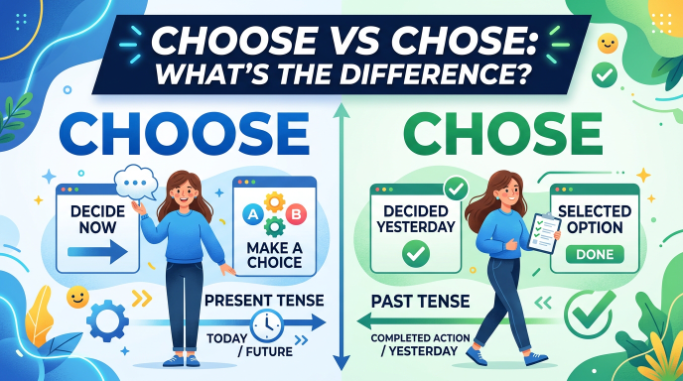
      Choose vs Chose: What’s the Difference?

      BySarah Mitchell September 8, 2026September 8, 2026

      Quick Answer Choose and chose are different forms of the same verb. The basic pattern is: choose → chose → chosen So, if the action is happening now or regularly, use choose. If the action happened and ended in the past, use chose. Form Grammar role Example choose Base form / present tense I choose…

      Read More Choose vs Chose: What’s the Difference?Continue

    • sans meaning explained
      Word Meanings & Idioms

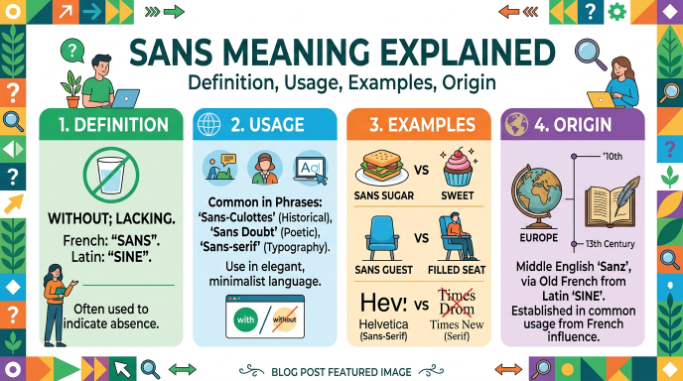
      Sans Meaning Explained: Definition, Usage, Examples, and Origin

      ByJames Wilson September 8, 2026September 8, 2026

      Quick Meaning Sans means “without.” It is used to describe something that is missing or absent. For example: In modern English, sans usually sounds more formal, literary, playful, or stylistically deliberate than the ordinary word without. Definition Table Word Meaning Part of speech Common English equivalent sans Without; lacking Preposition without sans something Without that…

      Read More Sans Meaning Explained: Definition, Usage, Examples, and OriginContinue

    • cannot or can not
      Confused Words & Word Choice

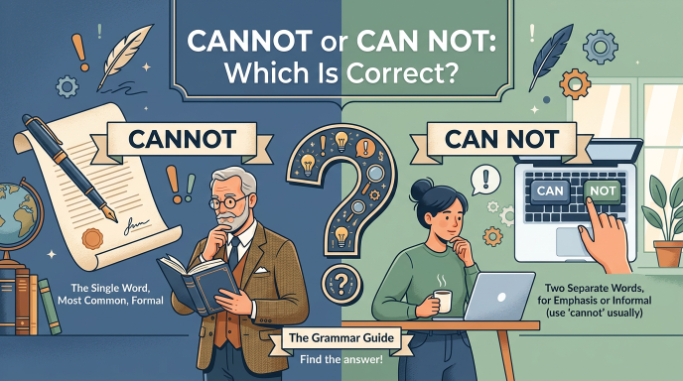
      Cannot or Can Not: Which Is Correct?

      BySarah Mitchell September 8, 2026September 8, 2026

      Quick Answer Usually, the correct spelling is cannot — one word. Use cannot when you mean “is not able to,” “is not allowed to,” or “is impossible to.” Can not, written as two words, is also possible in certain situations, but it is much less common. Use it when not belongs to a separate construction…

      Read More Cannot or Can Not: Which Is Correct?Continue

    • what happen vs what happened
      Confused Words & Word Choice

      What Happen vs What Happened: Which Is Correct?

      BySarah Mitchell September 7, 2026September 7, 2026

      Quick Answer “What happened?” is the standard and grammatically correct question when you are asking about something that occurred in the past. The reason is simple: happened is the past tense of happen, so it is used when asking about an event that has already taken place. Examples: By contrast, what happen can occasionally appear…

      Read More What Happen vs What Happened: Which Is Correct?Continue

    • is it correct to say ok thank you
      Grammar & Sentence Structure

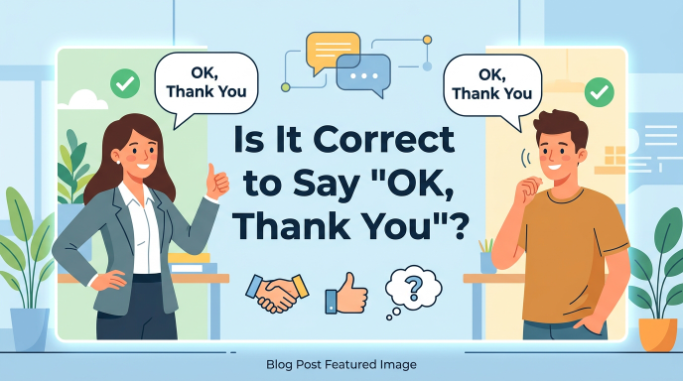
      Is It Correct to Say “OK, Thank You”?

      BySarah Mitchell September 7, 2026September 7, 2026

      Quick Answer Yes. “OK, thank you” is correct and natural English. It is a common response when you want to acknowledge information, accept something, or show that you understand, and then politely express gratitude. For example: The most natural written form is usually “OK, thank you.” with a comma between OK and thank you. Other…

      Read More Is It Correct to Say “OK, Thank You”?Continue

    • your sincerely or yours sincerely
      Confused Words & Word Choice

      Your Sincerely or Yours Sincerely: Which Is Correct?

      BySarah Mitchell September 7, 2026September 7, 2026

      Quick Answer “Yours sincerely” is correct. “Your sincerely” is incorrect when you are ending a letter or email. The reason is grammatical: your is a possessive determiner, while yours is a possessive pronoun. In the traditional letter closing “Yours sincerely,” the word yours is required. Correct: Yours sincerely,Incorrect: Your sincerely, In British English, Yours sincerely…

      Read More Your Sincerely or Yours Sincerely: Which Is Correct?Continue

    • complaint vs complain
      Confused Words & Word Choice

      Complaint vs Complain: What’s the Difference?

      BySarah Mitchell September 6, 2026September 6, 2026

      Quick Answer Complain is a verb. It means to express dissatisfaction, annoyance, or criticism about something. Complaint is a noun. It refers to the statement, expression, or issue being complained about. The simplest rule is: You complain (an action), but you make, file, or have a complaint (a thing). If you are describing what someone…

      Read More Complaint vs Complain: What’s the Difference?Continue

    • of course or ofcourse
      Confused Words & Word Choice

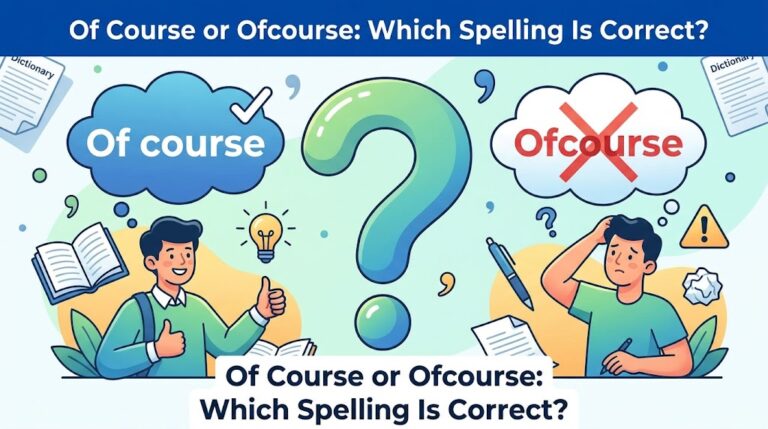
      Of Course or Ofcourse: Which Spelling Is Correct?

      BySarah Mitchell September 6, 2026September 6, 2026

      Quick Answer Of course is the correct spelling in standard English. Ofcourse is incorrect as a single word. If you are wondering “is it ofcourse or of course?”, the answer is simple: write of course as two words. The phrase of course is commonly used to express agreement, certainty, willingness, or something considered obvious or…

      Read More Of Course or Ofcourse: Which Spelling Is Correct?Continue

    Page navigation

    Previous PagePrevious 1 … 11 12 13 14 Next PageNext

    © 2026 Grammar Fixed - WordPress Theme by Kadence WP