Paucity Meaning: Definition, Usage, Synonyms, and Examples
Quick Meaning
Paucity means a very small amount or number of something, especially when there is less than is needed or expected.
In simple English, paucity = scarcity, shortage, or not enough of something.
For example:
The paucity of reliable information made the decision difficult.
Here, paucity means there was too little reliable information.
Paucity is a noun and is most commonly followed by of:
a paucity of evidence
a paucity of resources
a paucity of information
a paucity of opportunities
The word is relatively formal, so it is much more common in academic, professional, journalistic, and analytical writing than in casual conversation. Cambridge classifies it as formal and defines it as the fact or condition of having too little of something.

Definition Table
| Feature | Explanation |
|---|---|
| Word | paucity |
| Part of speech | Noun |
| Basic meaning | A very small amount or number; an insufficient supply |
| Simple synonym | shortage, scarcity, lack, dearth |
| Common pattern | paucity of + noun |
| Typical register | Formal |
| Pronunciation | UK /ˈpɔː.sə.ti/, US /ˈpɑː.sə.t̬i/ |
| Opposite | abundance, plenty, profusion, wealth |
| Plural | Usually uncountable in modern usage |
| Example | “There is a paucity of evidence.” |
Meaning in Context
The central idea behind paucity is not simply that something is small. It usually emphasizes that there is too little of something.
Compare these sentences:
The library has few books on the subject.
The library has a paucity of books on the subject.
The first sentence is straightforward and conversational. The second sounds more formal and analytical. It draws attention to the scarcity of available books.
This distinction matters because paucity often carries an implied sense of insufficiency. Saying that there is a “paucity of evidence” generally suggests that the available evidence is inadequate for the purpose at hand.
Cambridge’s examples show paucity being used with information, data, research, professionals, documents, and other things that can be limited in supply.
Literal Meaning
The literal meaning concerns an objectively small quantity or number.
For example:
The paucity of rainfall damaged the crops.
This means there was very little rainfall.
The paucity of seats forced several people to stand.
There were too few seats for the number of people who needed them.
The paucity of food became a serious concern.
There was not enough food.
Figurative Meaning
Paucity can also describe an abstract or intangible thing.
For example:
The project suffered from a paucity of ideas.
Ideas are not physical objects that can simply be counted in the same way as chairs or books. Here, paucity figuratively means that there were too few useful ideas.
Other abstract examples include:
a paucity of evidence
a paucity of imagination
a paucity of research
a paucity of opportunities
a paucity of reliable data
The underlying concept remains the same: an inadequate amount or number.
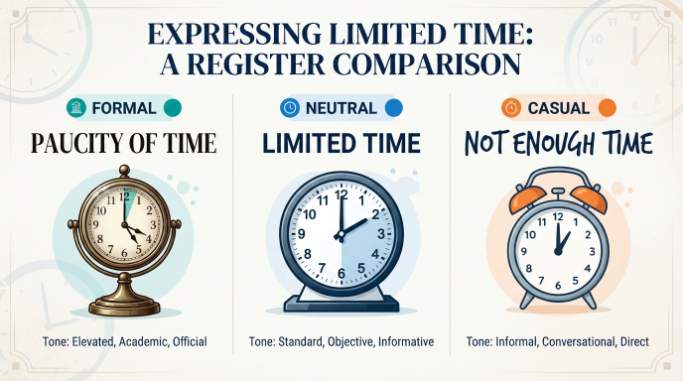
“Paucity of Time” Meaning
The phrase paucity of time means a lack or shortage of available time.
For example:
Because of the paucity of time, the researchers could not examine every possibility.
In simpler English:
Because there was not enough time, the researchers could not examine every possibility.
The phrase is grammatically possible, but lack of time, limited time, or time constraints will usually sound more natural in everyday conversation.
Usage and Grammar
“Paucity of” Is the Most Common Pattern
The most useful grammatical pattern to remember is:
a/the paucity of + noun
Examples:
There is a paucity of evidence.
The report highlighted a paucity of affordable housing.
Researchers noted a paucity of reliable data.
The region faces a paucity of trained professionals.
We were surprised by the paucity of information available.
The noun after of can refer to something countable or uncountable.
Countable:
a paucity of opportunities
a paucity of experts
a paucity of examples
Uncountable:
a paucity of information
a paucity of evidence
a paucity of funding
Is “Paucity” Countable?
In contemporary English, paucity is generally treated as an uncountable noun when it means scarcity or insufficient quantity.
You normally say:
There is a paucity of evidence.
Not:
There are three paucities of evidence.
The word describes a condition of scarcity, rather than individual objects.
Can You Say “A Paucity”?
Yes.
A paucity of is extremely common:
The study found a paucity of relevant evidence.
Here, a belongs to paucity, while evidence is the thing that is scarce.
You can also use:
the paucity of information
The choice between a and the depends on context. Use a paucity of when introducing a particular instance of scarcity; use the paucity of when referring to a specific or already established shortage.
Paucity as a Formal Word
One of the most important usage points is register.
You can use paucity in everyday speech, but it may sound unusually formal:
There is a paucity of coffee in the kitchen.
This is grammatically correct, but most people would naturally say:
There isn’t much coffee in the kitchen.
In academic or professional writing, however, paucity can be entirely natural:
The paucity of long-term studies limits our understanding of the problem.
This is one reason the word appears frequently in analytical prose.
How to Pronounce Paucity
The pronunciation differs slightly between British and American English. Cambridge gives /ˈpɔː.sə.ti/ for UK English and /ˈpɑː.sə.t̬i/ for US English.
paucity
/ˈpɔː.sə.ti/
Give feedback
The main stress falls on the first syllable. The word has three syllables.
A common spelling mistake is pausity. The correct spelling is paucity, with c after the pau-.
Examples of Paucity in a Sentence
Here are original examples showing how the word works in different contexts.
Academic Writing
The paucity of longitudinal research makes it difficult to draw firm conclusions.
Meaning: There is too little long-term research.
Business
The company faced a paucity of qualified applicants for the technical positions.
Meaning: There were too few qualified applicants.
Education
The paucity of updated textbooks affected the quality of classroom instruction.
Meaning: There were not enough current textbooks.
Science
The researchers acknowledged the paucity of available data.
Meaning: There was too little data available.
Journalism
Officials cited the paucity of reliable information as a reason for delaying the announcement.
Meaning: There was not enough reliable information.
Everyday Context
We had a paucity of snacks after the long journey.
This is perfectly understandable, but it sounds more formal than:
We didn’t have enough snacks.
Time
The paucity of time prevented the team from reviewing every proposal.
Meaning: There was not enough time.
Opportunities
A paucity of employment opportunities has encouraged many graduates to relocate.
Meaning: There are too few employment opportunities.
Evidence
The paucity of evidence makes the claim difficult to verify.
Meaning: There is insufficient evidence.
Information
The paucity of information on the website left visitors with several unanswered questions.
Meaning: The website contained too little information.

Paucity Synonyms and Similar Expressions
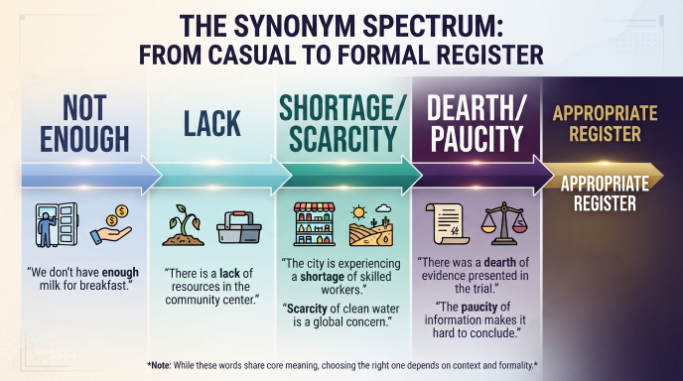
There are several synonyms for paucity, but they are not always interchangeable.
Scarcity
Scarcity means that something is in short supply.
The scarcity of clean water is a major concern.
Scarcity is often a very close synonym for paucity and can be used in both formal and general contexts.
Shortage
Shortage usually suggests that the available supply is insufficient to meet demand.
The city experienced a shortage of electricity.
This is generally more natural than paucity when discussing practical supplies or resources.
Lack
Lack is broader and much more common.
There is a lack of evidence.
There is a paucity of evidence.
The second sentence sounds more formal.
Dearth
Dearth is one of the closest formal synonyms of paucity.
There is a dearth of reliable information.
There is a paucity of reliable information.
Both indicate that something is scarce or insufficient.
Deficiency
Deficiency often implies that something is below a required or desirable standard.
The report identified a deficiency in the available data.
This can be more specific than paucity.
Insufficiency
Insufficiency emphasizes that something is inadequate.
The insufficiency of the evidence prevented a conclusion.
It focuses particularly on not being enough, rather than simply being scarce.
Few or Little
In ordinary conversation, few and little are often the best alternatives.
There are few opportunities.
There is little information.
These expressions are simpler and more natural in casual English.
Synonym Comparison
| Word | Main idea | Register |
|---|---|---|
| paucity | Very little or too few | Formal |
| scarcity | Something is scarce | Neutral/formal |
| shortage | Supply is insufficient | Neutral |
| lack | Absence or insufficient amount | Neutral |
| dearth | A serious scarcity | Formal |
| deficiency | Something falls below what is needed | Formal |
| insufficiency | Not enough for a purpose | Formal |
| few/little | Small number or amount | Everyday |
Paucity vs. Scarcity
Paucity and scarcity overlap heavily.
The paucity of evidence was problematic.
The scarcity of evidence was problematic.
Both sentences can mean that there was too little evidence.
The difference is largely one of emphasis and usage. Scarcity is a broader everyday term for a limited supply, while paucity is particularly characteristic of formal writing and often appears with abstract nouns such as evidence, information, research, and data.
Paucity vs. Shortage
A shortage often concerns supply and demand.
The country experienced a shortage of fuel.
A paucity can describe a shortage but is not restricted to physical resources:
The paucity of evidence complicated the investigation.
You would not normally replace every occurrence of shortage with paucity. The context and register matter.
Paucity vs. Abundance
Abundance is a natural opposite of paucity.
There was a paucity of food.
means:
There was very little food.
Whereas:
There was an abundance of food.
means:
There was plenty of food.
Other antonyms of paucity include:
- abundance
- plenty
- profusion
- wealth
- surplus
- ample supply
- multitude, when referring specifically to numbers
The most suitable opposite depends on whether you are talking about quantity, supply, or number.
Common Variations and Patterns
You will encounter several recurring constructions.
A Paucity of
The study revealed a paucity of evidence.
This is the standard construction.
The Paucity of
The paucity of reliable data remains a concern.
This refers to a particular known scarcity.
Relative Paucity
Relative paucity means that something is scarce in comparison with something else.
The region has a relative paucity of public transportation.
The word relative makes the comparison explicit.
Severe Paucity
The project was affected by a severe paucity of funding.
This emphasizes an especially serious shortage.
Paucity of Time
The paucity of time made a complete review impossible.
Formal, but grammatically natural.
Paucity of Information
The paucity of information made it difficult to understand what had happened.
This is a very natural formal use.
Paucity of Evidence
The paucity of evidence prevents us from reaching a firm conclusion.
Another common academic and analytical construction.

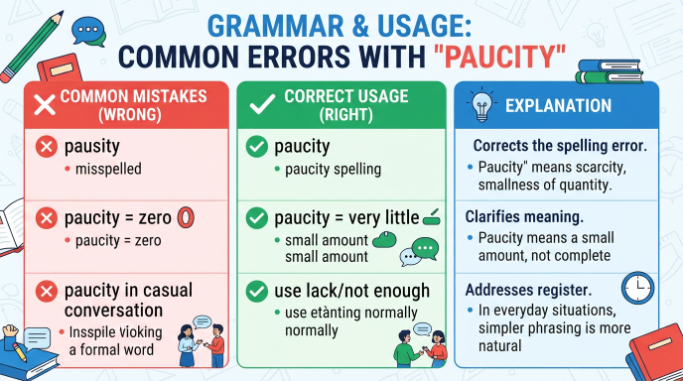
Common Mistakes
Mistake 1: Spelling It “Pausity”
The correct spelling is:
paucity
Not:
pausity
The unusual spelling probably explains why searches sometimes contain forms such as pausity, paucitu, paucitu, plaucity, or possity. These are not standard spellings of the English word.
Mistake 2: Assuming Paucity Means Complete Absence
Paucity does not normally mean zero.
There is a paucity of evidence.
usually means there is very little evidence, not necessarily that there is no evidence at all.
If something is completely absent, absence or lack may be more precise.
Mistake 3: Using It for Every Small Thing
A small quantity is not automatically a paucity.
The child ate a paucity of rice.
This is grammatically understandable but unnatural in ordinary contexts.
More natural:
The child ate very little rice.
Paucity works best when the small quantity is notable, relevant, insufficient, or worthy of analytical comment.
Mistake 4: Treating It as Casual Vocabulary
Using paucity in every conversation can sound overly formal.
Instead of:
There is a paucity of milk.
a normal conversation would usually say:
We’re almost out of milk.
Mistake 5: Confusing Paucity With Poverty
The words are historically related, but their modern meanings are different.
Paucity means scarcity or a very small quantity.
Poverty generally refers to a condition of lacking sufficient money or material resources.
The paucity of evidence was surprising.
does not mean:
The poverty of evidence was surprising.
Although poverty can sometimes be used figuratively to mean a deficiency, it is not a general replacement for paucity.
Mistake 6: Assuming “Paucity” Is Always Positive or Negative
The word itself mainly describes scarcity. Whether that scarcity is good, bad, useful, or irrelevant depends on context.
The paucity of unnecessary paperwork saved the staff time.
Here, a lack of paperwork may be beneficial.
Origin and History of Paucity
The etymology of paucity is well documented.
The English noun appeared in the late 14th century, originally in the form paucite, with the sense of “smallness of quantity” or “scantiness.” By the early 15th century, it was also being used for “smallness of number” or “fewness.” The word came into English through Old French paucité and ultimately from Latin paucitas, meaning “fewness,” “scarcity,” or “a small number.”
The Latin form is related to paucus, meaning “few” or “little.” Etymological sources further connect this family to the reconstructed Proto-Indo-European root *pau-, associated with the idea of “few” or “little.”
This historical connection helps explain why paucity has retained such a direct connection with small quantity and scarcity.
There is no need to rely on an elaborate folklore explanation for the word’s origin. The documented Old French and Latin history provides a clear etymological pathway.
FAQs About Paucity
What does paucity mean?
Paucity means a very small amount or number of something, especially an amount that is insufficient or less than expected.
What is the simplest synonym for paucity?
Depending on the context, lack, shortage, or scarcity can be simple synonyms. In everyday English, not enough, very little, or very few may be even more natural.
What is the synonym of paucity?
Common synonyms include scarcity, shortage, lack, dearth, deficiency, insufficiency, and scantiness.
What is the antonym of paucity?
Common antonyms include abundance, plenty, profusion, surplus, and ample supply.
What is the opposite of paucity?
The most direct opposite is usually abundance. The appropriate opposite can vary according to context.
How do you use paucity in a sentence?
Use paucity of + noun:
There is a paucity of reliable information about the subject.
This means there is very little reliable information.
Is “paucity of” correct?
Yes. Paucity of is the standard and very common grammatical construction.
a paucity of evidence
a paucity of resources
a paucity of opportunities
What does “paucity of time” mean?
Paucity of time means a shortage of available time or not enough time.
Is paucity a formal word?
Yes. It is generally considered formal vocabulary. It is particularly common in academic, professional, scientific, journalistic, and analytical writing. Cambridge explicitly labels it as formal.
Does paucity mean a complete lack?
Not necessarily. Paucity usually means very little or too little, rather than absolutely nothing.
Is “pausity” the correct spelling?
No. The standard English spelling is paucity.
What does “paucity” mean in English?
In English, paucity means a very small amount or number of something, especially when there is too little available.
Can paucity refer to people?
Yes.
The paucity of qualified nurses created difficulties for the hospital.
Here, paucity means there were too few qualified nurses.
Can paucity refer to time?
Yes. Paucity of time means a shortage of available time, although limited time or lack of time is generally more natural in everyday English.
What is another word for paucity?
Scarcity is one of the closest alternatives. Other choices include shortage, lack, dearth, deficiency, and insufficiency, depending on context.
Summary
Paucity means a very small amount or number of something, especially when there is less than needed or expected. It is a formal noun and most often appears in the pattern “a/the paucity of + noun.”
The paucity of evidence made the conclusion uncertain.
The simplest translation is often “not enough,” “very little,” “very few,” “shortage,” or “scarcity.” Unlike absence, paucity does not necessarily mean that something is completely missing. Unlike shortage, it can comfortably describe abstract things such as evidence, information, research, or opportunities.
For everyday conversation, simpler expressions are often more natural. For academic, professional, and analytical writing, paucity is a precise and established way to describe a notable lack or scarcity.