To Small or Too Small: Which Is Correct?
Quick Answer
“Too small” is the correct expression when you mean that something is smaller than necessary, expected, suitable, or wanted.
- Too small = excessively small or not large enough for a particular purpose.
- To small = generally incorrect when you are trying to describe size.
- To is normally a preposition or part of an infinitive, while too is an adverb meaning “more than is desirable” or “also.”
So, if you are asking whether a shirt, room, font, percentage, container, or object lacks sufficient size, use too small:
This shirt is too small for me.
The text is too small to read comfortably.
The sample size may be too small to support a strong conclusion.

At-a-Glance Table
| Expression | Correct? | Meaning | Example |
|---|---|---|---|
| too small | Yes | Smaller than necessary, suitable, or desired | The box is too small for the books. |
| to small | Usually no | Not the normal spelling for the size-related expression | ✗ The box is to small. |
| to | Yes, in other constructions | Often marks an infinitive or indicates direction/relationship | I need to leave. |
| too | Yes | Excessively, more than appropriate, or also | It is too small. |
| small too | Sometimes possible, depending on sentence structure | “Small” followed by “too,” usually meaning “also” | The second container is small too. |
| they are too small | Yes | They are smaller than necessary or wanted | These shoes are too small. |
The key distinction is grammatical rather than stylistic. Too modifies the adjective small. It tells the reader that the degree of smallness has gone beyond what is acceptable or useful in the context.
By contrast, to does not normally modify an adjective such as small. It performs other grammatical jobs, such as introducing an infinitive (to read, to understand) or expressing direction (go to school).
The Detailed Difference Between “To Small” and “Too Small”
What does “too small” mean?
Too small means that something has insufficient size relative to a particular requirement, expectation, purpose, or comparison.
The word too acts as an adverb modifying small:
The shoes are too small.
This does not merely mean that the shoes have a small size. It means their size is less than what is appropriate for the person wearing them.
Compare:
The shoes are small.
The shoes are too small.
The first statement is descriptive. The second adds a judgment about suitability or degree.
For example:
The apartment is small.
This simply describes its size.
The apartment is too small for a family of six.
Now the speaker is saying that its size is insufficient for the stated purpose.
That distinction is important because too small is context-dependent. Something can be small without being too small.
What does “to small” mean?
“To small” is normally a spelling or usage error when the intended meaning is “smaller than necessary.”
For example:
✗ This jacket is to small.
✓ This jacket is too small.
The error happens because to and too are pronounced alike in standard English, even though they have different meanings and grammatical functions.
There are unusual sentences in which to appears immediately before the word small, but that does not make to small an alternative spelling of too small.
For example:
I want to small the image.
This would generally be unnatural or incorrect in standard English because small is not normally used as a verb in this construction. A writer cannot simply substitute to for too because the two words sound alike.
The important point is that “to small” does not mean “excessively small.”
Why “Too Small” Is Grammatically Correct
The structure is:
too + adjective
Examples include:
- too small
- too large
- too expensive
- too heavy
- too difficult
- too cold
- too slow
- too narrow
In each case, too modifies an adjective and indicates an excessive degree relative to a relevant standard.
The room is too small.
The suitcase is too heavy.
The instructions are too complicated.
With too small, the adjective is small, and too indicates that the smallness exceeds an acceptable limit.
This is why:
The screen is too small to read comfortably.
is grammatical, while:
✗ The screen is to small to read comfortably.
is not.

When to Use “Too Small”
Use too small when the size falls below what is needed or acceptable for a particular purpose.
Physical objects
These shoes are too small for me.
The box is too small to hold the equipment.
This table is too small for eight people.
The label is too small to read from a distance.
Here, the phrase communicates inadequacy, not merely smallness.
Spaces
The bedroom is too small for two large beds.
This office feels too small for the entire team.
The storage area is too small to accommodate all the supplies.
Again, the relevant standard comes from the intended use.
Text, fonts, and screens
The font is too small on my phone.
The captions are too small to read easily.
The icons are too small for users with limited vision.
The phrase can therefore describe visual dimensions as well as physical objects.
Quantities and measurements
A quantity can also be too small:
The sample is too small to produce reliable results.
The budget is too small for the proposed project.
The opening is too small for the required airflow.
Here, small may describe an amount, capacity, or measurement rather than literal physical size.
Figurative or abstract contexts
English can use too small metaphorically:
The contribution is too small to make a meaningful difference.
The margin is too small to absorb another increase in costs.
The underlying idea remains the same: the amount or degree is insufficient relative to a relevant standard.
“Small” Versus “Too Small”
One of the most useful distinctions is between a neutral description and a statement of insufficiency.
| Sentence | What it communicates |
|---|---|
| The room is small. | The room has limited size. |
| The room is too small. | Its size is inadequate for the relevant purpose. |
| The font is small. | The font has a relatively small size. |
| The font is too small to read. | Its size prevents comfortable or practical reading. |
| The sample is small. | The sample contains relatively few observations. |
| The sample is too small for the analysis. | The number of observations is insufficient for the stated analysis. |
This is why small and too small are not interchangeable.
Someone might say:
I prefer small apartments.
But that same person could say:
This apartment is too small for my family.
There is no contradiction. Small describes size, while too small evaluates that size against a requirement or preference.
“Too Small” Does Not Always Mean Objectively Tiny
An important edge case is that too small is relative.
A studio apartment might be:
too small for a family of five
but:
perfectly large enough for one person.
Likewise:
The suitcase is too small for a two-week trip.
does not mean the suitcase is universally small. It means its capacity is inadequate for that particular trip.
This distinction matters when writing precisely. If you say something is too small, readers may naturally ask: too small for what?
The context usually supplies the missing standard.
“Too Small to” and “Too Small for”
Two particularly common structures are:
Too small to + verb
Use too small to when the small size prevents something from happening or being done.
The print is too small to read.
The container is too small to store the materials.
The opening is too small to fit the cable through.
The pattern is:
too + adjective + to + verb
Notice that this structure contains both “too” and “to.”
For example:
The text is too small to read.
The first word is too because it modifies small. The second is to because it introduces the infinitive read.
This is one reason learners sometimes confuse the two words.
Too small for + noun
Use too small for when identifying the person, object, group, purpose, or situation for which the size is inadequate.
The shoes are too small for me.
The room is too small for the meeting.
The box is too small for these books.
Both structures are standard English.

Examples by Context
Clothing and shoes
These jeans are too small around the waist.
The sleeves are too small for my arms.
I ordered the wrong size because the shoes looked larger online.
This jacket is small, but it is not too small for me.
Furniture and rooms
The desk is too small for two monitors.
Their dining room is small but comfortable.
This sofa is too small for the living room.
The storage cabinet is too small to hold all the files.
Technology
The buttons are too small to tap accurately.
The screen is small, but the resolution is excellent.
The text becomes too small when the page is zoomed out.
The notification icon is too small to identify quickly.
Writing and typography
The heading is too small compared with the body text.
The footnotes are small but still readable.
The letters are too small for the printed page.
Increasing the font size will make the instructions easier to follow.
Data and research
The sample size is too small for the intended analysis.
The difference is small, but it is still measurable.
The percentage is too small to affect the overall result noticeably.
Everyday conversation
Is this plate too small?
No, it is small, but it will work.
Those portions are too small for everyone.
The bag is too small for my laptop.
“How Small Is Too Small?”
The question “How small is too small?” is grammatically correct and asks where the practical or acceptable limit lies.
For example:
How small is too small for a bedroom?
This asks about a threshold rather than simply asking for a description.
Similarly:
How small is too small for a font?
asks at what point the font becomes difficult or inappropriate to read.
The answer depends on context. There is no universal size at which something automatically becomes too small.
Factors might include:
- intended use
- available space
- viewing distance
- number of users
- physical limitations
- accessibility requirements
- measurement system
- personal preference
- technical constraints
So too small often expresses a relationship between size and purpose rather than a fixed measurement.
“They Are Too Small”
“They are too small” is completely standard English.
Here, they is the subject, are is the verb, and too small is the subject complement.
These gloves are too small.
The structure can be represented as:
subject + be + too + adjective
Examples:
The shoes are too small.
The rooms are too small.
The buttons are too small.
The images are too small.
The expression does not require an object after small. The context can make the intended comparison clear.
“Small Too” — Is It Correct?
“Small too” can be correct, but it means something different from too small.
Compare:
The box is too small.
Here, too means “more than acceptable” or “to an excessive degree.”
Now consider:
The second box is small too.
Here, too means also.
The word order changes the meaning.
Too small
The screen is too small.
Meaning: The screen is smaller than suitable.
Small too
The second screen is small too.
Meaning: The second screen is also small.
The second construction is often more natural in everyday writing with too at the end:
The second screen is small, too.
This is a useful distinction because searching for “small too” may produce legitimate sentences even though to small is incorrect in the intended size expression.

Common Mistakes
Mistake 1: Writing “to small”
✗ This room is to small.
✓ This room is too small.
Why? The intended meaning is “smaller than necessary,” so too is required.
Mistake 2: Writing “too” when the sentence needs “to”
✗ I want too leave early.
✓ I want to leave early.
Here, to introduces the verb leave. It does not express excessive degree.
Mistake 3: Assuming pronunciation determines spelling
To and too normally sound alike in English, but homophones do not have to share spelling or meaning.
Other familiar examples include:
- there / their / they’re
- your / you’re
- right / write
- two / too / to
The sound alone cannot tell you which spelling is correct.
Mistake 4: Confusing “too small” with merely “small”
The room is small.
does not necessarily mean:
The room is too small.
The second statement introduces a judgment of insufficiency.
Mistake 5: Forgetting the second “to”
A sentence such as:
The text is too small to read.
contains both words correctly:
- too small = excessively small
- to read = infinitive
Do not “correct” the sentence by changing either word.
Mistake 6: Using “too small” without considering the context
The sample is too small.
This may be understandable, but a more precise version might be:
The sample is too small to support the analysis.
The second sentence tells the reader why the sample is considered too small.
“To Smal” and Other Misspellings
“To smal” is incorrect standard English.
The adjective is spelled:
small
with two ls.
Therefore:
✓ too small
✗ to small
✗ to smal
✗ too smal
The standard spelling is the same in British and American English.
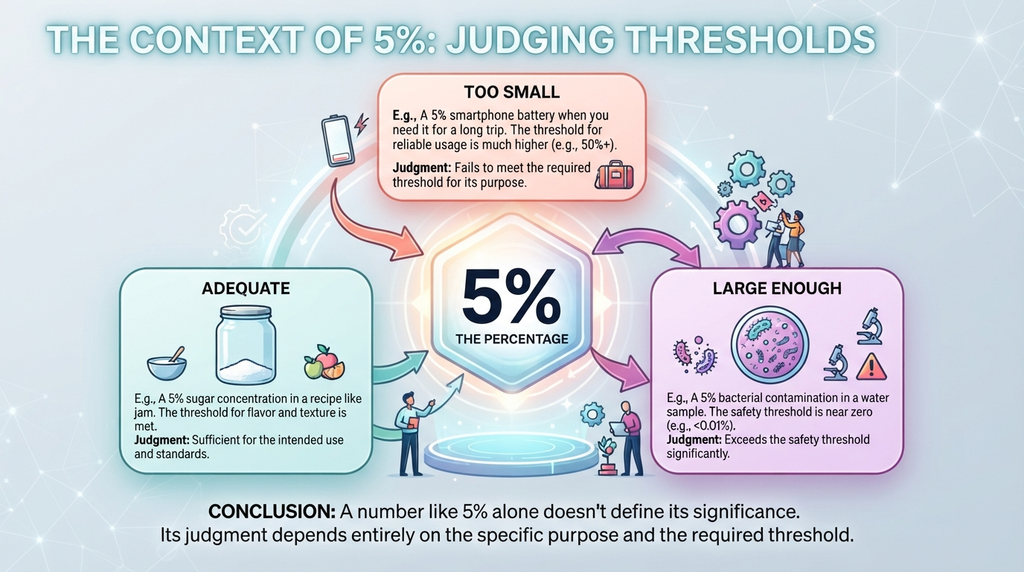
What About “Should Five Percent Be Too Small?”
The phrase “should five percent be too small?” is grammatically possible, but its meaning depends heavily on context.
For example:
Should five percent be too small to matter?
This asks whether 5% ought to be considered insufficient for a particular purpose.
But if the intended question is about whether 5% is actually insufficient, a more direct wording may be:
Is five percent too small?
Or, when discussing a specific standard:
Is five percent too small for this purpose?
The important point is that too small does not establish the threshold by itself. A percentage can be too small for one purpose and entirely adequate for another.
For example:
A five-percent margin may be too small for one application but acceptable for another.
The grammatical expression is straightforward; the substantive question is about the relevant threshold.
A Fast Decision Rule
When deciding between to small and too small, ask:
Am I saying that something is smaller than necessary, acceptable, or wanted?
If yes, use:
too small
If you are using to because it introduces a verb, indicates direction, or performs another grammatical function, use:
to
For example:
I need to check the size.
She went to the store.
The text is too small.
The text is too small to read.
The Practical Proofreading Test
Try replacing too with a phrase such as “more than is acceptable” or “not enough”.
The shirt is too small.
Can you understand it as:
The shirt is not large enough?
Yes. Therefore too is appropriate.
Now test:
I want to leave.
Can you replace to with “more than is acceptable”?
No. That makes no grammatical sense. Therefore the sentence needs to, not too.
Another useful test is to look at the word immediately after to.
If to introduces a base-form verb:
to read
to write
to understand
to check
then it is usually the infinitive marker.
If you are modifying an adjective:
too small
too large
too expensive
too difficult
then too is the likely choice.
A Simple Memory Trick
Remember:
Too has an extra “o” because it means “more.”
You can think of the two os in too as representing more than needed.
too small = more smallness than the situation allows
By contrast:
to read = the ordinary infinitive marker
Another quick association is:
- to → direction or action: go to, want to read
- too → excess or addition: too small, too expensive, me too
This is not a complete grammar rule for every possible use of the words, but it is an effective proofreading shortcut for this particular confusion.
Formal, Casual, British, and American English
There is no meaningful British-versus-American spelling difference between too small and to small.
Both British and American English use:
too small
The distinction is grammatical in both varieties.
Pronunciation is also essentially the same in standard varieties: to and too are normally homophones, although pronunciation can vary somewhat according to sentence position, speech rate, and accent.
The spelling therefore carries the distinction that pronunciation does not.
In formal writing, the same rule applies:
The sample size is too small to support the conclusion.
In casual writing:
These are way too small.
The word too remains correct in both.
Casual English can change the intensity with words such as really, very, or way:
really too small
way too small
But those stylistic choices do not turn too into to.
Related Expressions You May Encounter
Too small to fit
The opening is too small to fit the cable.
The size prevents the action.
Too small for
The container is too small for the ingredients.
The size is inadequate for the intended contents.
Too small by itself
The font is too small.
The context already makes the standard clear.
Small enough
Small enough has a different logical relationship.
The box is small enough to fit under the desk.
This means its size is within the required limit.
Compare:
The box is too small to hold the equipment.
Here, the box fails because its size is insufficient.
The two expressions can therefore point in opposite directions depending on the context.
Not small enough
This can also mean that something needs to be smaller:
The icon is not small enough to fit in the available space.
This is different from:
The icon is too small to see.
The first says it needs to be smaller. The second says it needs to be larger.
That distinction is useful when editing technical, design, or instructional writing.
More Natural Examples
Here are additional examples showing how the expression works in different situations:
The suitcase is too small for everything I need to pack.
The font looks attractive, but it is too small on a mobile screen.
The room is small, yet it feels comfortable because it is well organized.
These gloves are too small for the children.
The opening was too small to insert the replacement part.
The sample is too small to draw a reliable conclusion from it.
Five percent may sound small, but whether it is too small depends on the context.
The logo is small, but it remains visible.
The buttons are too small for easy use on a touchscreen.
Their first apartment was small, but they enjoyed living there.
The image became too small when the page was resized.
The container is too small for the amount of food being prepared.
The second version is small too, but it has better proportions.
I need to check whether the text is too small before printing the document.
These examples demonstrate an important principle: small is descriptive, while too small usually introduces a suitability judgment.
Frequently Asked Questions
Is “too small” correct?
Yes. Too small is the standard expression when you mean that something is smaller than necessary, suitable, or desired.
Is “to small” ever correct?
Not as an alternative spelling of too small. If you mean “smaller than necessary,” too small is correct.
The sequence to small can theoretically occur when to belongs to a larger grammatical construction, but ordinary English does not use to small as a synonym for too small.
What is the difference between “too small” and “small”?
Small simply describes size. Too small says that the size is insufficient for a particular purpose, requirement, or preference.
Is “they are too small” grammatically correct?
Yes.
They are too small.
Here, too modifies the adjective small.
Is “small too” correct?
Yes, when too means also.
The second boxes are small too.
This is different from:
The boxes are too small.
Why do people confuse “to” and “too”?
They are normally pronounced alike, so speakers cannot rely on sound to distinguish them. Their grammatical roles and meanings are different.
How do you remember “too small”?
Remember the pattern:
too + adjective
Examples:
too small
too large
too expensive
too difficult
If too is expressing an excessive degree, use the spelling with two os.
How small is too small?
There is no universal answer. Something is too small when its size falls below the requirement or acceptable level for the particular purpose.
Is “too small to read” correct?
Yes.
The text is too small to read.
The first too means excessively or insufficiently suitable in degree, while the second to introduces the infinitive read.
Is “too small for me” correct?
Yes.
These shoes are too small for me.
For me identifies the person relative to whom the size is inadequate.
Is “too small” used in both British and American English?
Yes. The spelling and grammatical distinction are the same in standard British and American English.
Final Takeaway
When the intended meaning is “smaller than necessary, suitable, or wanted,” use too small.
✓ The shoes are too small.
✓ The room is too small for the meeting.
✓ The text is too small to read.
Use to when it has another grammatical function:
✓ I need to check the size.
✓ She went to the store.
✓ The text is too small to read.
The easiest way to remember the distinction is:
too + adjective = excessive degree
to + verb = infinitive
So for the specific word-choice question “to small or too small?”, the answer is too small.